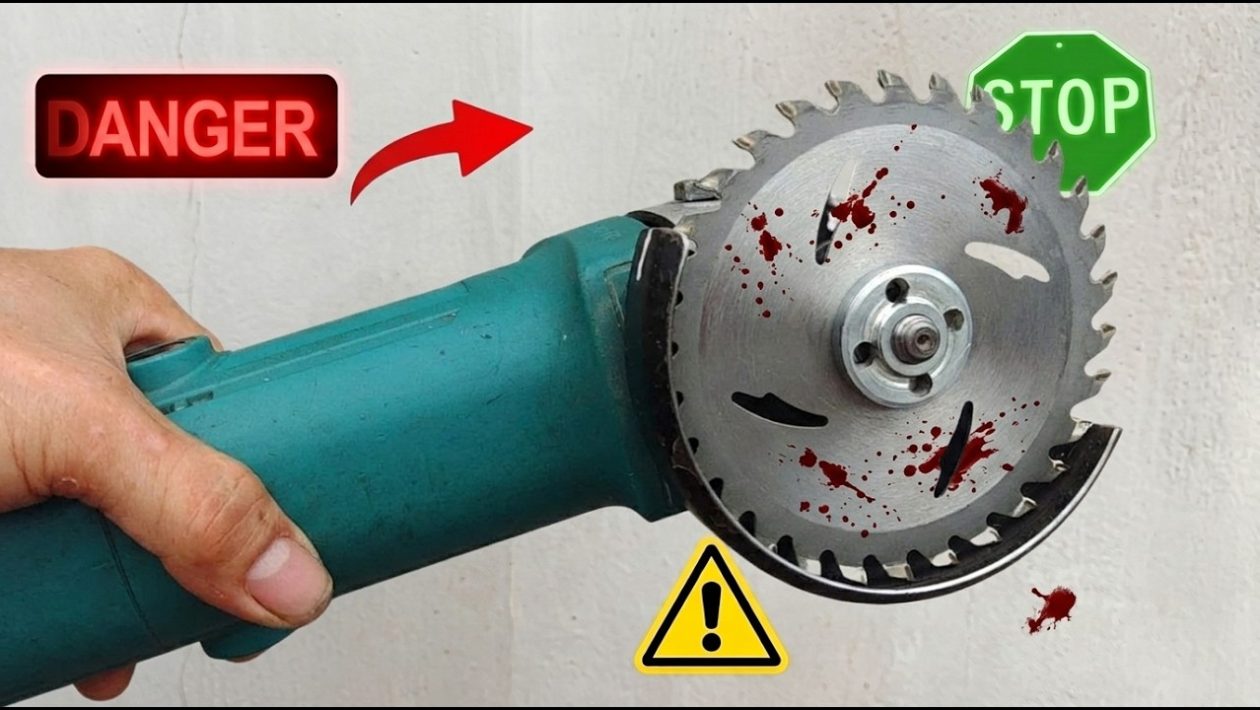
The angle grinder is arguably the most versatile power tool in any garage, but it is also the most dangerous. Operating at incredibly high speeds, this tool demands absolute respect and precise handling.
When operators attempt to use saw blades on angle grinders, the margin for error drops to zero. A single slip or poor setup can result in a shattered blade, violently thrown shrapnel, or uncontrolled kickback.
Here are the five critical mistakes you must avoid when fitting a cutting blade to your angle grinder, followed by a technique that drastically reduces your risk of injury.
1. Using a Toothed Wood Blade
Slapping a standard toothed circular saw blade onto an angle grinder is a recipe for disaster. Angle grinders do not have a baseplate to stabilize the cut like a circular saw does.
When the teeth of a wood blade catch on the material, the grinder will instantly kick back with violent force. The tool can easily rip out of your hands and swing directly toward your body before you have time to release the trigger.
2. Mismatching RPM Ratings
Every grinder and every blade has a maximum Revolutions Per Minute (RPM) rating printed directly on the tool or disc. A standard 4.5-inch angle grinder easily spins between 10,000 and 12,000 RPM.
Many saw blades are designed for much slower tools and max out around 6,000 RPM. If you put a low-RPM blade on a high-RPM grinder, the centrifugal force can literally tear the steel apart, turning the blade into high-speed shrapnel.
3. Removing the Safety Guard
To fit an oversized saw blade onto a grinder, operators frequently remove the factory safety guard. This is a massive safety violation.
The guard is not just there to block sparks. If a cutting blade binds and shatters in the kerf, the guard acts as a heavy-duty shield to deflect the fragmented pieces away from your face, neck, and torso.
4. Twisting the Blade in the Cut
Angle grinder cutting blades are incredibly thin to slice through material quickly. They are engineered strictly for straight-line cutting.
If you twist your wrists, change your angle mid-cut, or apply lateral pressure, the blade will bind against the material. This sudden friction can cause the disc to snap instantly or trigger an aggressive kickback.
5. Ditching the Side Handle
Removing the auxiliary side handle to squeeze into a tight space is a common but dangerous habit. Operating an angle grinder with one hand leaves you entirely vulnerable.
If the saw blade snags, the torque generated by the motor is impossible to control with just one hand. The side handle provides the essential leverage needed to stabilize the tool and fight back against sudden jumps.
The Little-Known Trick: The Rotational Escape Path
Most operators focus entirely on the cutting line and ignore the rotational physics of the tool. The trick to surviving a bind is anticipating exactly where the grinder will jump before you even pull the trigger.
Look at the directional arrow stamped on the metal head of your grinder. That arrow shows you which way the blade spins. If the blade catches, the tool will forcefully kick in the opposite direction of that spin.
Always position your body out of this “escape path.” Shift your stance so that if the blade binds and kicks, the rotational force throws the grinder into the floor or safely past your side—never directly into your body.