The Foundation of True Craftsmanship
Modern workshops are filled with expensive gadgets, complex jigs, and pneumatic fasteners. Yet, decades of hands-on woodworking experience reveal a simple truth: the strongest furniture relies on traditional joinery, not metal hardware.
For a veteran carpenter who has spent 65 years cutting, fitting, and assembling timber, structural integrity always takes priority. When you understand how wood grain behaves, you can lock pieces together in ways that outlast the builder.
You do not need a shop full of high-end machinery to create heirloom-quality pieces. Master carpenters rely on a handful of proven techniques that maximize glue surface and mechanical strength.
Here are three brilliant corner joints that form the backbone of durable woodworking.
1. The Corner Half-Lap Joint
The corner half-lap is one of the most reliable and straightforward joints in a carpenter’s arsenal. It is heavily used in frame construction, cabinet bases, and doors.
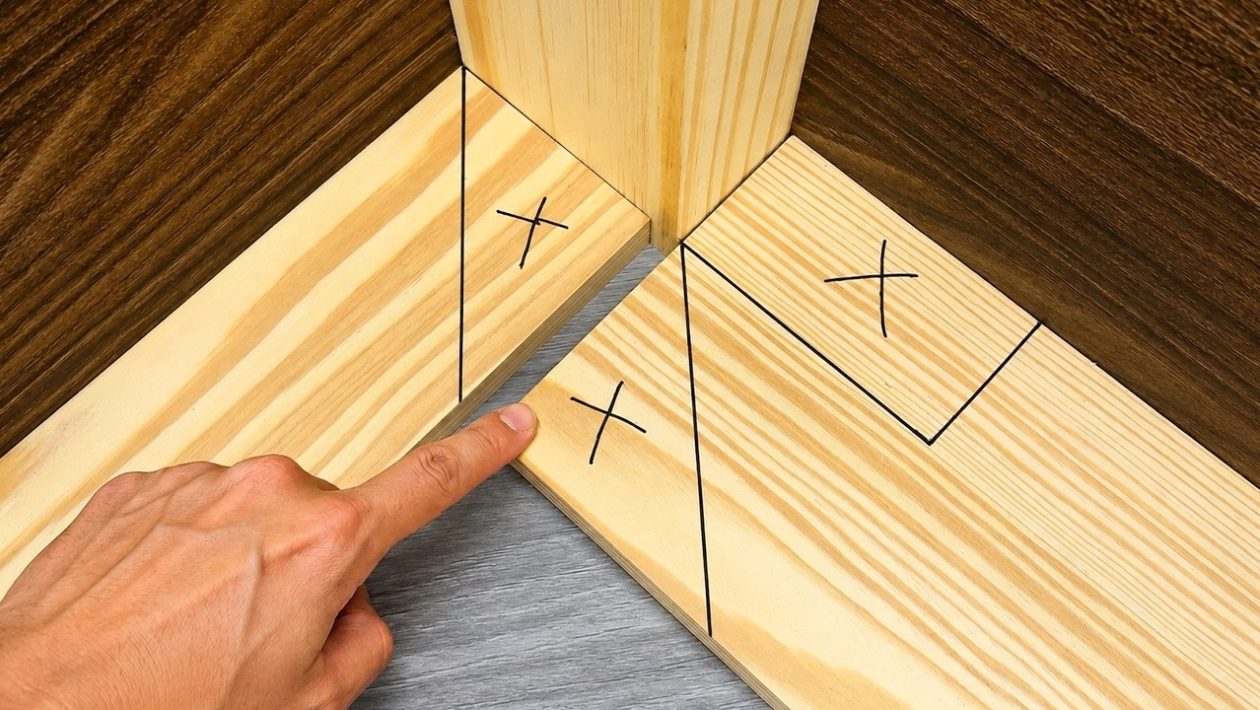
To create it, you remove exactly half the thickness of the material from the ends of both mating pieces. When the two boards are pressed together, they sit flush, creating a perfectly flat 90-degree corner.
Why it works: Wood glue forms the strongest bond when applied to long-grain (the flat face of the board) rather than end-grain. The half-lap exposes a massive amount of face-grain surface area.
Once glued and clamped, the bond becomes stronger than the surrounding wood itself. It also provides excellent resistance against racking, keeping square frames from shifting under heavy loads.
- Requires only a hand saw and chisel, or a table saw.
- Highly forgiving for beginners to cut.
- Can be reinforced with wooden dowels for extra security and visual appeal.
2. The Box Joint (Finger Joint)
When you need a corner joint to withstand serious abuse, the box joint is the ultimate solution. It is commonly found in toolboxes, heavy-duty drawers, and premium cabinetry.
The box joint features a series of interlocking rectangular pins and tails cut into the ends of two adjoining boards. They mesh together like interlaced fingers, creating a striking geometric pattern on the outside corner.
Why it works: The strength of this joint comes from its sheer mechanical grip. The interlocking fingers multiply the available glue surface exponentially compared to a standard butt joint.
Because the pieces slot into one another from multiple directions, a box joint cannot be easily pulled apart. Even before the glue dries, a properly cut box joint will hold itself together tightly.
While cutting multiple fingers requires patience and precision, a simple shop-made jig on a table saw or router table makes the process highly repeatable.
3. The Splined Miter Joint
A standard miter joint—where two boards are cut at 45-degree angles and glued together—looks clean because it hides the wood’s end grain. However, it is notoriously weak.
Because standard miters rely entirely on gluing porous end-grain to end-grain, they often snap under pressure. Experienced carpenters solve this by introducing a spline.
Why it works: After gluing the basic miter joint, a thin slot is cut directly through the outside point of the corner. A small strip of wood (the spline) is then glued securely into this slot.
The spline bridges the two separated pieces, acting like an internal lock. This introduces crucial face-grain glue surface across the weakest point of the joint, completely transforming its structural integrity.
Beyond the functional benefits, splines allow for deep customization. Carpenters often use a contrasting wood species for the spline, such as a dark walnut strip inside a light maple frame, turning a structural necessity into a beautiful design feature.