Why Good Drill Batteries Play Dead
Power tool batteries are easily the most expensive part of a cordless tool kit. When a battery suddenly refuses to charge, the immediate instinct is to toss it and buy a replacement.
However, a battery that shows zero signs of life is rarely completely dead. In most cases, the internal computer has simply locked you out.
Modern lithium-ion batteries contain a Battery Management System (BMS). This small circuit board monitors the voltage of individual cells to prevent overheating and over-discharging.
If you run a drill until the battery is completely drained, the voltage drops below the safety threshold. The BMS activates a protective sleep mode, communicating to the charger that the battery is defective.
The Safety Pin Solution
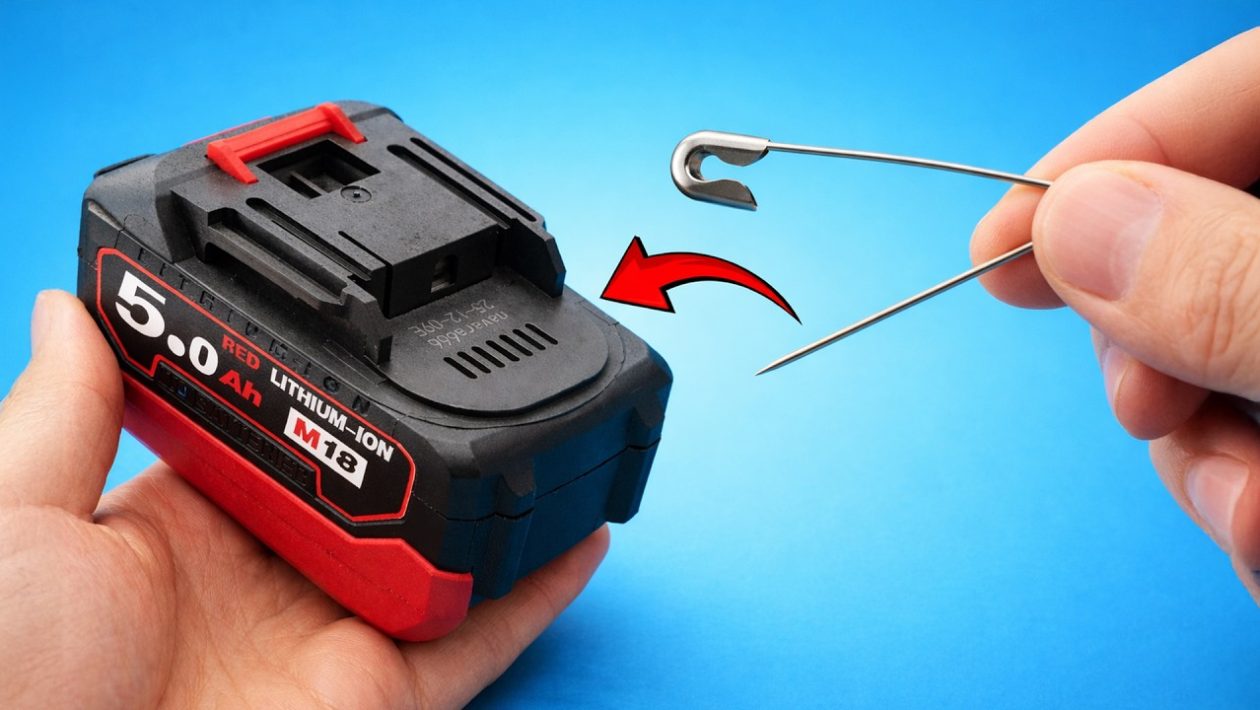
To get the battery accepting a charge again, you need to bypass or reset the BMS. This is where a common household safety pin comes into play.
A safety pin is thin enough to reach recessed reset buttons and conductive enough to briefly bridge diagnostic terminals.
On many generic and name-brand batteries, the BMS board features a tiny reset micro-switch. It is often hidden behind a small pinhole near the main terminal block.
Inserting a safety pin into this hole presses the switch, rebooting the circuit board. Once rebooted, the lockout clears, allowing the charger to recognize the battery again.
Waking Up a Sleeping Board
If your battery does not have a physical reset button, the safety pin can act as a temporary jumper.
You must first remove the outer plastic casing of the battery using a Torx or Phillips screwdriver. Inside, you will see the exposed circuit board attached to the lithium cells.
Locate the positive terminal (B+) coming directly from the battery cells and the positive terminal (P+) leading out to the external charger contacts.
By carefully touching the metal safety pin to both the B+ and P+ pads simultaneously for two seconds, you bypass the BMS lockout. This sends a tiny surge of voltage directly to the charger contacts.
Immediately place the reassembled battery onto the charger. The charger will detect the brief voltage spike, assume the battery is healthy, and begin the normal charging cycle.
Essential Safety Precautions
Lithium-ion cells store a massive amount of dense energy. You must exercise extreme caution when exposing the internal circuit board.
Never use the safety pin to bridge the main positive and negative battery terminals. Doing so creates a direct short circuit, which will melt the pin and potentially cause a fire.
Always work on a clear, non-conductive surface like a wooden workbench. Wear safety glasses during the process.
If the battery casing feels physically hot, appears swollen, or smells vaguely sweet, do not attempt to revive it. These are signs of permanent internal cell failure, and the battery must be safely recycled.
When the trick works, the charger indicator light will shift from a flashing red error to a solid charging state. You just saved yourself the cost of a brand-new battery.