Super glue is a reliable staple in almost every toolbox, but it has a fundamental weakness. While cyanoacrylate (CA) glue excels at bonding two tight surfaces together, it lacks structural volume.
If you need to fill a gap, bridge a crack, or rebuild a snapped piece of plastic, liquid super glue alone will fail. That is where a standard box of baking soda comes in.
Combining everyday sodium bicarbonate with liquid super glue transforms the adhesive into a rock-hard, durable cement that cures in seconds.
The Chemistry of the Cure
Cyanoacrylate glue naturally cures when exposed to the trace amounts of moisture in the air. This process usually takes a few minutes to fully set.
Baking soda changes the equation. As an alkaline powder, sodium bicarbonate acts as a rapid accelerator for the cyanoacrylate.
When the liquid glue makes contact with the powder, it triggers an instant exothermic (heat-producing) polymerization reaction. The resulting compound is no longer just a glue; it is a rigid, plastic-like filler that can be sanded, filed, and painted.
How to Execute the Repair
Timing is critical. You cannot mix the glue and baking soda together before applying them, or the mixture will instantly harden on your mixing tool.
Instead, the process requires layering.
First, position your broken parts together. If there is a void or a gap, pack it tightly with dry baking soda powder.
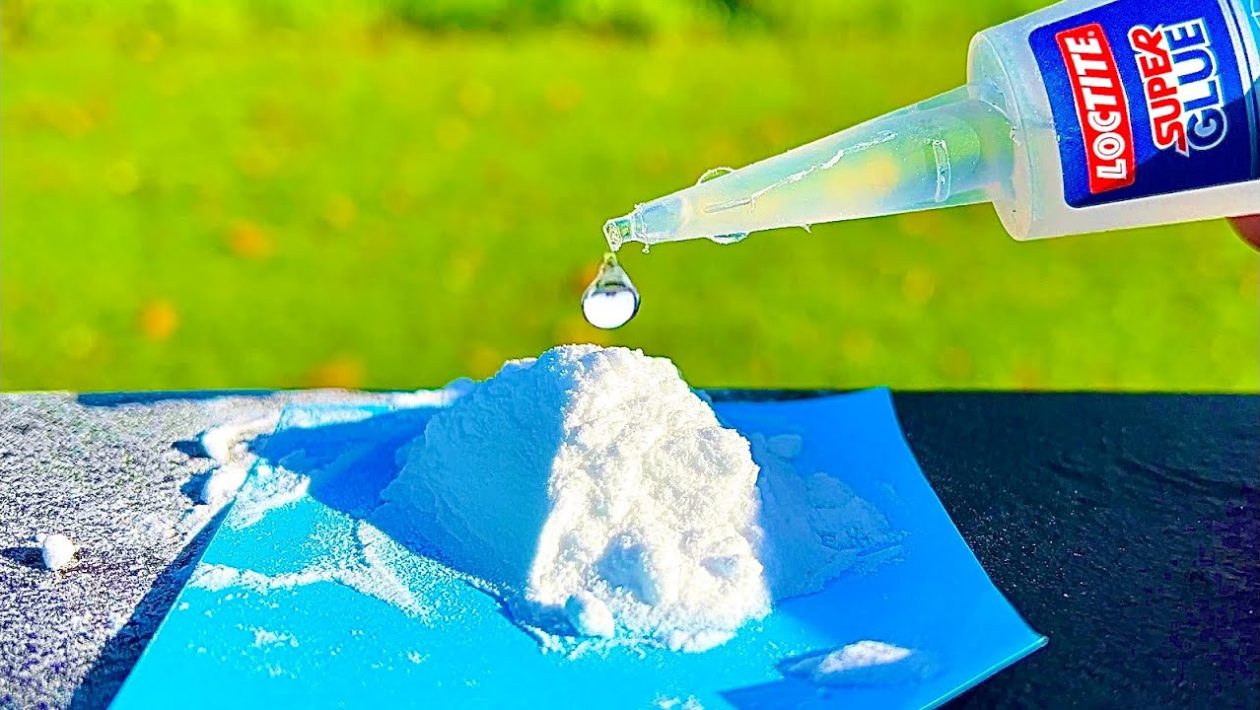
Once the powder is shaped exactly how you want the final repair to look, carefully drip thin liquid super glue directly onto the baking soda.
The powder acts like a sponge, instantly wicking in the adhesive. Within three to five seconds, the saturated powder will cure into a solid mass.
Where This Method Excels
This technique is a lifesaver for repairing high-stress household items. It is highly effective for rebuilding snapped plastic mounting tabs on automotive interiors or household appliances.
It is also an excellent solution for stripped screw holes in wood or plastic. Simply pack the stripped hole with baking soda, saturate it with super glue, and wait a few minutes. You can then drill a brand-new pilot hole directly into the hardened filler.
While some DIYers rely on packing gaps with cotton fibers before applying super glue, baking soda creates a much denser, more rigid, and more durable final structure.
Crucial Safety Warnings
Do not underestimate the speed and intensity of this chemical reaction. The instant cure generates a significant amount of heat.
If you get the baking soda and glue mixture on your skin, it can cause immediate thermal burns alongside bonding your skin together.
Additionally, the rapid curing process releases a visible plume of irritating cyanoacrylate fumes. Always perform these repairs in a well-ventilated area, wear safety glasses, and never position your face directly over the repair zone as you apply the glue.