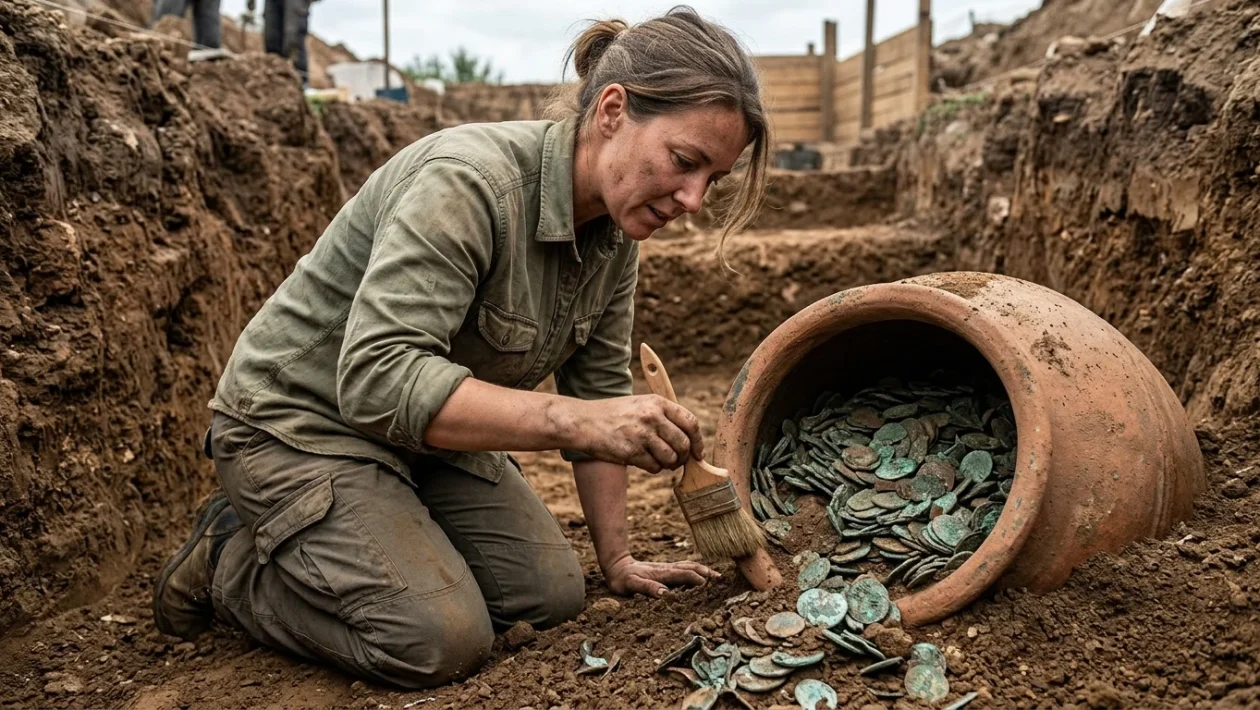
Two large ancient Roman amphorae filled with thousands of bronze coins unearthed from a dirt excavation site.
A Monumental Roman Hoard
Archaeologists working in northeastern France have uncovered an astounding archaeological discovery: a massive cache of Roman currency left completely untouched for 1,800 years.
While excavating an ancient settlement in the modern-day town of Senon, researchers found three large vessels deliberately buried beneath the floorboards of an ancient home.
Inside the buried pots, they found a staggering trove of more than 40,000 ancient coins.
The Contents of the Dig
The excavation was spearheaded by the French National Institute for Preventive Archaeological Research (INRAP).
The team found that two of the three amphorae remained perfectly intact. A third vessel had been removed during Roman times, leaving behind a nearly empty pit holding just three stray coins.
According to data reported by Live Science, the surviving vessels were packed to the brim with heavy currency:
- The first amphora weighed nearly 38 kilograms and held between 23,000 and 24,000 coins.
- The second vessel weighed 50 kilograms, containing another 18,000 to 19,000 coins.
An Ancient Piggy Bank
This discovery provides crucial historical information about the daily lives and financial habits of everyday Roman citizens.
The amphorae were not buried in a rush to hide wealth from invaders. Instead, they were placed in specially prepared pits with the mouths of the jars resting exactly at ground level.
Experts conclude this layout allowed for easy, frequent access. It functioned as a long-term household savings system—a direct Roman equivalent to a modern piggy bank.
Abandoned to the Flames
The coins remained securely in the ground for millennia due to a series of localized disasters.
In the early 4th century, a severe fire ripped through the settlement, destroying the home above the hoard. While the town was eventually rebuilt, a second devastating fire struck soon after.
The recurring destruction forced the permanent abandonment of the site. The residents fled, leaving their life savings buried in the dirt for nearly 2,000 years.