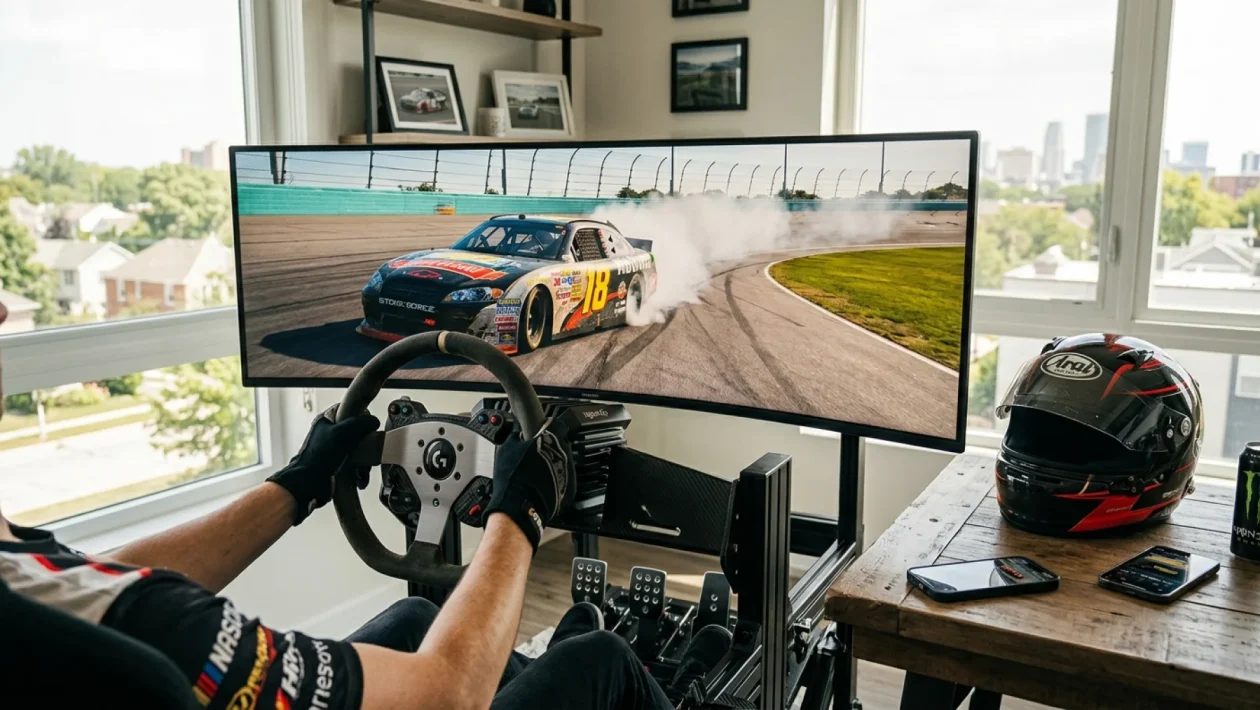
Max Verstappen doesn’t do anything halfway. Put him in a digital NASCAR stock car around Miami, and you’re guaranteed absolute carnage mixed with sheer brilliance. Forget the polished, laser-precise world of Formula 1; this is about wrestling a heavy V8 beast around an oval until the tires scream for mercy. Teaming up with NASCAR phenom Connor Zilisch and F1 junior Isack Hadjar, Verstappen recently took to iRacing to prove his skills translate to the heavy metal of American stock cars. If you’re wondering what happens when a reigning world champion steps entirely out of his comfort zone, the answer is spectacularly dramatic.
Verstappen NASCAR Crossover: When Open-Wheel Royalty Meets Stock Car Muscle
This isn’t just a casual weekend gaming session. When Verstappen boots up his sim rig, it’s serious business.
Jumping from a high-downforce F1 rocket into a heavy Cup car is like trying to race a snowplow through a Canadian Tire parking lot on black ice. It requires a completely different kind of muscle and a whole lot of patience.
Consider this brutal reality check: an F1 car weighs around 1,759 pounds, while a NASCAR stock car tips the scales at a massive 3,300 pounds. That’s nearly double the weight you have to haul into a corner, with a fraction of the aerodynamic grip.
You can’t just brake late and expect the car to stick. You have to coax the chassis, manage the weight transfer, and pray the rear end doesn’t step out on you.
Why The F1 Champ’s Dramatic iRacing Run Was Pure Chaos
The virtual laps around Miami weren’t just a parade; they were raw, unfiltered entertainment. The transition from precise apex-clipping to bumper-to-bumper drafting resulted in some seriously sideways action.
Verstappen and Hadjar quickly found out that digital walls hurt your pride just as much as real ones. Want to know how an F1 driver actually adapts to a heavy stock car? It’s a steep learning curve:
- Scrap the downforce habit: You can’t flat-out trust the air to pin you to the track. Grip is purely mechanical, heavily tire-dependent, and incredibly fleeting.
- Master the weight transfer: You have to deliberately shift that 3,300-pound chassis under braking just to get the heavy nose to turn into the corner.
- Embrace the slide: Loose is fast in NASCAR. You have to steer with the throttle just as much as you do with the steering wheel.
How This Digital Shake-Up Changes Everything For Sim Racing
When the biggest name in global motorsport embraces cross-discipline sim racing, the whole industry takes notice.
It breaks down the walls between elitist European open-wheel racing and gritty North American stock car culture. Let’s look at the sheer contrast of the machinery Max was wrestling on his home rig.
| Vehicle Spec | F1 Car (Usual Office) | NASCAR (The Challenge) |
|---|---|---|
| Weight | ~1,759 lbs | ~3,300 lbs |
| Aero Dependency | Extreme | Minimal |
| Driving Style | Precision & Momentum | Slide & Muscle |
This kind of crossover proves that raw driving talent translates across disciplines, even in the digital realm. It brings fresh eyes to iRacing and bridges a massive gap between fanbases.
“When a generational talent like Max jumps into a virtual stock car, it forces the entire sim racing community to elevate their game. It proves that elite car control is universal, no matter how heavy the chassis.”
Frequently Asked Questions
Why is Max Verstappen racing NASCAR on iRacing?
Verstappen is a notorious sim racing addict with his own professional esports team. He regularly uses iRacing to keep his reflexes razor-sharp between race weekends, often exploring vastly different racing series to continually challenge his adaptability.
Who is Connor Zilisch?
He’s a highly touted American racing prospect who has been tearing up both sports cars and NASCAR developmental series. Pairing his stock car expertise with Max’s raw pace made for a brilliant, high-profile crossover event.
Can F1 drivers easily adapt to NASCAR?
Not usually. The physics of the cars are polar opposites. While their reaction times are elite, F1 drivers often struggle initially with the sheer weight, lack of downforce, and the necessity to “slip and slide” a stock car to find the limit.
🤝 So, there you have it. The next time you fire up your own sim rig, remember that even the absolute best in the world have to fight to keep a stock car out of the virtual wall.
💡 Whether you’re turning laps on a basic controller or a $10,000 direct-drive setup, the thrill of mastering a brutally difficult machine is universal.
📱 Share your thoughts in the comments—do you think Verstappen has what it takes to run the real-life Daytona 500 before he retires?
👇 Keep the rubber on the road, and good luck out there on the virtual track!