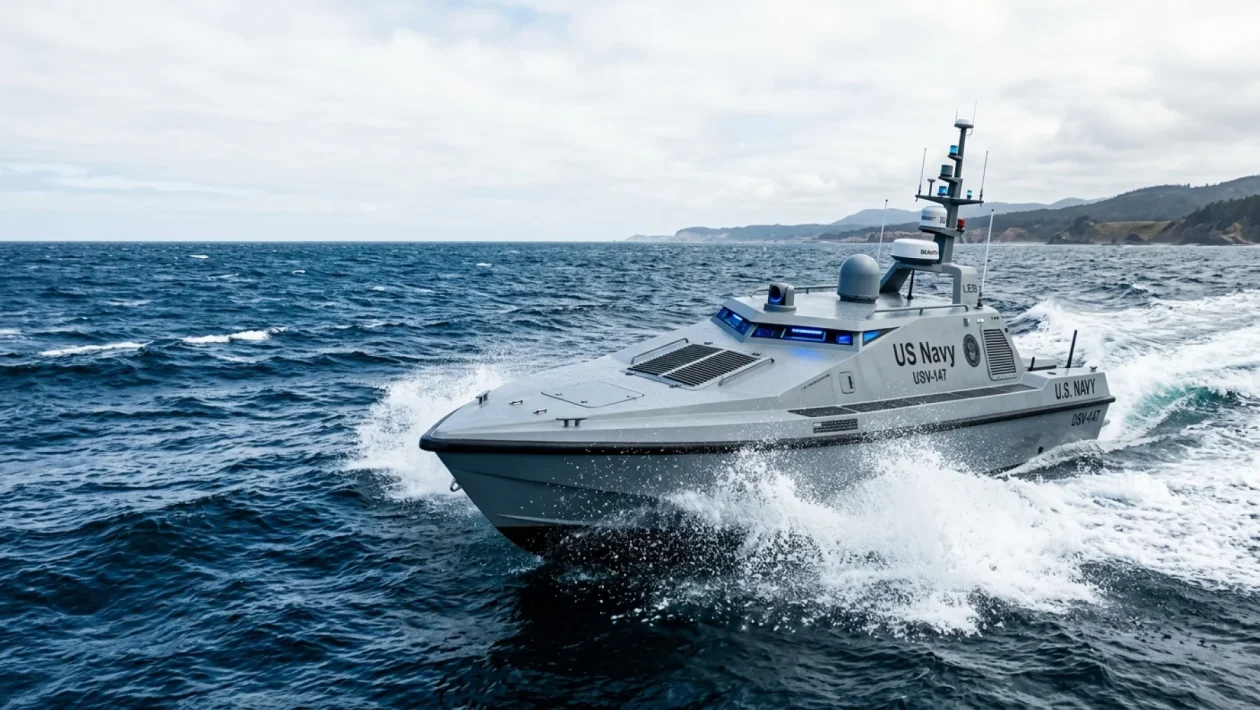
Forget the aircraft carriers for a second. The real muscle flexing in the Pacific this summer isn’t carrying thousands of sailors—it’s entirely empty. US sea drones are quietly taking over the world’s most contested waterways, and they are doing it with lethal efficiency. If you want to know how the next major global conflict will be fought, you need to look at the robotic ghost fleet patrolling the oceans right now.
Transforming Modern Naval Warfare
The era of risking thousands of lives on massive, slow-moving targets is fading fast. Today, naval supremacy is about speed, surveillance, and artificial intelligence.
By deploying US sea drones, the military can cover more ocean for a fraction of the cost. A traditional destroyer costs billions to build and millions to run. A drone ship? A drop in the bucket by comparison.
Here is a quick look at why the military is pivoting so hard toward unmanned tech.
| Traditional Warships | US Sea Drones |
|---|---|
| Requires a crew of 300+ | Zero onboard crew |
| $2 Billion+ per vessel | $15 – $50 Million per vessel |
| High risk to human life | Expendable in high-threat zones |
It’s not just an American effort, either. North American defense contractors are working in lockstep. Take Newfoundland’s own Kraken Robotics, which has been pioneering subsea sensors that integrate seamlessly with allied surface networks. When our continental tech merges, the situational awareness is absolutely staggering.
Inside the Autonomous Ghost Fleet
We aren’t just talking about remote-controlled speedboats here. These are highly advanced, self-navigating vessels capable of crossing oceans without human intervention.
They use advanced collision avoidance, satellite uplinks, and AI-driven radar to track adversaries through extreme weather. The sheer scale of this operation is wild. In fact, the Navy’s specialized drone unit, Task Force 59, recently logged an astonishing 50,000 hours of autonomous operations in Middle Eastern waters alone.
“The integration of unmanned surface vessels isn’t just an upgrade; it’s a fundamental rewrite of maritime strategy. We are seeing a network of mechanical eyes and ears that never sleep.” – Cmdr. Marcus Vance, Maritime AI Analyst.
How the Military Operates These Sea Drones
You might be wondering how a guy sitting in a control room in San Diego actually drives a ship near the Taiwan Strait.
It’s not quite like playing a video game. The process relies heavily on trusted autonomy, meaning the machines do the heavy lifting while humans act as supervisors.
- Mission Programming: Commanders upload the patrol route and target parameters into the vessel’s AI core before it ever leaves port.
- Autonomous Navigation: The drone sails itself to the destination, using onboard sensors to dodge civilian traffic and rogue waves.
- Data Collection: Once on station, it acts as a massive router, pinging radar and sonar data back to manned destroyers and aircraft.
- Human Intervention: If a threat is detected or a weapons system needs to be engaged, a human operator always takes the digital wheel to make the final call.
It’s a brilliant division of labor. The robots handle the boring, dangerous patrols, and the humans handle the critical thinking.
Frequently Asked Questions
Are US sea drones armed?
Some of them are. While most are designed for surveillance and reconnaissance, newer models like the Ranger class have successfully test-fired modular missile systems. The goal is to create floating, unmanned missile magazines.
Can these drones be hacked by enemies?
It’s the number one concern for defense experts. However, these vessels use heavily encrypted, multi-layered satellite communications. If the connection drops or is jammed by an adversary, the drones are programmed to automatically return to a designated safe zone.
Will drone ships replace human sailors completely?
Not in our lifetime. Unmanned ships are designed to compliment manned vessels, not replace them. Think of them as loyal, expendable wingmen for the traditional fleet.
💡 Make no mistake, the ocean is getting a lot more crowded with machines, and that’s a good thing for our sailors.
🤝 We are watching a technological leap that keeps human beings out of the line of fire while securing international waters.
📱 If you found this breakdown on the military’s robotic fleet helpful, share your thoughts with us on social media.
👇 Good luck out there, and keep your eyes on the horizon for the next big wave in naval tech!