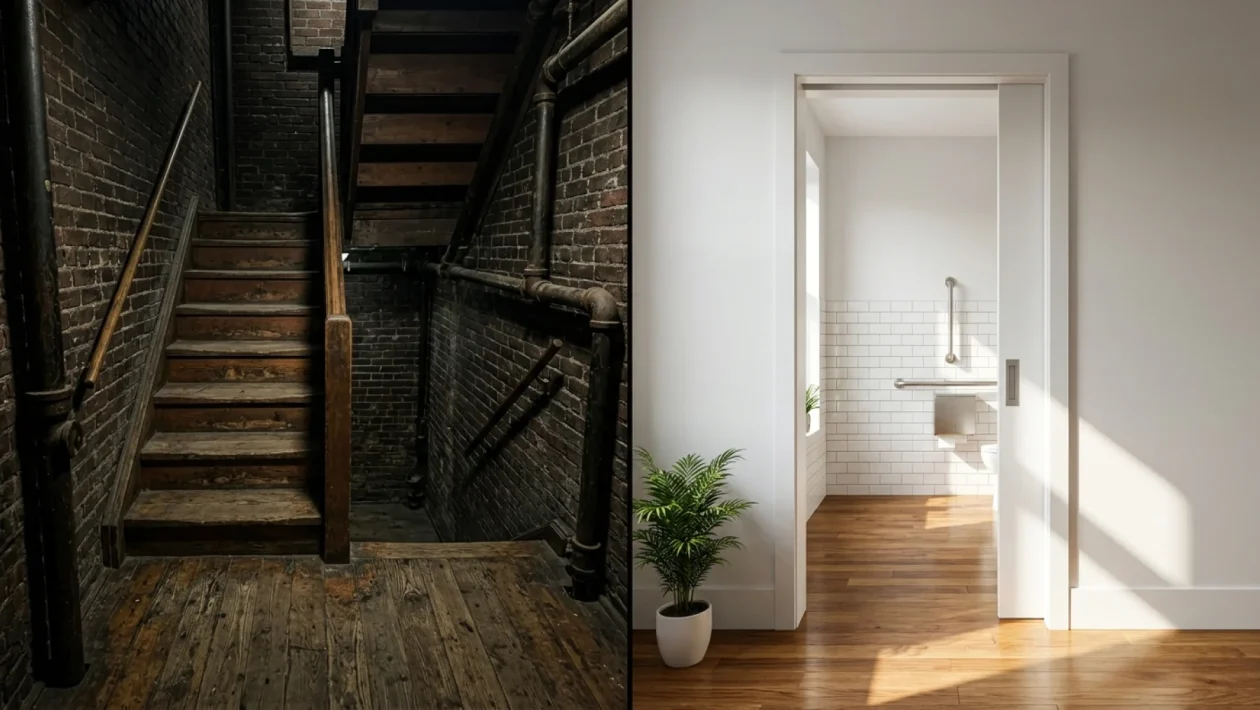
You are enjoying a great pint downtown, nature calls, and suddenly you are staring down a steep, creaky, dimly lit staircase just to find a toilet. Toronto basement bathrooms aren’t just a quirky local annoyance—they are a massive physical barrier locking thousands of paying customers out of the city’s best spots. We are going to dig into the dirty, centuries-old reason our toilets are underground and exactly how local businesses can fix it without bankrupting themselves.
Toronto basement bathrooms: Why we are always heading underground
Space is absolute cash in the hospitality game.
If you are running a pub on Queen West or pulling pints of Moosehead in a century-old building, every square foot on the ground level needs to generate revenue. Tables make money; toilets simply don’t.
According to Toronto’s chief planner Jason Thorne, business owners historically pushed washrooms into the cellar to maximize their dining footprint. But today, this outdated floorplan is creating a massive accessibility gap for wheelchair users, who frequently find the city’s hottest spots completely off-limits.
The 1800s plumbing flaw that started it all
Let’s rewind the clock to a much dirtier era.
Before modern plumbing, Toronto relied heavily on pit latrines that literally leaked human waste into the groundwater, creating a massive public health nightmare. When the city finally rolled out a proper sewer system and treated water in the mid-1800s, there was a major catch.
The municipal water pressure was incredibly weak. It simply didn’t have the mechanical juice to push water up to a second floor, or even comfortably service a main floor in some localized areas.
So, the heavy plumbing stayed as low to the ground as possible, and we have been walking down scary basement stairs ever since.
Costing restaurants millions today: The accessibility crisis
Fast forward to May 2026, and those historical quirks are costing businesses serious money.
While the 1975 Ontario Building Code mandates full accessibility for new builds, it is not retroactive. Old buildings get a legal pass unless they do a massive structural renovation. But ignoring the problem means ignoring a massive demographic of paying customers.
“If you can’t go to the bathroom, you can’t stay.”
That is the hard, unavoidable truth from accessibility consultant Julie Sawchuk. Wheelchair users, parents with large strollers, and anyone with mobility issues will simply take their wallets to a competitor.
| The Old Basement Setup | The Accessible Main-Floor Upgrade |
|---|---|
| Zero upfront renovation costs. | Higher initial investment. |
| Turns away mobility-challenged guests. | Welcomes all customers and their wallets. |
| Requires constant hazard liability checks. | Future-proofs the business for modern building codes. |
How to modernize a heritage building
You do not need a massive, big-box store footprint to make an old space accessible.
It takes a bit of elbow grease and out-of-the-box thinking. Here is a simple blueprint for owners looking to bring their facilities out of the dark ages:
- Audit the ground floor: Find dead zones like oversized storage closets or under-utilized prep areas that can easily be converted.
- Tap into government funds: Apply for provincial grants. Programs like the Enhancing Access to Spaces for Everyone (EASE) Grant literally hand out cash to help cover these exact renovations.
- Consult a specialist: Bring in an accessibility expert who knows how to maximize tight square footage without destroying the building’s heritage charm.
Frequently Asked Questions
Are Toronto restaurants legally required to have main-floor bathrooms?
Not always. If the building is older than the 1975 Ontario Building Code, it is generally grandfathered in. Upgrades are only legally required during major, permitted renovations.
Why can’t they just put in an elevator?
Many of these historic downtown buildings lack the structural integrity or the sheer physical space to safely accommodate a modern commercial elevator.
Is there financial help for businesses wanting to upgrade?
Yes. The province occasionally opens funding windows designed specifically to offset the heavy costs of accessible renovations for small businesses.
🤝 It is time to step up and leave the basement behind. We love the heritage and charm of our old local haunts, but keeping our neighbors out just to save a few feet of floor space isn’t the Canadian way.
💡 Smart business owners know that true hospitality means welcoming absolutely everyone. By rethinking these outdated layouts, you aren’t just doing the right thing—you are opening your doors to a massive, incredibly loyal customer base.
📱 Please share your thoughts with us below! Have you ever had to navigate a terrifying basement bathroom, or do you know a local spot that absolutely nailed their accessible upgrade?
👇 Drop a comment and let’s keep the conversation going. Good luck out there, and watch your step!