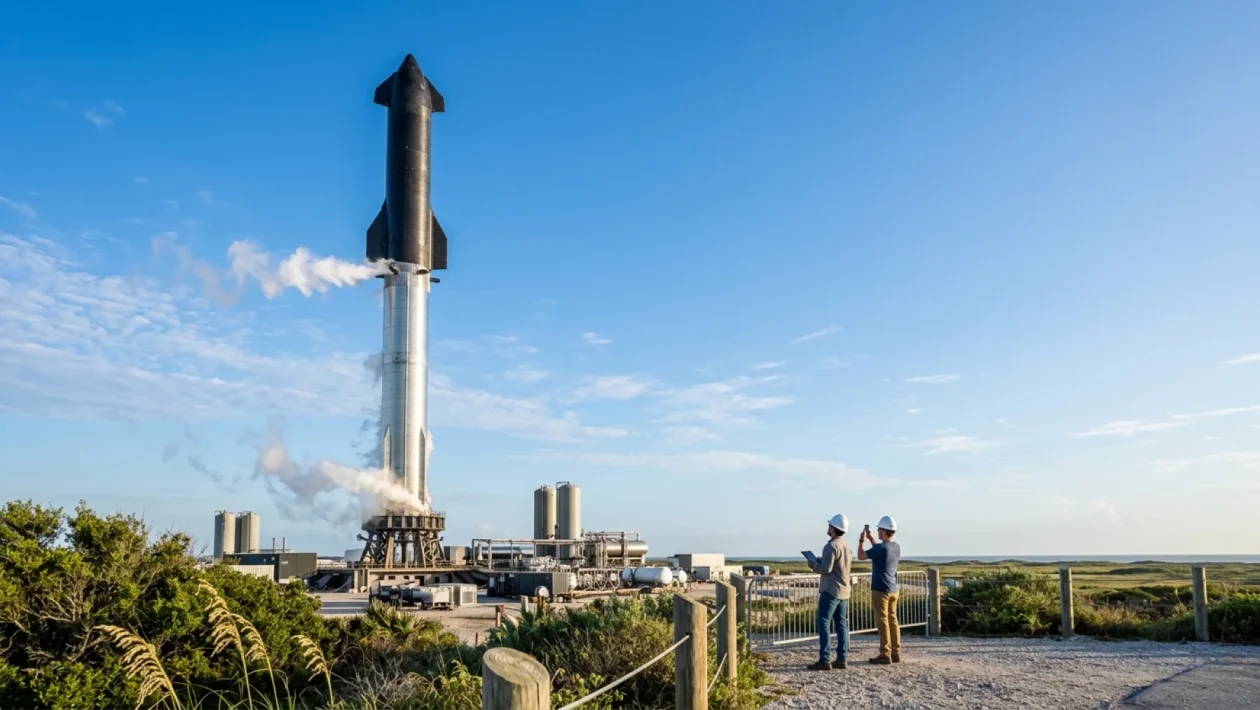
Elon Musk just hit the brakes on the biggest rocket humanity has ever built. If you were glued to your screen waiting for the Starship Flight 12 launch today, you’re going to have to hold your horses.
SpaceX has officially pushed the highly anticipated test flight another 24 hours to May 21, 2026. But this isn’t just a standard scrub—this is the debut of the mind-boggling Version 3 (V3) prototype.
Getting a 400-plus-foot steel skyscraper off the ground is no small feat. Let’s break down exactly what is holding up the launch, the insane new hardware sitting on the Texas launchpad, and how you can catch the action.
Decoding Starship Flight 12
This mission isn’t just another notch on Elon Musk’s belt. Flight 12 represents a massive generational leap for the Starship program.
The main objective here is to test entirely new hardware in a real-world flight environment. SpaceX treats these test flights as massive data-gathering exercises, pushing the vehicle to its limits to see what breaks and what holds strong.
The aerospace industry across North America is watching closely. Canadian space tech heavyweights like MDA Space—the brains behind the Canadarm—rely on heavy-lift vehicles like Starship to eventually haul massive lunar infrastructure into orbit for NASA’s Artemis missions.
Why SpaceX Delayed The V3 Megarocket
So, why the delay? SpaceX originally targeted May 19, bumped it by 24 hours, and has now settled on Thursday, May 21. While the company hasn’t released a specific reason for the hold-up, this is standard operating procedure in the rocket business.
When you are dealing with millions of pounds of highly explosive propellant, “go fever” gets people hurt. Engineers will routinely pause countdowns to double-check a sensor reading, monitor upper-level winds, or tweak fueling protocols.
Plus, they are dealing with a brand-new beast. The V3 prototype is the largest version of Starship ever built, standing an astonishing 407 feet tall when fully stacked.
| Starship V3 Components | Quick Specs |
|---|---|
| Super Heavy Booster | 236 feet tall, powered by 33 Raptor engines |
| Starship Upper Stage | 171 feet tall, designed for crew/cargo in orbit |
What To Expect On May 21
If the stars align and the hardware cooperates, the 90-minute launch window will open at 6:30 p.m. ET on Thursday, May 21. The sheer raw power of this launch is going to be a spectacle.
Here is exactly how the launch sequence will play out if the countdown hits zero:
- Ignition: All 33 Raptor engines on the Super Heavy booster will roar to life, delivering a deafening, ground-shaking burst of thrust.
- Max Q: The rocket will endure maximum aerodynamic pressure as it punches through the thickest part of the Earth’s atmosphere.
- Stage Separation: The Super Heavy booster will detach, allowing the 171-foot upper stage to fire its own engines and continue pushing toward orbit.
“The primary objective of Flight 12 isn’t a flawless orbit, it’s surviving the brutal environment of ascent. Testing this massive V3 hardware under real stress is exactly how you build a reliable transportation system for Mars.”
If V3 reaches orbit successfully, it will prove that this next-generation hardware is capable of midflight refueling—a critical feature for sending massive payloads to the moon and beyond.
Frequently Asked Questions
Why is midflight refueling so important for Starship?
Because Starship is so heavy, it burns through most of its fuel just escaping Earth’s gravity. To make the long trip to the moon or Mars, it needs to dock with a “tanker” Starship in orbit to top up its gas tank before heading into deep space.
Will both parts of the V3 rocket come back to Earth?
Yes, that is the ultimate goal. SpaceX designed Starship to be a fully reusable transportation system. Both the Super Heavy booster and the Starship upper stage are engineered to return to the ground intact so they can be turned around and flown again quickly.
🤝 Share your thoughts! Are you planning to tune into the live stream on Thursday evening?
💡 The sheer scale of what SpaceX is attempting down in South Texas is nothing short of historic. Whether it makes it to orbit or ends in a spectacular fireball, we are watching the future of spaceflight unfold in real-time.
📱 Keep your eyes on the skies and your notifications on. In the rocket business, schedules can change in the blink of an eye.
👇 Good luck to the engineering teams at Starbase, and here’s hoping for a smooth countdown on May 21!