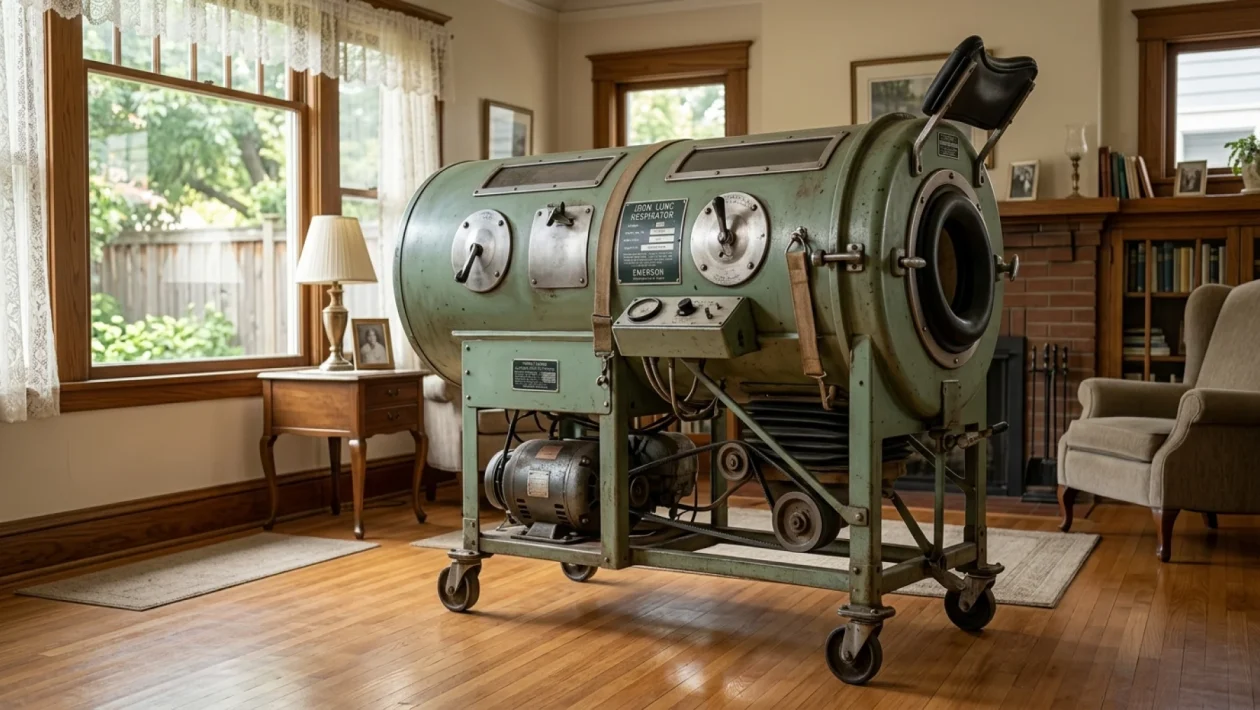
Imagine your life depending entirely on a 70-year-old electric motor and a canvas strap. Martha Lillard didn’t just imagine it; she lived it every single day until she passed away at the age of 78. When news of her death rippled through the world, we didn’t just lose a remarkable woman. We lost one of the final living testaments to an era of pure, unadulterated human grit and mechanical survival. Today, I’m taking you under the hood of how this incredible woman kept an antique steel cylinder running against all odds.
Martha Lillard: The Woman Who Refused to Quit
At five years old, Martha contracted polio during a childhood birthday party. Within days, her respiratory system shut down completely. Her only lifeline became a massive, half-ton steel tank that breathed for her.
Most people would have given up right there. Not Martha.
She spent over seven decades strapped inside that machine, painting, writing, and living a life that defied every medical textbook. As a journalist who appreciates folks who build and maintain things, I am utterly floored by her tenacity.
The Last Iron Lung Survivor: An Off-Grid Mechanic
Let’s talk hardware for a second. An iron lung isn’t just a hospital bed; it’s a hermetically sealed mechanical marvel.
When the original manufacturer stopped servicing these machines in the early 2000s, Martha was left to fend for herself. She essentially became an off-grid mechanic to stay alive. When the custom collars that sealed the machine deteriorated, she scavenged for alternative materials.
When the motor started grinding, she couldn’t call a tech support line because it no longer existed. She relied on local mechanics and standard automotive fan belts—the kind you could once pick up at Canadian Tire or your neighborhood auto parts shop—to keep the heavy bellows pumping.
- Sealing the Chamber: The patient slides into the tank, with only their head exposed, and a tight rubber collar seals the neck.
- Creating the Vacuum: A motorized leather or canvas bellows expands, dropping the air pressure inside the steel cylinder.
- Forced Inhalation: Because the pressure inside the tank is lower than the room, atmospheric air naturally rushes into the patient’s nose and mouth, expanding their lungs.
- The Exhale: The bellows contract, increasing tank pressure and gently forcing the chest to deflate.
Cheating Death Until 78: A Legacy of Resilience
Looking back from where we sit today in the summer of 2026, the polio epidemic feels like ancient history. But in the early 1950s, it was a parent’s absolute worst nightmare.
Here is a sobering hard fact: At the peak of the 1952 outbreak, over 3,145 people died in the U.S. alone, and more than 21,000 were left with mild to disabling paralysis.
Martha beat those terrifying odds through sheer willpower and a stubborn refusal to let a piece of machinery dictate her spirit.
| Feature | 1950s Iron Lung |
|---|---|
| Weight | Over 600 lbs (Solid Steel) |
| Airflow Method | Negative pressure (pulls the chest) |
| Maintenance | Scavenged parts & custom mechanical repairs |
“Martha’s survival wasn’t just a medical miracle; it was a blue-collar engineering triumph. She and a small army of local handymen kept a museum piece functioning flawlessly for half a century.” – Dr. Richard W. Price, Medical Historian.
Frequently Asked Questions
How did Martha Lillard maintain her antique machine?
She relied heavily on a network of friends, local mechanics, and pure ingenuity. When official factory parts vanished decades ago, she used automotive belts, custom-sewn canvas, and duct tape to keep the vacuum seal intact and the motor humming.
Why didn’t she switch to a modern, portable ventilator?
Modern positive pressure ventilators push air into the lungs through a tube or mask. For Martha, the iron lung’s negative pressure—which simulates natural breathing by pulling on the chest cavity—was much more comfortable and effective for her specific, severe chest wall paralysis.
Are there any iron lungs still in use today?
Following the passing of survivors like Martha Lillard and Paul Alexander, the use of traditional iron lungs has effectively reached zero. Modern medicine has completely transitioned to lighter, digital positive-pressure ventilation.
Conclusion
🤝 It’s stories like Martha’s that remind us how much we take the simple act of breathing for granted. She didn’t just survive a terrifying era; she maintained a piece of history with her own two hands and endless grit.
💡 Look around at the tech you use today. It’s incredibly easy to get frustrated when a smartphone glitches, but imagine keeping a steel submarine motor running just to take your next breath.
📱 I want to hear from you. Did you have family members who lived through the polio era, or do you have a personal story of ultimate mechanical survival?
👇 Drop a comment below, share your thoughts, and let’s keep the memory of these incredible survivors alive.