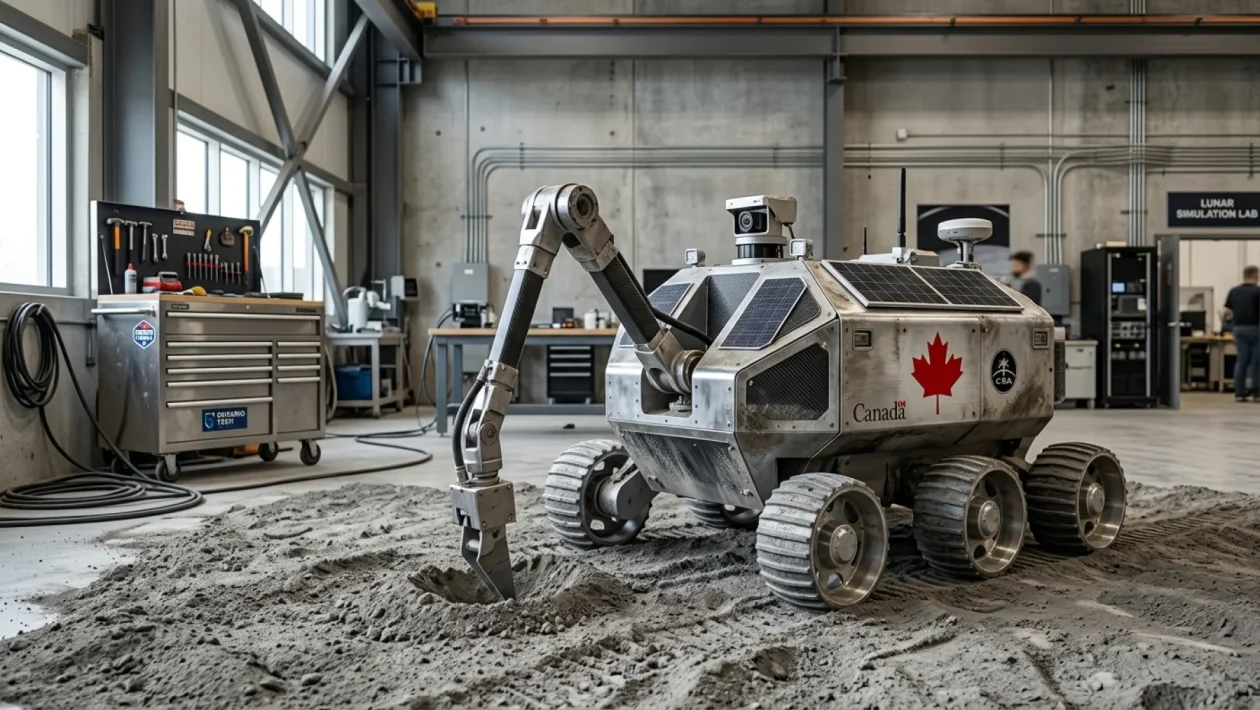
NASA just hit the brakes on the Lunar Gateway, and with it, our beloved Canadarm3 is officially riding the bench. If you’ve been following the space industry this spring of 2026, you know NASA’s recent “Ignition” event flipped the script entirely. The Americans are fast-tracking a permanent moon base, leaving orbital cranes in the dust. If Canada wants to stay relevant, we can’t wait around for instructions. We need to get our tech in the lunar dirt, and we need to do it yesterday.
The ultimate solution isn’t packing up and going home. It’s aggressively pivoting to lunar surface robotics to ensure our aerospace industry doesn’t get left behind.
Lunar Surface Robotics: The Ultimate Pivot
Look, nobody likes finding out the blueprint just changed halfway through the build. But adaptability is what makes Canadian engineering world-class.
NASA’s new timeline, driven by Administrator Jared Isaacman, measures success in months, not years. They are laser-focused on building out permanent infrastructure right on the lunar crust. That means the demand for heavy-lifting robotic rovers, autonomous unloaders, and rugged terrain vehicles is skyrocketing.
Instead of building an arm for a space station that’s currently on indefinite hold, we need to adapt our world-renowned robotic expertise for gravity. Lunar surface robotics is the new gold rush, and we already have the foundational tools to strike it rich.
How Canada Can Dominate: The Blueprint
We can’t sit on our hands waiting for Washington or Ottawa to hash out the paperwork. Former NASA Chief Economist Alex MacDonald made it crystal clear at the Space Canada Horizons conference: it’s on us to forge our own path.
To dominate this new frontier, the Canadian Space Agency (CSA) needs to execute a rapid three-step teardown and rebuild of our current strategy:
- Buy the Flight Tickets Now: We must purchase or negotiate two to three rides on Commercial Lunar Payload Services (CLPS) landers for 2027 and 2028. We need to test our surface tech in the field immediately.
- Buddy Up with Haulers: The CSA must strike deals with major commercial cargo lander companies. We want Canadian robotic tech to be the undisputed primary mechanism for unloading heavy infrastructure once it touches down.
- Fast-Track the Rover: We need an immediate down-select to two teams for the Canadian Lunar Utility Vehicle (LUV). The development timeline has to go into hyper-drive to meet NASA’s accelerated base-building schedule.
The New Moon Base Race: Why Time is Running Out
This isn’t a casual ten-year project anymore. The new space race is an all-out sprint.
If we don’t jump in now, other international players will happily take our spot. We have a massive advantage, but complacency will kill it. Consider this hard fact: Canada is currently the world’s second-largest uranium producer. Why does that matter for space? Because lunar bases need serious juice.
We have an incredible opportunity to leverage our terrestrial mining dominance and our legendary CANDU reactor safety heritage. We shouldn’t just be driving the rovers; we should be powering the entire settlement.
Surviving Without Canadarm3: Moving Past the Orbit
It stings to bench Canadarm3. Canadian companies like MDA Space have built their legacy on those iconic orbital arms. But clinging to a paused project is bad for business.
“NASA no longer has a clear near-term use for the Canadarm3. We need to rapidly pivot away from our gateway activities and focus immediately and with urgency on lunar surface robotics.” – Alex MacDonald, Former NASA Chief Economist
By reallocating the Canadarm3 budget, we can actually diversify our space portfolio. We can move past being just “the robotic arm guys” and become foundational pillars of human survival on the Moon.
Here is a quick look at where those redirected funds can give us an immediate tactical advantage:
| Lunar Sector | The Canadian Advantage |
|---|---|
| Space Nuclear Power | Deep expertise from CANDU reactors and massive domestic uranium reserves. |
| Space Agriculture | Extreme-environment food tech already proven via the Narvik project in Nunavut. |
| Medical Systems | World-class remote healthcare infrastructure easily adapted for astronaut monitoring. |
Frequently Asked Questions
What exactly is the Lunar Utility Vehicle?
Think of it as a heavy-duty, autonomous pickup truck for the Moon. It’s designed to survive the brutal lunar night and haul critical infrastructure around the new permanent base.
Is Canadarm3 dead forever?
Not necessarily dead, but definitely on ice. NASA’s Gateway is on an indefinite pause. If they eventually build the station, the arm will fly. But we can’t afford to wait around to find out.
Why the sudden rush?
Leadership changes at NASA have dramatically shifted the timeline. The new strategy demands immediate, tangible results on the lunar surface. If you aren’t ready to launch in the next few years, you aren’t part of the mission.
🤝 We are standing at a massive crossroads for the Canadian aerospace industry.
💡 The pivot from orbital stations to ground-level operations is tough, but it’s exactly the kind of gritty, hands-on challenge Canadian engineers eat for breakfast.
📱 If you want to see our flag on the side of the next generation of moon rovers, share your thoughts with your local reps and let’s keep the pressure on.
👇 Good luck to the teams at the CSA navigating this shift—we are all rooting for you to get this right!