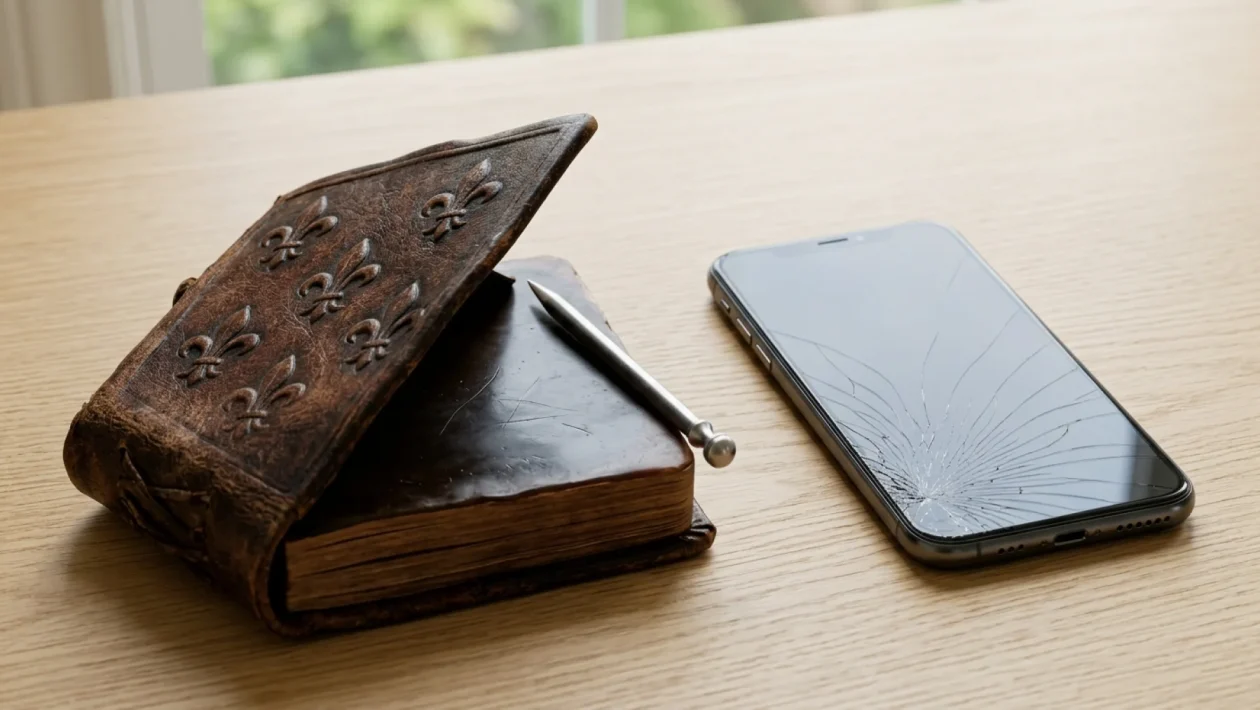
Imagine the sheer, heart-stopping panic. You’re handling your daily business, you fumble your grip, and plop—your most vital, expensive piece of daily technology plunges straight into the murky depths of the toilet. We’ve all been there with our smartphones, but it turns out a wealthy German merchant experienced this exact nightmare eight centuries ago. Instead of a cracked iPhone, this poor guy dropped a beautifully crafted medieval leather notebook into a dank latrine in Paderborn, Germany. The crazy part? That highly disgusting plunge actually protected the artifact perfectly for 800 years.
The Medieval Leather Notebook
When archaeologists from the Westphalia-Lippe Regional Association dug up a medieval latrine recently, they expected to find standard garbage. Instead, they pulled out a pocket-sized, 800-year-old gadget that essentially served as the iPad of the Middle Ages.
This wasn’t some flimsy piece of parchment. The cover was built with a rugged thickness that would put a vintage Roots Canada leather duffle bag to shame. It was tightly bound and elegantly embossed with lilies, a popular symbol for purity at the time.
Inside, the notebook didn’t use paper. It relied on a brilliant, reusable engineering trick. Here is exactly how an elite medieval merchant operated this daily driver:
- Crack open the tight binding: The leather was stitched tight enough to completely seal out moisture and muck.
- Carve into the wax: The inner wooden pages were coated with layers of colored wax, allowing the user to scratch notes using the sharp point of a metal stylus.
- Erase and reuse: When a business deal was done, the user simply flipped the stylus over and used the flat end to smooth the wax back out, instantly wiping the screen clean.
How An 800-Year-Old Toilet Mishap Happened
It’s incredibly easy to assume people from the 1200s were totally alien to our modern way of life. But human error never changes. A quick, hard statistic proves the point: roughly 19% of North Americans have accidentally dropped their cell phone into a toilet at least once.
Back then, wealthy merchants used these latrines, and slipping up was just as easy. You reach to adjust your heavy wool tunic, the notebook slides out of your pocket, and it’s gone forever into the filth. Naturally, retrieving it wasn’t worth the effort.
“We need to remember that people dropped things in toilets then, as now,” notes historian Katherine Weikert on the HistoryExtra podcast. “It lands in a smoosh, then it gets covered up. … If that cesspit doesn’t get cleared out or gets abandoned, it’s just there waiting to be found, which is amazing.”
Preserving History’s Craziest Time Capsule
So, how does a wooden object sit in a literal toilet for 800 years without rotting into dust? It all comes down to the perfect cocktail of gross, oxygen-free science.
The latrines under the early modern buildings of Paderborn had been sealed completely airtight for centuries. The humidity, the specific soil conditions, and the utter lack of oxygen meant that bacteria couldn’t survive to eat the wood and leather. It acted like a giant, smelly vacuum sealer.
| The Medieval Wax Notebook | Your Modern Smartphone |
|---|---|
| Bound in heavy-duty, moisture-resistant leather | Wrapped in slippery, shatter-prone glass |
| Survives 800 years submerged in a toxic cesspit | Requires a bowl of rice after a tiny splash |
| Infinite battery life fueled by physical wax | Needs to be frantically plugged into a wall by 2 PM |
Because the airtight seal was so flawless, the notebook’s Latin cursive text is still completely legible to conservators today. It’s a genuine treasure trove for historians looking to peek into the daily business transactions of medieval high society.
Frequently Asked Questions
What was actually written inside the notebook?
Because of the erasable wax, a quick scan revealed what experts believe to be records of business transactions. Since it’s written in Latin cursive, researchers know the owner was highly educated and upper-class. Translating the corrupted, abbreviated medieval spellings is currently an ongoing project for the conservators.
Does the artifact still smell bad?
Yes, absolutely. Because the airtight latrine was so incredibly good at preserving materials, it also preserved the scent. Conservators noted that even after 800 years in the ground, the notebook still carried a distinctly unpleasant odor when they opened it.
Did they really use silk as toilet paper?
Amazingly, yes. Alongside the leather notebook, archaeologists found scraps of fine silk fabric in the latrine. For the wealthy merchant class of the 13th century, standard leaves or moss simply wouldn’t do—they preferred the luxurious touch of imported silk.
🤝 Share your thoughts in the comments below! Have you ever lost a valuable tool or piece of tech to the plumbing gods, or are you usually careful with your gear?
💡 Good luck trying to convince anyone that our modern gadgets are built to last after seeing an 800-year-old erasable tablet survive a literal cesspit.
📱 Next time you carry your phone into the bathroom, keep a tight grip on it. You never know if you’re about to accidentally create a time capsule for archaeologists in the year 2826.
👇 Drop a comment and let me know what piece of everyday carry gear you’d hate to lose the most!