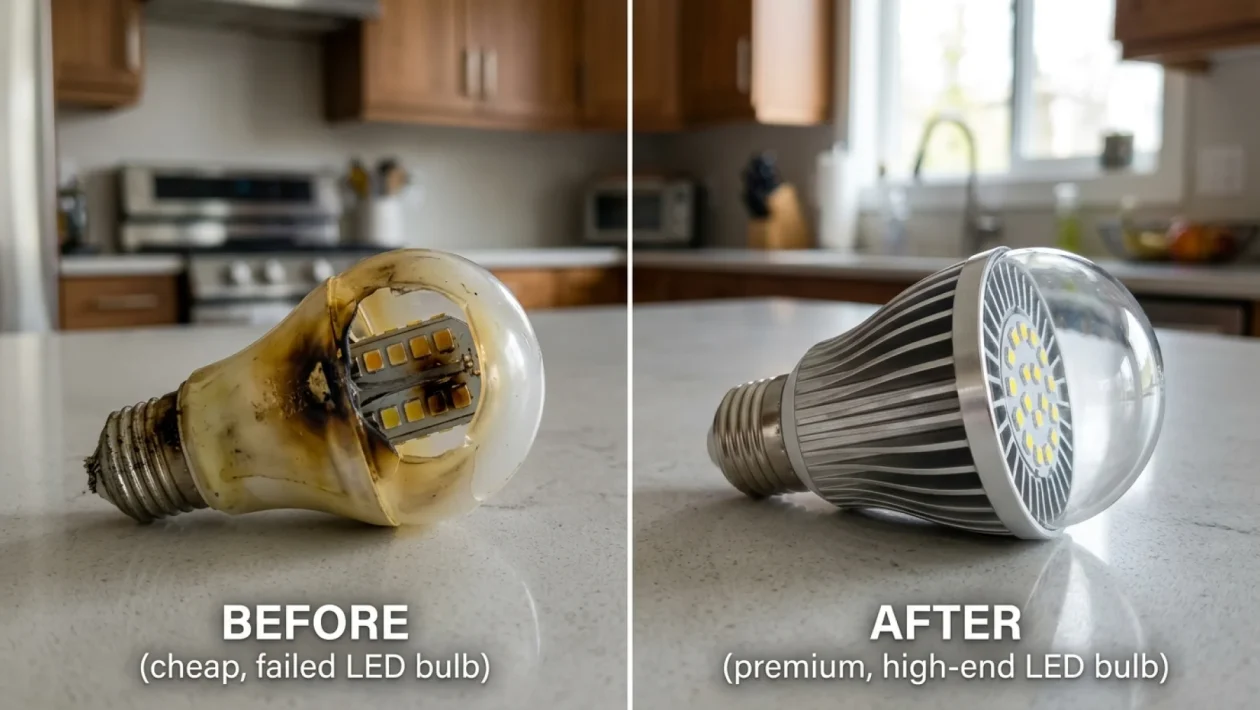
You screwed in that expensive LED bulb expecting it to outlast your mortgage. The glossy box proudly promised 25,000 to 50,000 hours of brilliant, energy-saving light.
Yet here we are in July 2026, and you are standing on a kitchen chair, unscrewing a dead, flickering piece of plastic after just 36 months of normal use. You are not crazy, and you are definitely not alone in this frustration.
The modern lighting industry is built on a very well-crafted illusion. Today, we are going to tear apart your broken bulbs, expose the engineering flaws, and show you exactly how to buy the right lights so you never have to climb that step-ladder again.
LED Bulb Lifespan Myths
To understand why your lights keep dying, we need to talk about how these bulbs are actually tested before they hit store shelves.
No manufacturer leaves a bulb running for twenty years to see when it finally gives up the ghost. Instead, they use accelerated laboratory testing under absolutely flawless conditions.
These tests take place in strictly climate-controlled rooms sitting at exactly 25°C. They are fed perfectly filtered, laboratory-grade electrical currents without a single voltage spike.
Furthermore, the industry lifespan standard often just measures the time it takes for the light-emitting diode itself to drop to 70% of its original brightness. It completely ignores the fragile power electronics hidden in the base of the bulb.
When you take that lab-tested product and feed it the fluctuating power of an aging North American electrical grid, those perfect laboratory promises fall apart instantly.
Why They Burn Out in 3 Years
The biggest lie we’ve been sold is that LEDs don’t produce heat. While it is true they don’t blast infrared heat forward like the old tungsten bulbs, they still generate a massive amount of residual heat right at the base of the diode.
In older, poach-proof designs, manufacturers used heavy aluminum heat sinks to pull this heat away. Today, to keep costs rock-bottom, they use cheap thermal plastics. If that internal heat isn’t actively dissipated, temperatures inside the bulb easily skyrocket past 85°C to 100°C.
“People think the light itself dies, but over 80% of LED failures happen because the liquid inside the driver’s electrolytic capacitors literally evaporates from trapped heat.”
This thermal nightmare gets drastically worse when you factor in modern interior design.
Those beautiful, enclosed glass globes or minimalist flush-mount ceiling fixtures you picked up at Home Depot or Canadian Tire are absolute death traps for standard LEDs. They choke off all natural airflow, creating a miniature oven that cooks the internal power driver.
Add in the frequent power surges—like when your refrigerator’s compressor kicks on—and your bulb’s delicate internal circuit board doesn’t stand a chance.
| Cheap LED Bulb ($2 – $4) | Premium LED Bulb ($10+) |
|---|---|
| Plastic body with poor heat dissipation. | Heavy aluminum or advanced ceramic heat sinks. |
| Basic capacitors rated for exactly the warranty period. | High-temperature rated capacitors designed for durability. |
And How to Actually Make Them Last Decades
Now that you know exactly how the industry cuts corners, you can outsmart the system. You can absolutely get decades of reliable light if you change how you shop and where you install them.
Here is your step-by-step playbook for keeping your home brilliantly lit for the long haul:
- Check for the “Enclosed Fixture Rated” label: If you are putting a bulb inside a glass dome, a bathroom ceiling fan, or a recessed can, you must buy bulbs specifically rated for enclosed spaces. These use upgraded, heat-resistant capacitors.
- Feel the weight: When you are in the hardware store, literally weigh the bulbs in your hands. A heavier bulb usually indicates a proper aluminum heat sink inside the casing, which will draw deadly heat away from the electronics.
- Match your dimmers: Using an old dimmer switch designed for incandescent bulbs on a modern LED will fry the driver circuit in months. Upgrade to an LED-compatible dimmer to ensure smooth, low-voltage power delivery.
- Beware of motion sensors: Hallways or exterior lights with motion sensors switch on and off dozens of times a night. This causes repeated “inrush current” shocks to the bulb’s power supply. Buy commercial-grade bulbs for high-traffic, sensor-driven areas.
Frequently Asked Questions
Why does my LED bulb flicker before it dies?
Flickering is the universal distress signal of a dying electrolytic capacitor inside the bulb’s power driver. When the capacitor dries up from excessive heat, it can no longer filter the alternating current from your house, causing the strobe-light effect.
Do frequent on/off cycles ruin LED bulbs?
The diodes themselves don’t care how many times you turn them on. However, the internal electronic power supply takes a massive voltage spike (inrush current) every single time you flip that wall switch. Over time, high-frequency switching will absolutely kill a cheap bulb’s circuitry.
🤝 Share your thoughts with me in the comments below—have you noticed your modern bulbs dying faster than the old-school ones your parents used?
💡 I highly recommend you take ten minutes this weekend to check your enclosed ceiling fixtures and swap out any standard bulbs before they bake themselves to death.
📱 If you found this breakdown helpful, send it to a friend who is constantly complaining about their burnt-out bathroom vanity lights.
👇 Good luck out there, keep those receipts, and always read the fine print on the box!