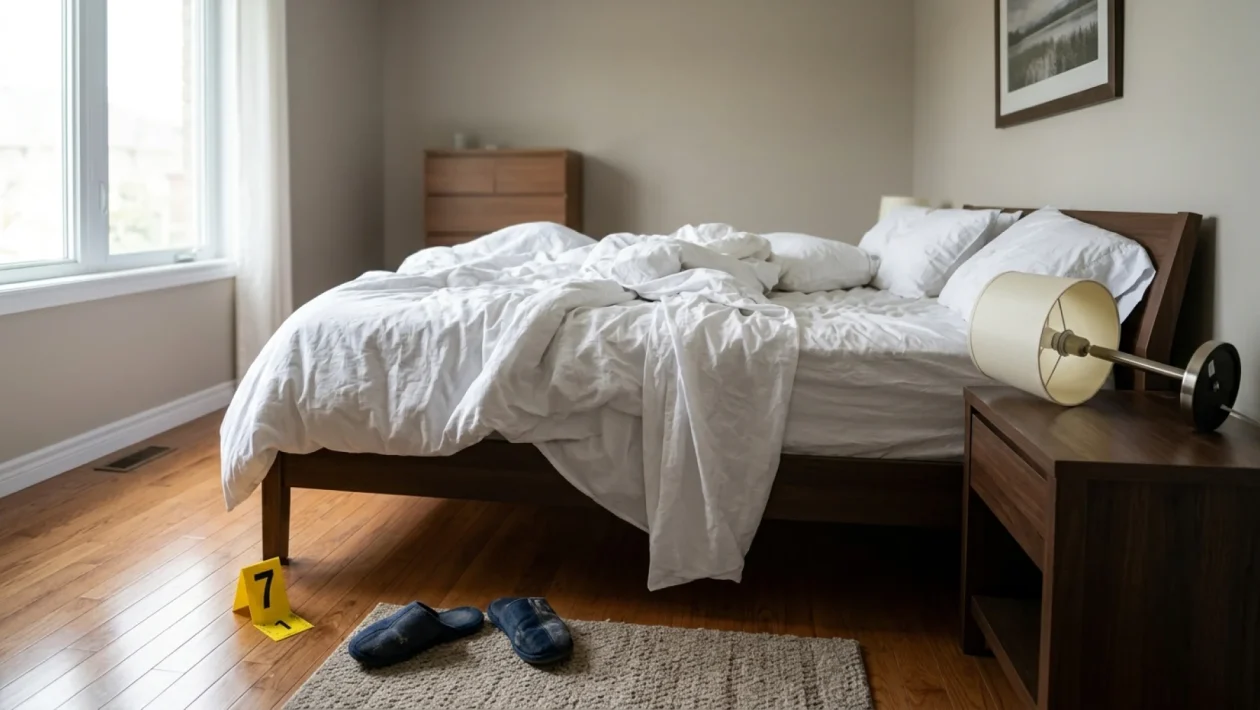
You go to sleep in your own bed, but wake up in the middle of a nightmare. That is the chilling reality at the center of the Jackson sleepwalking death investigation in Missouri. When a routine emergency call turns into a baffling case of fatal parasomnia, police are forced to ask a nearly impossible question. How do you investigate a suspect or victim who was completely unconscious?
As an investigative journalist, I have seen my fair share of complex crime scenes. But when the human brain short-circuits between deep sleep and wakefulness, the standard detective playbook goes right out the window. Today, we are breaking down the forensic science, the legal grey areas, and the surprising home security steps you need to know to protect your family.
The Jackson Sleepwalking Death: What Actually Happened?
When authorities in Jackson, Missouri, first arrived on the scene, nothing made sense. The physical evidence pointed to a tragic accident, yet the behavioral clues felt completely contradictory. It was a textbook closed-door mystery.
To understand a case like this, you have to separate Hollywood myths from biological facts. Sleepwalking, or somnambulism, is not just wandering around with your arms outstretched. It is a highly complex state where the brain’s motor functions are awake, but the rational decision-making center is completely offline.
In this Missouri investigation, the entire tragedy hinged on whether complex actions could legitimately happen without conscious thought. The answer, terrifyingly, is yes.
Inside the Missouri Investigation: Unraveling Unconscious Actions
Figuring out what happens in the dark requires a massive shift in how police gather evidence. Detectives can no longer rely just on fingerprints and typical motives. They have to virtually reconstruct the neurological state of the person involved.
Here is a hard fact that keeps sleep specialists on high alert. According to the American Academy of Sleep Medicine, roughly 4% of adults experience sleepwalking, but violent or fatal episodes happen in less than a fraction of a percent of those cases. It is incredibly rare, which makes investigating it incredibly difficult.
“When a tragedy occurs during an episode of parasomnia, the traditional concept of ‘motive’ vanishes. We are no longer investigating a crime; we are investigating a catastrophic medical misfire.”
That insight from forensic neurologists completely changes the trajectory of a police probe. Investigators must look backward at medical histories, chronic stress levels, and even severe sleep deprivation leading up to the fatal night.
How This Case is Changing Forensic Science in North America
The fallout from complex parasomnia cases has forced a massive update to forensic protocols across the US and Canada. Now, in mid-2026, rural police departments and federal agencies alike are treating “sleep forensics” as a specialized investigative field.
When a parasomnia defense or sleep-related accident is suspected, investigators now follow a rigid new protocol:
- Digital Footprint Extraction: Tech is the new eyewitness. Police immediately pull data from Ring doorbell cameras and interior motion sensors tied to systems like SimpliSafe to track exact nighttime movements.
- Polysomnography Review: Medical records are subpoenaed to look for a documented history of sleep terrors, restless leg syndrome, or extreme somnambulism.
- Environmental Trigger Analysis: Detectives meticulously catalog what was in the person’s system, focusing heavily on prescription sleep aids or alcohol.
- Subconscious Capability Testing: Experts evaluate if the actions taken during the event were routine enough to be performed entirely by unthinking muscle memory.
Genuine Parasomnia vs. Staged Scenes
The hardest job for any detective is figuring out if someone is faking it to cover up a crime. Cases like the Missouri investigation highlight distinct differences between genuine sleep tragedies and staged scenes.
| Genuine Sleepwalking Action | Red Flags for Staging |
|---|---|
| Blank, glassy-eyed expression during the event. | Attempts to actively conceal identity or hide evidence. |
| Complete amnesia and genuine panic upon waking. | Overly detailed, highly logical explanations of the “dream.” |
| Clumsy, routine-based movements driven by muscle memory. | Complex, multi-step problem solving (e.g., cracking a safe). |
If the evidence leans heavily toward the right column, the sleepwalking defense falls apart instantly. The physical environment never lies, even when the human mind is trying to.
Frequently Asked Questions
Can you really be held legally responsible for a sleepwalking crime?
It depends entirely on legal precedent and jurisdiction. In North America, if a forensic sleep expert can definitively prove the person was in a state of “automatism” (acting without conscious control), they are generally found not criminally responsible. However, the burden of proof is incredibly high.
How can I secure my home if someone in my family sleepwalks?
Keep it practical and safe. Install high-placed deadbolts that require conscious effort and reaching to unlock. You should also set up simple motion-activated chimes on bedroom doors so you are immediately alerted if a family member starts wandering at night.
Do certain medications cause violent sleepwalking?
Yes, certain prescription sleep aids, especially when mixed with alcohol or extreme physical exhaustion, have been known to trigger “complex sleep behaviors.” Always lock up hazardous items and consult a medical professional if you experience extreme grogginess or missing time.
🤝 It is a wrap on this complex case, but the broader conversation is just getting started. Tragedies like this remind us that the human brain remains the ultimate unsolved mystery.
💡 Protect your space by taking a quick audit of your home security and bedtime routines tonight. A simple door chime or motion sensor can literally be the difference between a safe night and an unthinkable accident.
📱 Share your thoughts with me on social media or in the comments below. Have you or a family member ever experienced extreme or bizarre sleepwalking?
👇 Good luck, stay safe, and make sure you prioritize a healthy, restful night’s sleep!