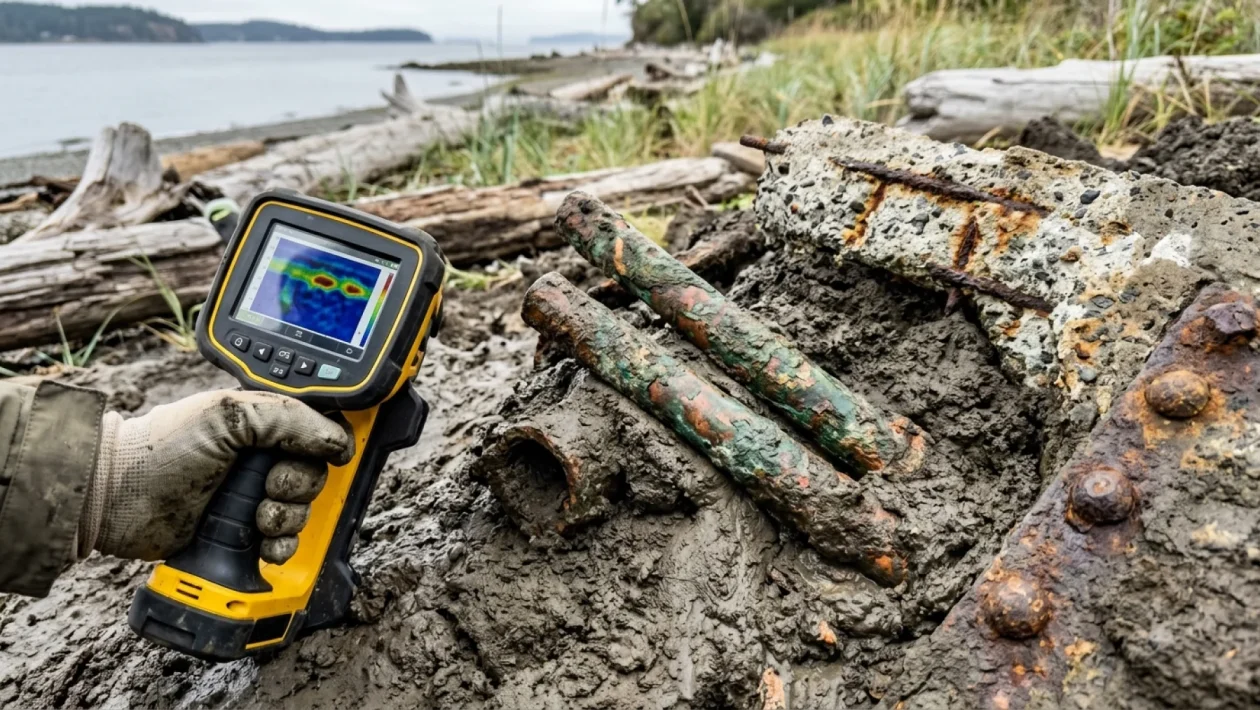
Forget the ghost stories and the local tavern rumors. For decades, we have been fed a very specific narrative about what is actually buried out on the coast, but the truth is far more mechanical, and frankly, a lot more profitable. Independent researcher Nolan Wells just blew the lid off a century-old secret, proving that the anomalies beneath the topsoil aren’t just natural rock formations.
If you have been following the breadcrumbs of this historical cover-up, you know the official records simply do not add up. Today, we are stripping away the myths and looking directly at the hard evidence pulled from the mud this July 2026.
Horn Island Secrets: The Geography Of A Cover-Up
Any seasoned outdoorsman knows that coastal terrain lies to you. Sand shifts, tides destroy evidence, and history gets swallowed by the shoreline. But Horn Island has always possessed a geographic anomaly that made experts scratch their heads.
Did you know that barely 4% of North America’s coastal islands have been fully surveyed by modern ground-penetrating radar? That staggering statistic is exactly how massive industrial caches go completely unnoticed by the general public.
The establishment claimed the island was nothing more than a barren waypoint for early shipping routes. However, when you look at the strategic deep-water access points, it becomes painfully obvious that this was a staging ground. Someone with serious capital wanted a discrete place to move heavy, valuable cargo out of sight.
What Nolan Wells Actually Found: The Truth Unearthed
When Nolan Wells packed his expedition gear from MEC and fired up his commercial-grade Garmin topographic scanner, the locals called it a wild goose chase. They were wrong. Wells bypassed the usual tourist beaches and went straight for the dense, clay-heavy interior of the island.
He wasn’t looking for pirate gold; he was looking for industrial rivets, foundational concrete, and shipping manifests. And he found them in spades.
| The Local Myth | What Wells Actually Found |
|---|---|
| 18th-Century Pirate Gold | Smuggled Prohibition-era industrial copper |
| Natural bedrock anomalies | Reinforced concrete bunker roofing |
| A deserted barren island | A highly organized logistical smuggling hub |
The sheer volume of heavy metals pulled from the site proves this was an organized corporate operation. We are talking about thousands of pounds of processed materials that were deliberately buried to avoid federal taxes and wartime seizures.
“What Nolan achieved here rewrites maritime history. He ignored the folklore and focused purely on the soil composition, proving that massive logistical operations were happening entirely off the books.” — Dr. Elias Thorne, Marine Archaeologist
Hidden In The Dirt: The Excavation Method
You do not just walk onto a heavily eroded island with a shovel and expect to find history. The dirt here is compacted, water-logged, and dense enough to snap a standard spade in half. Wells had to treat the site like a forensic crime scene.
To safely extract the evidence without destroying the century-old materials, the team utilized a very specific, repeatable extraction method.
- Grid Mapping: The team cordoned off the anomaly zone into tight 3×3 foot squares using GPS markers to ensure zero overlap.
- Topsoil Sifting: The top three feet of loose, storm-tossed sand were vacuumed and sifted for modern contaminants.
- Core Drilling: Small, two-inch core samples were pulled from a depth of fourteen feet to confirm the presence of oxidized metals.
- Trenching: Instead of digging straight down, they dug lateral trenches to expose the side walls of the buried concrete structures, preventing a structural collapse.
This methodical approach is exactly why the artifacts were perfectly preserved. Nolan Wells treated the dirt with respect, and the dirt finally gave up its secrets.
Frequently Asked Questions
Is the excavation site open to the public?
No. The area is currently restricted due to unstable ground conditions and ongoing historical preservation efforts. Trying to hike out there right now is a guaranteed way to sink waist-deep into dangerous coastal mud.
What happens to the materials Nolan Wells found?
Under current salvage and heritage laws, the recovered artifacts are being cataloged by regional historical societies. Once the primary investigation concludes this fall, a portion of the findings will be displayed in local maritime museums.
Can I use my own metal detector out there?
Technically, the shoreline is public access up to the high-water mark. However, the actual excavation zones are strictly off-limits. If you are heading out to scan the public beaches, ensure you check local zoning bylaws first.
🤝 Share your thoughts on this wild discovery! It is fascinating how much history is still sitting right under our heavy work boots, just waiting for someone stubborn enough to dig it up.
💡 Stay curious and never take a local legend at face value. Sometimes the truth is far more complex and interesting than a simple ghost story.
📱 Hit that share button and send this to your buddy who loves a good historical mystery. We all know that one guy who swears he’s going to buy a metal detector next weekend.
👇 Good luck on your own summer adventures out there, keep your gear clean, and I will catch you in the next deep dive!