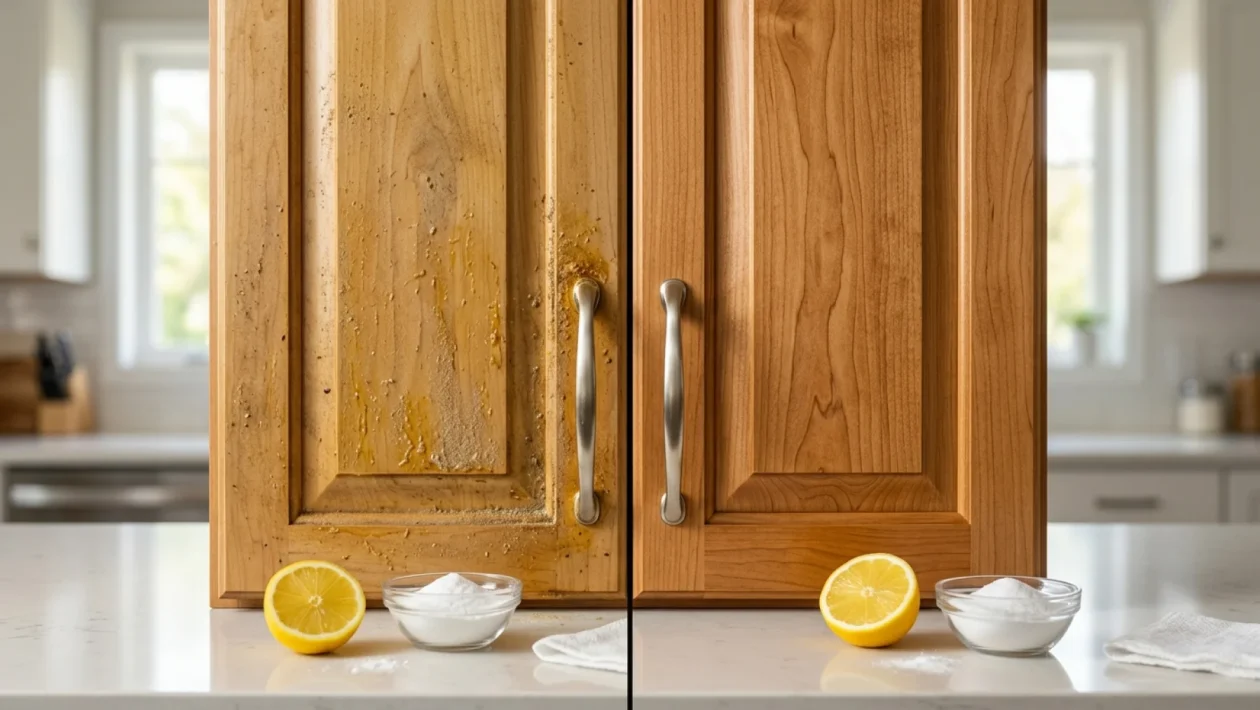
Look at your kitchen cabinets right now. Run a finger right above the handle. If it feels like you just touched a strip of flypaper, we need to talk. Cooking grease doesn’t just vanish into the range hood; it atomizes and glues itself to your cabinet doors. I’ve seen homeowners ready to rip out perfectly good maple cabinets just because years of baked-on grime made them look hopelessly dull. But before you head to Canadian Tire for industrial-grade chemical strippers, stop. The ultimate degreaser is already sitting in your pantry.
Tackling greasy kitchen cabinets
Cooking is a messy, beautiful business. You sear a steak or fry some bacon for a mid-summer brunch, and those microscopic oil particles go completely airborne.
In fact, indoor air quality studies show that over 70% of airborne cooking oils settle directly onto vertical surfaces within 48 hours. When that vaporized oil mixes with everyday household dust, it forms a stubborn, sticky resin.
If left unchecked, this resin turns into a concrete-like sludge. It makes your otherwise gorgeous kitchen look neglected, and it acts as a magnet for even more dirt.
The 5-minute natural wipe-down
You do not need toxic fumes or heavy scrubbing to cut through this mess. Social media cleaning expert Chantel Mila (@mama_mila_) recently went viral for reminding us of an old-school contractor secret.
The magic comes down to two basic, incredibly cheap ingredients: baking soda and lemon juice. It’s a combination that has been trusted for generations, long before aggressively marketed chemical sprays hit the shelves.
| The Natural Method | Commercial Sprays |
|---|---|
| Pennies per use | $6 to $12 per bottle |
| Zero toxic fumes | Requires heavy ventilation |
| Safe on most wood finishes | Can strip expensive varnishes |
Baking soda is a mild alkali. This makes it an absolute powerhouse for dissolving grease without scratching your delicate cabinet finishes. When you add a dash of citric acid from the lemon juice, you trigger a grease-busting reaction.
How it melts grime fast
The beauty of this method is the absolute lack of elbow grease required. You are letting basic chemistry do the heavy lifting for you.
Here is exactly how to execute this quick wipe-down:
- Prep the powder: Grab a medium-sized bowl and pour in 1/4 cup of standard baking soda.
- Add the acid: Drop in exactly one teaspoon of lemon juice. The citric acid immediately begins breaking down the structural integrity of the grime.
- Hydrate and mix: Pour in one cup of warm water. Stir the solution until the baking soda is completely dissolved.
- Wipe it on: Dip a clean microfiber cloth into the mix. Apply it to your cabinets using wide, circular motions.
- Let it melt: This is the crucial part. Walk away for five minutes. Let the solution actively melt the grease before you come back to wipe it clean.
“A lot of folks ruin their expensive cabinet finishes with harsh chemical degreasers. The mild abrasion of baking soda combined with natural citric acid cuts the fat without eating the varnish.”
Frequently Asked Questions
Will this damage my wood cabinets?
Because the baking soda is dissolved in water, it loses its abrasive edge, making it safe for most finishes. However, always do a quick spot-test on the inside of a cabinet door first just to be completely certain.
Can I use bottled lemon juice?
Absolutely. Fresh lemons smell incredible, but the bottled stuff contains the exact same citric acid required to break down the sticky oils.
What do I do with the leftover mixture?
Don’t just dump it! Pour the remaining lemon-soda water directly down your kitchen sink drain. It works wonders for cutting through plumbing grease and leaves your drain smelling incredibly fresh.
🤝 You don’t need to overcomplicate home maintenance. Sometimes, the simplest, oldest tricks in the book are still around for a reason—they actually work.
💡 Give this a shot this weekend. It takes less time to mix this up than it does to brew a pot of coffee, and the results will genuinely shock you.
📱 Did this trick save your cabinets? Feel free to share your thoughts or send this along to a friend who is fighting a losing battle against kitchen grease. Good luck, and happy cleaning!