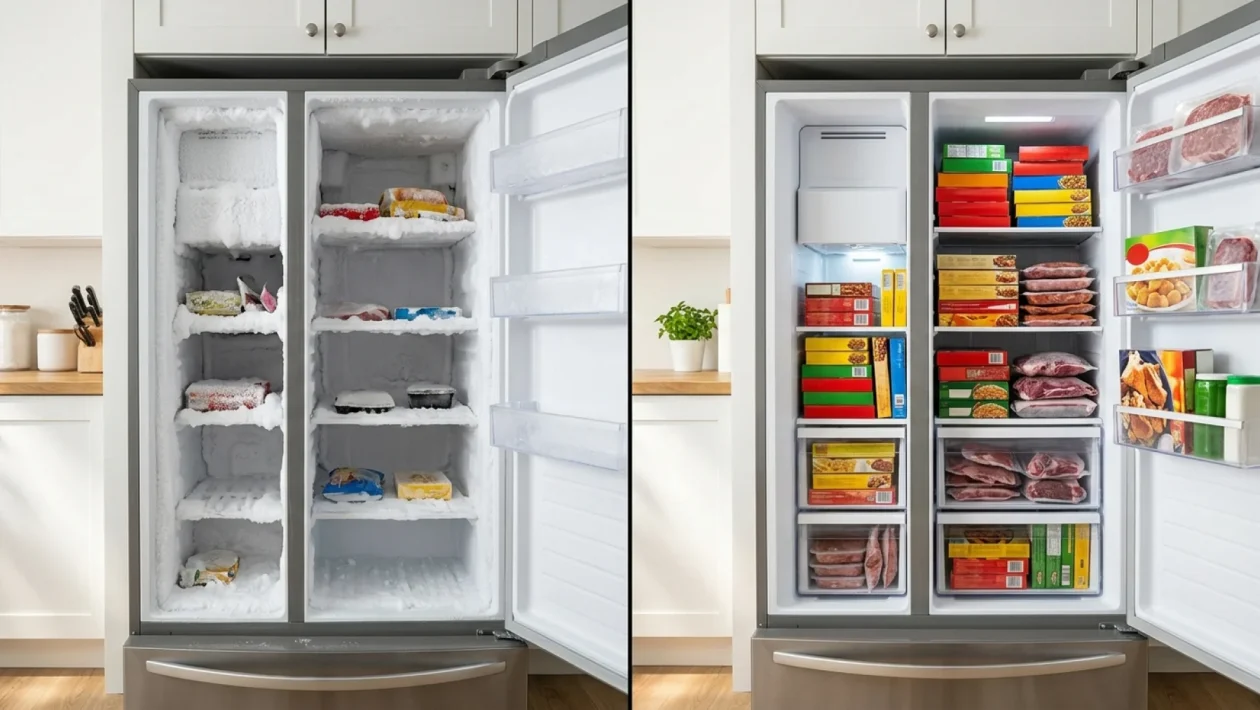
Right now, the heavy metal box sitting in your kitchen or basement is quietly bleeding your wallet dry. You open your hydro statement this July and wonder why the numbers have suddenly skyrocketed. The answer is your freezer working double-time to fight off the ambient heat creeping into your home. Fortunately, you don’t need to unplug the unit or toss out your frozen steaks to fix this. By making three simple adjustments to how you maintain and load the appliance, you can instantly throttle down its power consumption and keep your hard-earned cash where it belongs.
Why Your Freezer Energy Bills Are Spiking Right Now
The math on this is brutal but straightforward. When ambient temperatures rise, your freezer’s compressor has to work overtime just to maintain its baseline zero-degree state.
Every time you pop that door open to grab some ice, heavy, moisture-rich air floods the compartment. That moisture instantly freezes against the walls and coils.
Suddenly, your appliance isn’t just cooling your food. It’s actively fighting through a thick wall of ice just to regulate the internal temperature, causing your freezer energy bills to soar without warning.
The Defrost Protocol: Stripping Away the Ice Barrier
You might think a layer of ice inside a freezer is a good thing. In reality, ice acts as an incredibly stubborn thermal insulator.
According to energy experts, a frost buildup of barely two millimeters will spike your freezer’s electricity consumption by a massive 10%. That means the appliance is burning extra power just to push cold air through its own frosty walls.
Unless you’re running a modern frost-free Danby or Whirlpool model, you need to manually intervene. Empty the unit, store the contents in coolers, and let that stubborn ice melt away completely. Wipe the interior bone-dry before turning it back on to reset your efficiency baseline.
Ventilate to Accumulate: Giving Your Appliance Room to Breathe
A freezer doesn’t actually “create” cold air. It extracts heat from the inside and physically dumps it out the back.
If your freezer is shoved tight against a wall or buried under boxes in a sweltering garage, that expelled heat has nowhere to go. The compressor ends up suffocating in its own exhaust, running continuously without ever cycling off.
Pull the unit at least three inches away from the wall immediately. Next, grab a vacuum and suck the dust off the condenser coils at the rear. A clean, well-ventilated coil sheds heat effortlessly.
Pack It Tight: Why a Full Freezer is a Cheap Freezer
Here is the most counterintuitive rule of appliance management: an empty freezer is an expensive freezer.
Air is terrible at holding onto cold temperatures. When you open a half-empty unit, all that chilled air literally falls out and pools on your floor, immediately replaced by warm room air.
Solid frozen objects, on the other hand, retain the cold brilliantly. They act as massive internal ice packs, helping the entire unit recover its temperature rapidly after the door is closed.
| Freezer State | Energy Efficiency Impact |
|---|---|
| Empty (mostly air) | High power draw; massive cold air loss when opened. |
| 70-80% Full (food/ice) | Low power draw; acts as a self-cooling thermal mass. |
If you don’t have enough food to hit that sweet spot of 70% to 80% capacity, don’t buy unnecessary groceries. Just fill a few empty plastic jugs three-quarters full of tap water and toss them in to freeze.
The Strategy to Save Cash: Stopping the Leaks
Before you even start shifting food around, verify the structural integrity of your cold seal.
“Most homeowners completely ignore their gaskets. A degraded rubber seal forces a compressor to run 24/7, silently doubling the appliance’s operating cost during peak summer rates,” notes a recent energy conservation report from Hydro One.
Here is exactly how you test it today:
- Grab a crisp five-dollar bill or a standard piece of printer paper.
- Open the freezer door and place the paper half-in, half-out across the rubber gasket.
- Close the door tightly on top of the paper.
- Pull the paper straight out toward you.
If it slides out with zero resistance, your gasket is shot. Cold air is pouring out, and you need to clean or replace the seal right away.
Frequently Asked Questions
Does moving my freezer to the basement actually help?
Absolutely. For every degree you drop the ambient temperature around the unit, it uses less power to run. Moving a chest freezer from a 30-degree garage to an 18-degree basement yields massive, instant savings.
Do frost-free freezers use more electricity?
They typically use slightly more base energy because they occasionally activate a small internal heater to melt off coil frost. However, they prevent the drastic efficiency drops caused by neglected ice buildup, saving you money in the long run.
🤝 Getting your energy costs under control doesn’t require a master’s degree in thermodynamics. By defrosting the ice, giving the unit room to breathe, and keeping it packed tight, you take all the heavy lifting off the motor.
💡 Good luck making these fast tweaks this weekend. You’ll hear the compressor kick off more often, and your wallet will definitely thank you when the next utility bill arrives.
📱 Share your thoughts or let us know how much your bill dropped in the comments below!
👇 If you found this helpful, send it to a buddy who’s currently cooling half the neighborhood with a leaky garage freezer.