High-tech car thieves don’t need a crowbar, a coat hanger, or a smashed window to drive off with your truck while you are fast asleep. They just need a cheap digital antenna to capture the continuous radio signal bouncing out of your smart key fob right through your front door. The ultimate defense against this invisible hijacking doesn’t require a pricey security system, complex wiring, or a call to the dealership. The exact tool you need to block their scanners and protect your driveway is sitting right inside your kitchen drawer.
Foil Car Keys: The Core Mechanism
Your modern keyless entry fob is incredibly convenient, but it is constantly broadcasting a low-frequency ping looking for your vehicle. Thieves exploit this open communication by using relay amplifiers to boost that signal from your front hallway all the way to your driveway.
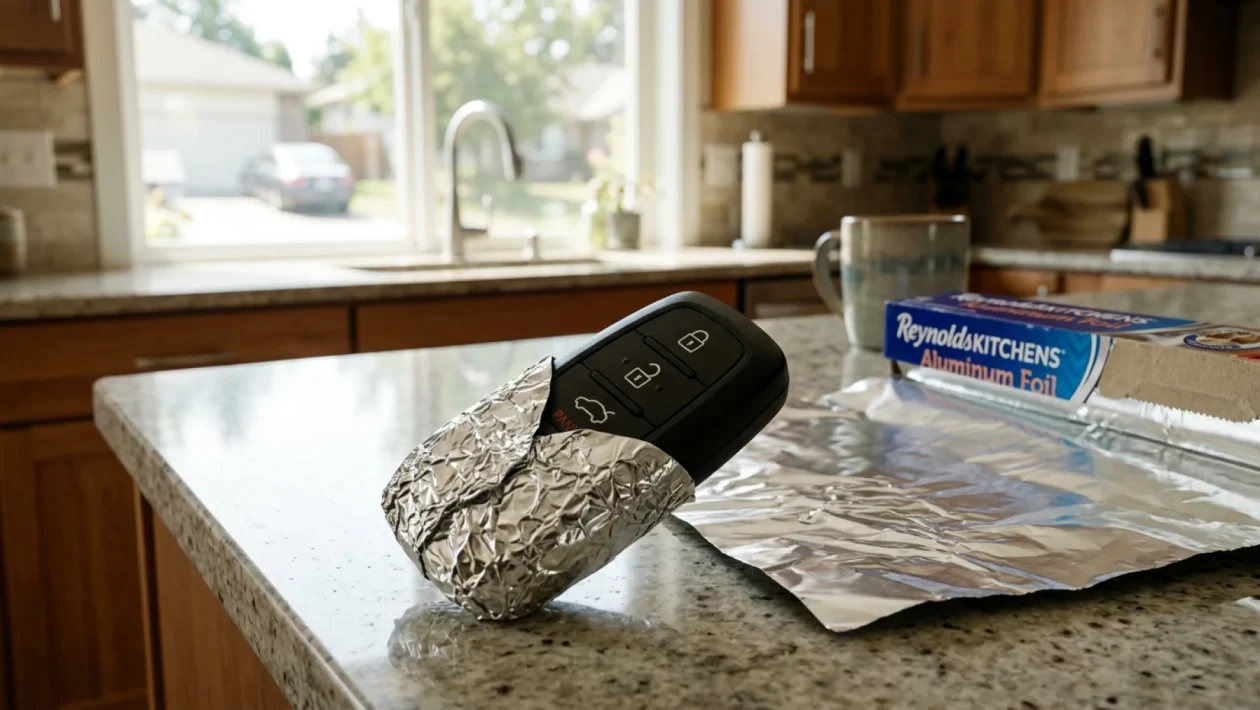
By wrapping your fob in foil car keys instantly become invisible to these digital scanners. The metal creates what physicists and electrical engineers call a Faraday cage.
This barrier absorbs and redistributes electromagnetic fields, completely trapping the radio waves inside the foil envelope. If the signal cannot leak out into the open air, the thieves’ amplifiers have absolutely nothing to grab onto.
The 10-Cent Kitchen Solution
You do not need to drive down to Canadian Tire to drop fifty bucks on a specialized, tactical signal-blocking pouch if you are in a pinch. Standard aluminum foil—yes, the exact same Alcan roll you use for your barbecue ribs—does the exact same job.
It is the most accessible, cost-effective security upgrade you can make this May 2026 as spring road trips kick into high gear.
Here is how standard kitchen metal stacks up against commercial RFID-blocking bags:
| Feature | Aluminum Foil | Commercial RFID Pouch |
|---|---|---|
| Cost | Pennies per use | $15 – $40 |
| Signal Blocking | 100% (if fully sealed) | 100% |
| Durability | Low (tears easily) | High (leather/nylon) |
| Aesthetic | DIY / Messy | Sleek / Professional |
Stopping High-Tech Auto Thieves
Relay theft is not just a minor neighborhood nuisance; it is an organized, billion-dollar enterprise sweeping across North America. According to a recent report by the Équité Association, a vehicle is stolen every five minutes in Canada, with electronic relay attacks driving the historic spike in modern auto thefts.
The criminals operate in pairs in the dead of night, quietly targeting residential driveways. One thief stands near your front porch with a receiver to capture your key’s signal, while the other stands by your car door with a transmitter.
Within ten seconds, your vehicle’s computer is tricked into thinking you are grabbing the handle. The engine fires up, and your truck is bound for an overseas shipping container before you even pour your morning coffee.
“If your smart fob is actively transmitting inside your house, your vehicle is a sitting duck. Wrapping it in foil is literally using 19th-century physics to stop a 21st-century digital crime.”
Securing Your Ride In Seconds
Creating your own protective barrier takes less than a minute. The absolute key to success is ensuring there are zero gaps for the radio waves to escape.
- Tear off a square of heavy-duty aluminum foil, roughly the size of a standard piece of printer paper.
- Place your smart key fob squarely in the center of the foil sheet.
- Fold the edges over the fob tightly, ensuring every single plastic surface is covered by the metal.
- Crimp the seams shut with your fingers to seal the makeshift Faraday cage completely.
- Test it by standing right next to your locked car door with the wrapped key—if the door refuses to open, you are fully protected.
Frequently Asked Questions
Will wrapping my key in foil damage the battery?
Not at all. The foil simply blocks the outward transmission of radio waves; it does not drain the internal battery or interfere with the microchips inside the fob.
Can I just put the key in a metal coffee can instead?
Yes, a thick metal tin can work perfectly as a Faraday cage, provided the lid is also solid metal and closes tightly. If your tin has a plastic lid, the radio waves will easily leak right through the top.
Is this a long-term solution?
Foil is fantastic for a quick fix, a hotel stay, or a temporary travel hack, but it tears easily in your pocket. For everyday use, investing in a durable, specialized Faraday pouch is much more practical for your daily commute.
🤝 Protecting your hard-earned assets shouldn’t require a software engineering degree or a massive budget. A simple sheet of kitchen metal is all it takes to keep the digital bandits out of your driveway.
💡 If you haven’t secured your smart keys yet, walk into your kitchen right now and wrap them up before you head to bed. It is the cheapest, easiest peace of mind you will ever get.
📱 Share your thoughts in the comments below: have you ever tested this foil technique on your own vehicle, or do you prefer a commercial signal-blocking pouch?
👇 Good luck, stay safe out there, and keep those rides exactly where you parked them!