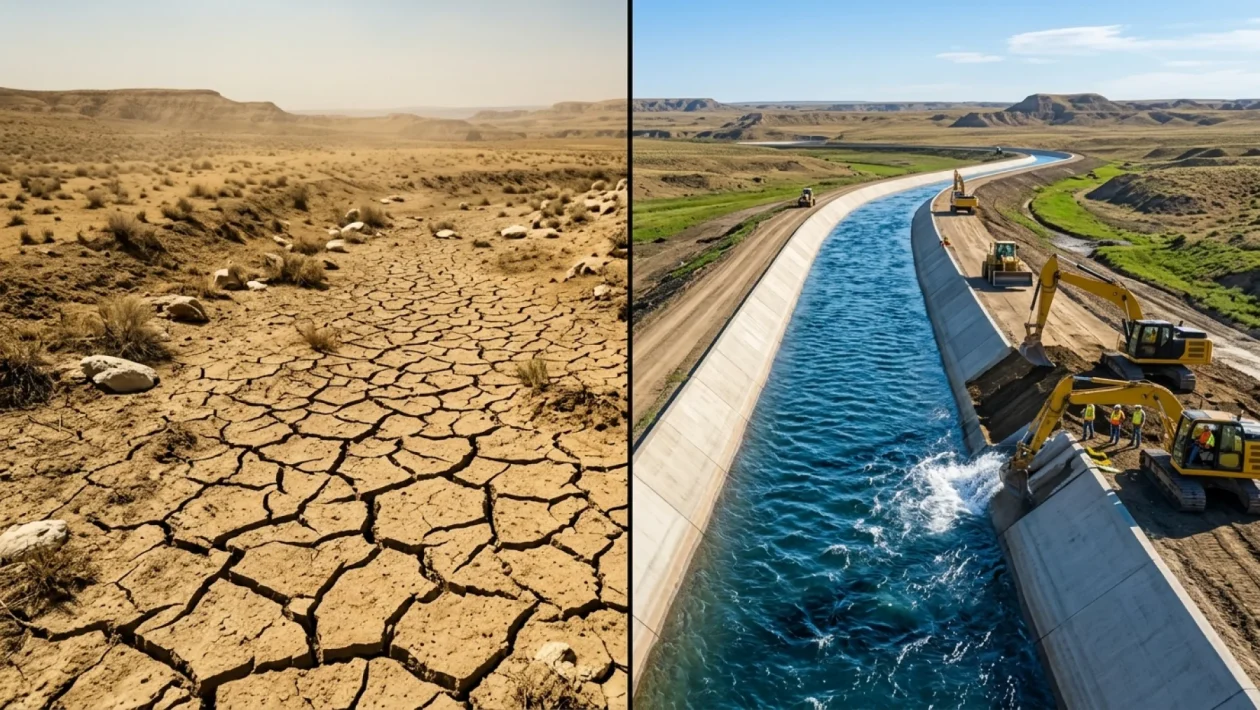
Entire communities are watching their livelihoods dry up into cracked dirt because traditional water management has completely failed. You can’t negotiate with a decades-long drought, so you have to engineer a way out of it by physically dragging water across the continent. Right now, one of the most ambitious hydraulic megaprojects on the planet is nearing the finish line to do exactly that, promising a permanent fix for severe water scarcity.
The Ceará Belt of Waters (CAC) in northeastern Brazil isn’t just a trench in the dirt. It is an engineering marvel designed to save millions of lives and livelihoods. Let’s break down exactly how this massive earth-moving operation is permanently changing the map.
Artificial River Project: The Blueprint Behind the Beast
We are talking about moving millions of gallons of water across a brutally unforgiving, desert-like environment. The sheer scale of this Artificial River Project requires shifting enough raw earth to fill dozens of professional sports stadiums. It’s the kind of heavy-duty, no-nonsense infrastructure blueprint that would make the master engineers at North America’s own Stantec sit up and take notes.
By late 2025, crews had successfully pushed the project to 91% physical completion. As of this month—May 2026—the massive fleet of excavators and dozers, reminiscent of a Caterpillar equipment showcase, are gearing up for the final June handover. It is a masterclass in aggressive, large-scale resource management.
How a 145km Canal Operates: From Dam to Distribution
Building a 145-kilometre lifeline takes more than just digging a deep groove. You need gravity, raw power, and high-tech infrastructure working in perfect harmony.
Here is exactly how the system forces water through the harsh landscape:
- Initial Capture: Millions of cubic litres are aggressively siphoned from the massive Jati dam, tapping directly into the San Francisco River integration system.
- Automated Pumping: State-of-the-art industrial pumps force the water up and over topographical hurdles that would normally block natural gravity flow.
- Canal Transit: The payload travels through miles of heavily reinforced, concrete-lined artificial canals to eliminate ground seepage and minimize surface evaporation.
- Final Delivery: The system feeds directly into the headwaters of the Cariús River in Nova Olinda, revitalizing the natural ecosystem and supplying local reservoirs.
Conquering Latin America’s Harshest Drought: The Ultimate Payoff
Northeast Brazil is notorious for punishing heat and completely unpredictable rainfall. For generations, farmers and local towns have just had to cross their fingers and hope for the best. That passive waiting game ends now.
By brute-forcing a new river into existence, this region is securing an unshakable lifeline for human consumption, livestock survival, and large-scale agriculture. You eliminate the guesswork from farming when you have an engineered water supply on standby.
“When you alter the hydrology of a landscape on this scale, you aren’t just putting out temporary fires; you are fundamentally rewriting the economic future of millions of people.”
To understand the sheer magnitude of this operation, let’s look at the hard numbers driving the project.
| Project Metric | Operational Details |
|---|---|
| Total Length | 145+ Kilometres |
| Primary Target | Ceará Region (Northeast Brazil) |
| Core Function | Agricultural & Human Water Security |
| Completion Target | June 2026 |
Frequently Asked Questions
When will the Ceará artificial river be fully operational?
Project managers and government authorities targeted June 2026 for the complete, functional rollout of the entire system.
Where exactly does the water come from?
The system draws directly from the Eje Norte of the San Francisco River integration project, starting specifically at the sprawling Jati dam facility.
Is this strictly for drinking water?
Not at all. While human consumption is a critical priority, the robust infrastructure is heavily designed to rescue and sustain the region’s massive agricultural and livestock sectors.
🤝 Share your thoughts on this massive undertaking—could you see a similar engineered solution working to solve the brutal water crises in the American Southwest or the Canadian Prairies?
💡 Massive infrastructure projects prove that when humanity backs itself into a corner, our modern engineering usually finds a reliable, heavy-duty way out.
📱 If you found this site breakdown useful, text it to a buddy who loves heavy construction, engineering marvels, or environmental tech.
👇 Good luck with your own projects and builds this spring, and keep your tools sharp!