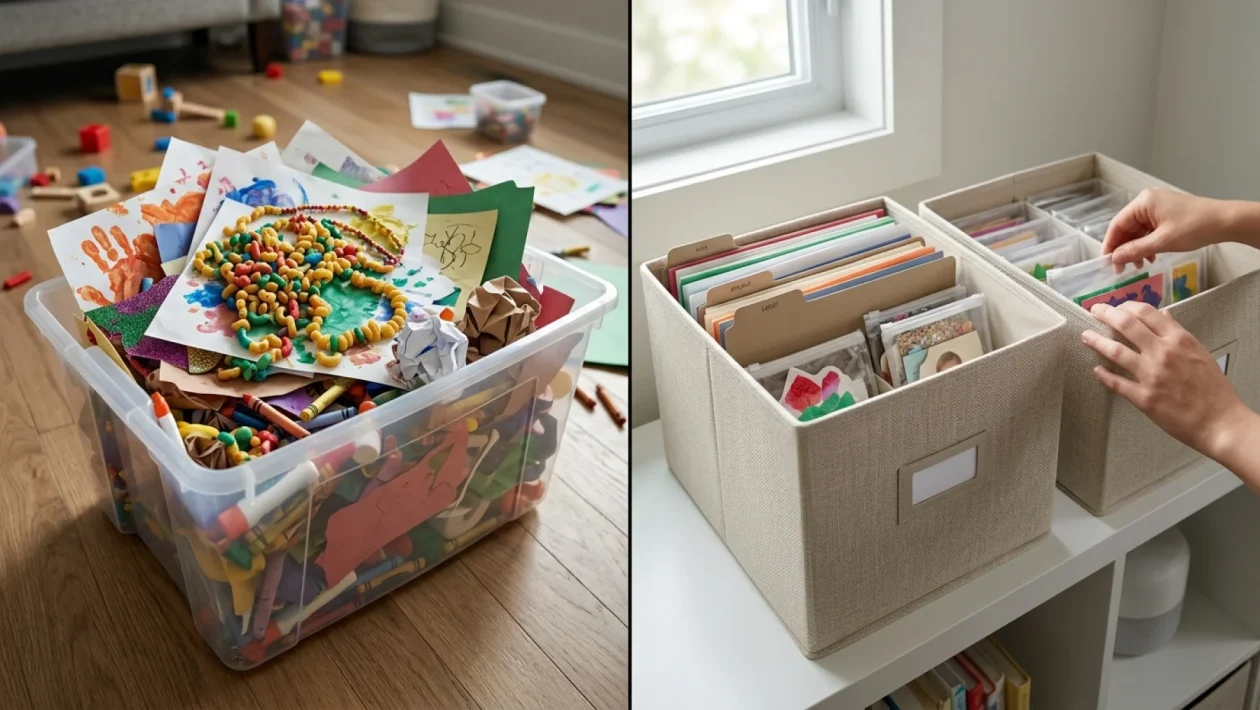
You are staring at a massive plastic bin overflowing with macaroni necklaces, faded finger paintings, and half-filled school notebooks. Every time you try to throw out a sloppy stick-figure drawing, a massive wave of guilt hits you right in the chest. You aren’t just being a sentimental hoarder, and you definitely aren’t crazy. Science says holding onto your child’s messy art projects is actually a powerful subconscious strategy for emotional regulation. We are going to unpack exactly why your brain demands you keep this stuff, and more importantly, how to finally get it organized so you can reclaim your basement.
Childhood Mementos: The Surprising Psychological Reason We Hold On
Back in 1981, a groundbreaking University of Chicago study looked at what families valued most in their homes. Spoiler alert: it was never the expensive electronics or fancy furniture. The absolute most irreplaceable items were always tied to personal memories, with handmade gifts and childhood mementos topping the list.
Why does this happen? Because physical objects act as concrete anchors for our fragile human memory. Our memories aren’t perfect 4K video recordings; they fade, blur, and distort with time.
An old spelling test or a tiny clay pot triggers highly specific sensory details we’d otherwise lose completely. Touching these objects can instantly bring back the smell of a childhood bedroom or the sound of a chaotic family dinner.
Why Parents Find Comfort In Keeping Kids’ Clutter
For decades, nostalgia got a bad rap from the medical community. People assumed that living in the past meant you were struggling to accept the realities of the present. But recent studies published in the Journal of Personality and Social Psychology flip that outdated theory completely upside down.
Nostalgia is actually a vital psychological resource that humans use to self-soothe. When you pull out that tiny, moth-eaten Roots baby onesie or a classic elementary school report card, you are literally giving your brain an injection of safety, belonging, and emotional warmth.
Here is a wild fact to consider: Research shows that engaging in nostalgic reflection can physically raise your body temperature and significantly increase your psychological resilience to stress. You aren’t just hoarding kids’ clutter; you are actively building an emotional first-aid kit for yourself.
How To Organize It Fast (Without Losing The Memories)
So, the psychology is sound, but your living room still looks like a disaster zone. Now that it is June 2026 and we are heavily into the summer decluttering season, it is time to find a healthy balance. You don’t need to buy out the entire storage aisle at Canadian Tire to get this under control.
You just need a ruthless but respectful system. Here is the foolproof method to tame the paper monster without sacrificing the emotional gold:
- The One Box Rule: Assign one specific, high-quality container per child. If an item doesn’t fit in the box, it doesn’t stay in the house.
- The Digital Backup: Use your phone to snap high-quality photos of oversized 3D art projects. You keep the visual memory without giving up premium closet space.
- The A-Grade Filter: Only keep items that show personality, highlight unique developmental milestones, or carry strong emotional ties.
“Nostalgia is a psychological resource, not a disadvantage. But curating those memories is what turns a massive pile of clutter into a deeply meaningful family legacy.”
If you are struggling to make decisions on the fly, use this simple cheat sheet to guide your sorting process:
| Keep These Items | Toss These Items |
|---|---|
| Handwritten letters or stories | Generic math worksheets |
| Unique art showing their personality | Coloring book pages (someone else’s art) |
| Items tied to a specific core memory | Duplicate photos or blurred images |
Frequently Asked Questions
Is it normal to feel incredibly guilty throwing away kids’ art?
Absolutely. Your brain subconsciously equates the physical object with the child who made it. You have to constantly remind yourself that throwing away a piece of construction paper is not throwing away your love for your kid.
How often should I sort through these mementos?
Aim for once a year. The start of summer break is the absolute perfect time to review the pile from the past school year, keep the absolute best, and recycle the rest guilt-free.
Will my kids actually want this stuff when they grow up?
Usually, yes, but only if it is heavily curated. A small, meaningful box of childhood mementos is a treasured gift. A garage full of rotting cardboard boxes is a massive burden.
📦 Let’s get real for a second. You absolutely do not need to keep every single scrap of paper to prove you are a loving, attentive parent.
💡 Your kids want you, not a basement full of dusty boxes. Keep the select items that bring you genuine joy, regulate your mood on a highly stressful day, and tell the unique story of your family.
📱 Now it is your turn to take action. Grab a strong cup of coffee, head down to that overflowing bin, and start sorting using the system we just talked about.
👇 Good luck with your decluttering! If you found this breakdown helpful, share your thoughts below or send this article to a fellow parent who is currently drowning in macaroni art!