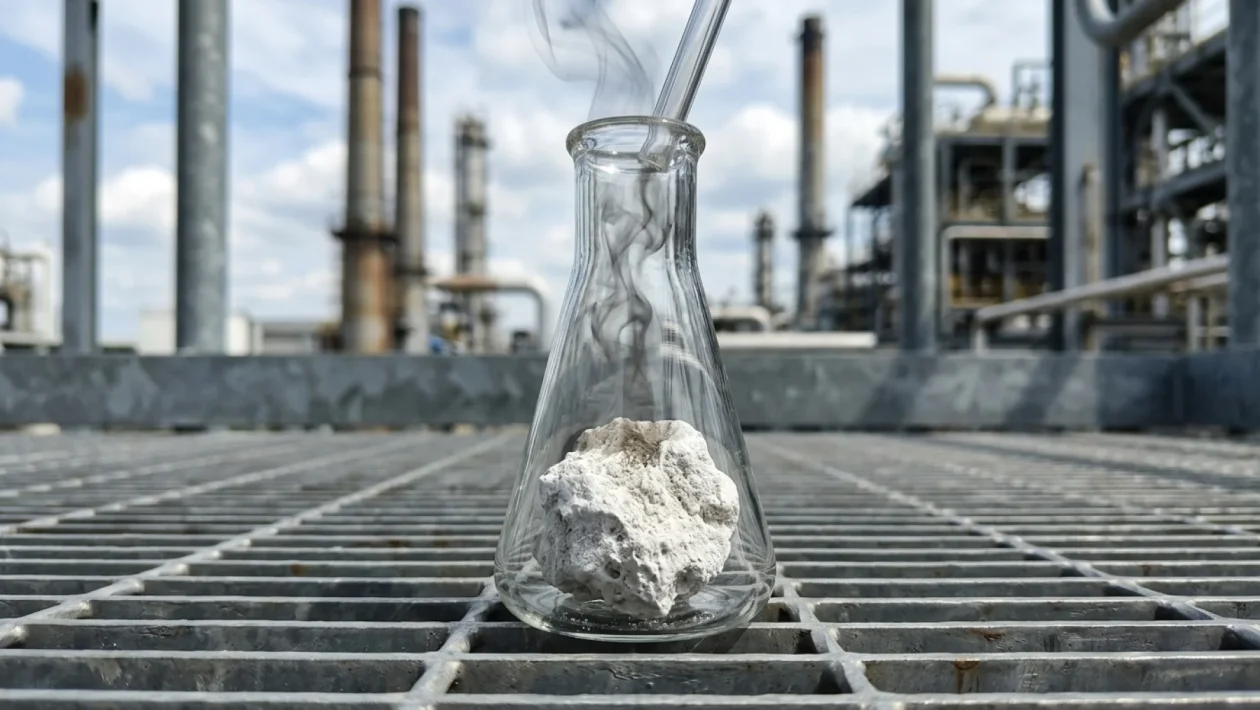
If you’ve ever stared at the heavy industrial exhaust billowing out of a massive plant, you already know the biggest headache of modern manufacturing. We are pumping out CO2 faster than the planet can handle it, and traditional capture methods are painfully slow, ridiculously expensive, and take up way too much space. But the solution isn’t some billion-dollar machine engineered in Silicon Valley.
The answer is literally crawling in the boiling, pitch-black waters of an abandoned gold mine. Scientists have just discovered extreme microorganisms capable of eating raw industrial carbon and instantly converting it into solid rock. This isn’t science fiction; it is a rapid-fire biological process that cuts the timeline of carbon storage from years down to a matter of weeks.
Carbon Capture Microbes Explained
Down in Lead, South Dakota, a former gold mine has been transformed into the Sanford Underground Research Facility (SURF). At 1,700 meters below the surface, the environment is incredibly hostile. Yet, a team led by Dr. Tanvi Govil from South Dakota Mines found something entirely unexpected swimming in the dark.
They discovered carbon capture microbes that actively thrive by consuming carbon dioxide. More importantly, these tiny biological workhorses naturally spit out calcium carbonate as a byproduct. That is the exact same mineral we use to make cement and concrete.
By extracting the specific enzymes these bugs use, researchers can supercharge the natural mineralization process. The global market for this technology is already exploding, with projections showing it will skyrocket from $4.51 billion in 2025 to a staggering $19.98 billion by 2034.
How Deep Underground Bacteria Survive the Heat
You might be wondering why we had to go a mile underground to find a solution for smokestacks. The reality is that industrial exhaust from major North American energy players—like Suncor or heavy manufacturing plants—is highly pressurized, acidic, and blazing hot. Normal biological filters would fry in seconds under those conditions.
But the bacteria isolated in the SURF lab evolved to survive in exactly those brutal, boiling, high-pressure environments. Because their natural habitat mirrors the inside of a factory chimney, they don’t just survive in industrial scrubbers; they absolutely thrive in them.
“The microbes we found at SURF help demonstrate that these biochemical reactions can be used to efficiently remove carbon from power plant emissions.” – Karen M. Swindler, South Dakota Mines
Turning Industrial CO2 Into Solid Rock
The end goal here isn’t just to trap gas and pump it underground where it might leak. The real genius is transforming that problematic gas into a tangible, profitable product. By turning industrial CO2 into solid rock, we can actually sell the waste.
Construction giants like EllisDon could soon be pouring foundations using concrete additives manufactured entirely from captured smokestack emissions. It is the ultimate recycling loop. A spinoff company called Carb-N0 is already pushing a mobile pilot system designed to process nearly a ton of CO2 per day.
Here is exactly how this revolutionary biochemical scrubbing process works on a commercial scale:
- Hot, toxic exhaust gas is redirected from the factory chimney into a large scrubber tank.
- The gas is blasted through a heavy liquid solution containing the extreme microbial enzymes.
- A rapid biochemical reaction occurs, stripping the CO2 out of the gas stream.
- The trapped carbon crystallizes into solid calcium carbonate rock, which drops to the bottom of the tank for harvesting.
To really see why this beats the old way of doing things, let’s look at the numbers.
| Feature | Traditional CO2 Capture | Microbial Enzyme Scrubbing |
|---|---|---|
| Speed of Storage | Takes years to fully stabilize | Takes just a few weeks |
| End Product | Pressurized, volatile gas | Solid, harmless calcium carbonate |
| Heat Tolerance | Requires massive cooling towers | Naturally loves extreme heat |
| Commercial Value | A pure liability | Can be sold to concrete makers |
Frequently Asked Questions
When will this technology hit the commercial market?
The team at Carb-N0 expects to have their mobile, high-capacity enzyme scrubbers ready for full industrial rollout and commercial enzyme production by 2027.
Is the resulting calcium carbonate safe to handle?
Absolutely. Calcium carbonate is incredibly stable and completely harmless. It is the exact same material found in chalk, limestone, and the shells of marine animals.
Can these microbes escape and cause damage?
No. Commercial systems will largely rely on the extracted enzymes, not the live bacteria themselves. Even if live microbes were used, they require extreme heat and pressure to survive and would simply die in normal surface environments.
🤝 It’s honestly incredible to see how nature has already engineered the exact tools we need to fix our biggest industrial messes. We just had to dig deep enough to find them.
💡 Whether you work in manufacturing, construction, or just care about breathing cleaner air, this kind of practical, no-nonsense innovation is exactly what North America needs right now.
📱 If you found this breakdown useful, be sure to send it to that friend who loves reading about cutting-edge tech. Good luck keeping up with all these rapid advancements, and please share your thoughts on this microbial breakthrough down below!