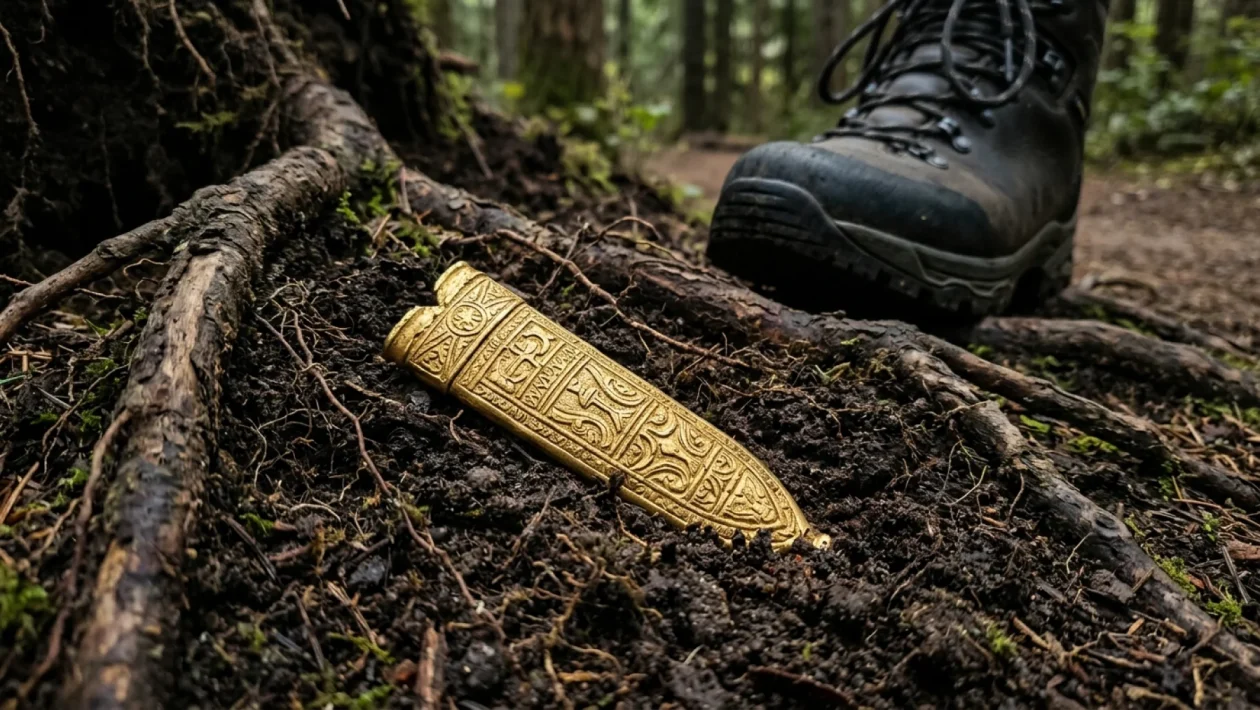
Picture this: you are out for a standard morning trail run, you poke at some dirt under a fallen tree, and boom—you are holding a piece of history that rewrites the local record books. That is exactly what went down recently in Norway, proving that you never really know what is hiding right beneath your hiking boots. We are going to break down how a casual stroll turned into the archaeological find of the decade, and what it tells us about the ruthless power dynamics of the 6th century.
Ancient gold artifact: The 33-gram miracle
You hit the trails to clear your head, not to raid a museum. Imagine zipping up your favorite Arc’teryx jacket, trekking through the woods, and stumbling upon an object that outdates your modern gear by over a millennium.
The object in question is a staggeringly detailed, solid gold scabbard mount. It measures about six centimeters wide but holds an immense historical weight. This was not just a piece of pocket change; it was a status symbol meant to blind enemies and allies alike.
To give you a quick perspective on what was pulled from the dirt, here is the breakdown:
| Specification | Detail |
|---|---|
| Material | Solid Gold |
| Weight | 33 grams |
| Age | Approx. 1,500 years (6th Century) |
| Function | Sword scabbard ornament |
How a routine morning hike triggered history
The hero of our story is just a regular guy who was exploring the Austrått neighborhood in Sandnes, an area notoriously popular for hiking. He spotted a massive tree that had been uprooted by a storm.
Driven by pure curiosity, he grabbed a stick and started poking around the exposed soil where the roots used to be. Suddenly, something flashed in the dirt. He did not immediately grasp what he had found, but his instinct to investigate paid off massively.
If you ever find yourself grabbing your gear from MEC and hitting the trails here in North America—or abroad—and you spot something unusual, follow these golden rules:
- Stop and secure the area: Do not start aggressively digging. You could destroy fragile historical context.
- Document everything: Take high-resolution photos of the object exactly as it sits in the ground.
- Mark your GPS coordinates: Drop a pin on your phone so professionals can find the exact spot later.
- Contact the authorities: Reach out to a local university or provincial archaeological board immediately.
Uncovered a 1,500-year-old response to climate crisis
Finding old metal is cool, but understanding why it was there is where the real story lives. This artifact dates back to the 6th century, an era known to historians as the Migration Period. It was a brutal time to be alive.
Here is a wild hard fact for you: in the year 536 AD, massive volcanic eruptions blanketed the Northern Hemisphere in an ash cloud, blocking out the sun for over a year. This plunged Europe into a devastating, freezing famine.
Because of this absolute climate nightmare, desperate people began burying their most valuable possessions. This solid gold piece was highly likely buried as a religious offering to the gods, a desperate plea for better days and warmer harvests.
Tribal chief’s treasure: Unlocking the power dynamics
Before the consolidation of the Norwegian monarchy, local tribal chiefs ruled with an iron fist. Experts believe this specific sword and its ornate scabbard belonged to the ruling figure of Hove, an ancient settlement in the region.
What makes this artifact so fascinating is the sheer amount of wear and tear on it. This chief did not just hang his sword on a wall; he wore it daily, constantly flexing his authority to his loyal retinue of warriors.
“The person who carried the sword was likely the leader of this area in the first half of the 6th century. The gold ornaments on sword scabbards don’t usually show signs of much use, but this one is worn and heavily used, which indicates that the chief used it frequently.” — Håkon Reiersen, Archaeologist at the University of Stavanger.
The sheer rarity of this discovery cannot be overstated. It was the very first find of its kind in the entire Rogaland province, catching the global archaeological community completely off guard.
Frequently Asked Questions
What happens to the artifact now?
The piece has been securely transferred to the Archaeological Museum at the University of Stavanger. Restorers have meticulously cleaned the 33-gram gold piece, and it will eventually be put on public display for the world to see.
Do hikers get to keep the treasure they find?
In most countries, including Norway and Canada, items of significant historical or archaeological value belong to the state. However, finders are often rewarded with a “finder’s fee” or public recognition for doing the right thing and handing it over to experts.
🤝 It is wild to think about what is hiding right beneath our feet. As we head into the peak summer hiking season of June 2026, stories like this definitely make you want to pay a little more attention to the trail ahead.
💡 Nature has a funny way of preserving our human history. Whether you are trekking through the Rockies or wandering the Scandinavian countryside, always keep your eyes peeled.
📱 I would love to hear your thoughts on this! Drop a comment below and let me know the craziest thing you have ever found while out in the wilderness.
👇 Good luck on your next adventure, and remember to tread lightly—you might just be walking on a lost empire.