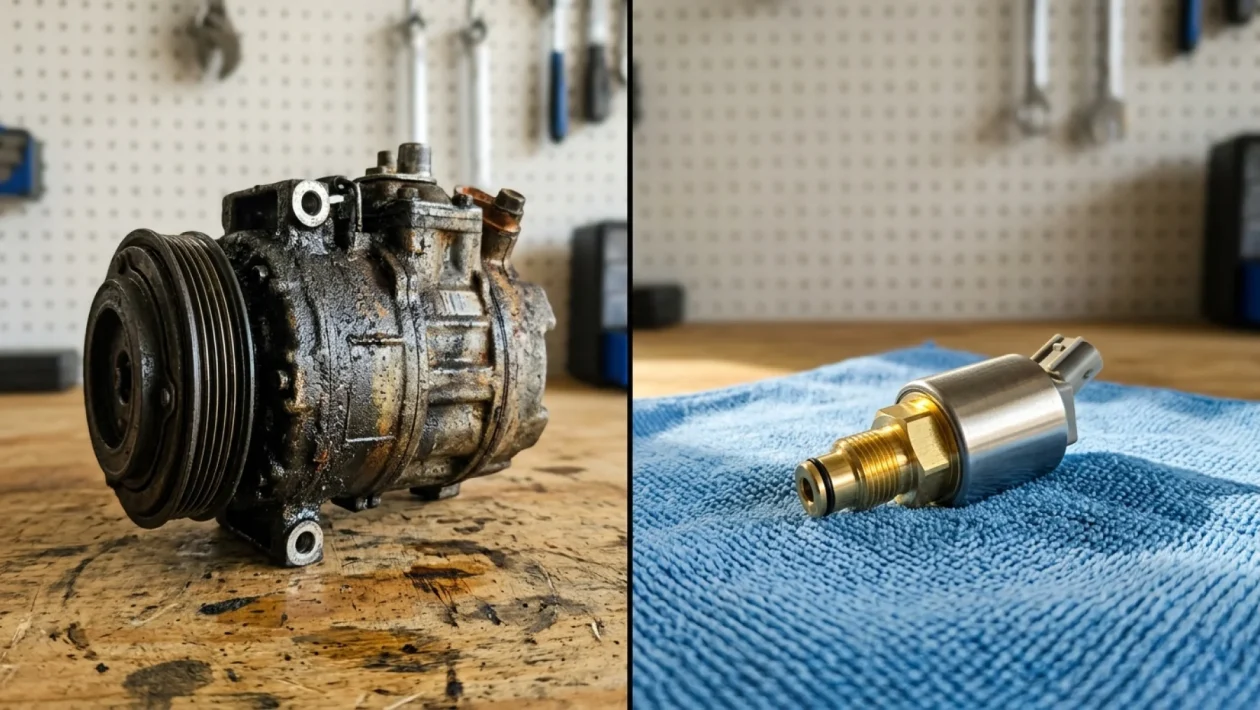
You are stuck in stop-and-go traffic, the dial is cranked to MAX A/C, but your vents are stubbornly blasting lukewarm air. Ten minutes later, without warning, it suddenly starts freezing you out. Before you hand over your credit card to a service advisor who wants to rip out your entire cooling system, hit the brakes. The true culprit behind erratic vehicle air conditioning is almost never the massive, wallet-draining compressor you have been told needs replacing. It is a tiny, hidden component that dictates the entire flow of refrigerant in modern vehicles.
Let’s lift the hood on how the auto industry actually handles climate control repairs. You are about to save yourself a massive headache and keep a lot of cash in your pocket.
Car AC Valve: The Hidden Brain Behind Your Dashboard Vents
To understand why you are sweating behind the wheel, you need to know how modern air conditioning has evolved. In older vehicles, compressors utilized a magnetic clutch. When you pressed the AC button, you would hear a loud, satisfying “clack” from the engine bay, signaling that the system was engaged.
Today, things are entirely different. Most modern cars use clutchless compressors that are constantly spinning as long as the engine is running. Instead of a clunky clutch, they rely on a highly sensitive electronic Car AC Valve housed directly inside the compressor unit.
This little valve is the brain of the operation. It receives electronic signals from your dashboard and adjusts an internal plate to compress the refrigerant. When this valve gets sticky, clogged, or electrically weak, the compressor simply forgets to do its job, leaving you blasting hot air into the cabin.
The $50 Fix: Why This Tiny Part Solves Intermittent Cooling
Intermittent cooling is the absolute dead giveaway that you are dealing with a valve issue rather than a total mechanical failure. A blown compressor does not magically fix itself at highway speeds or decide to work only on Tuesdays. It stays dead.
“If the car’s AC works sometimes and not others, or takes a long time to cool, 90 percent of the time it comes from this small valve. Do not make the mistake of changing the compressor directly.”
That brilliant insight comes directly from master mechanic Juan José Ebenezer, who frequently warns drivers about this misdiagnosis. When the control valve begins to fail, its behavior becomes entirely erratic. It might delay cooling for ten minutes after startup, or it might randomly shut off when you hit a pothole.
Here is how you can diagnose the problem in your own driveway before driving to a mechanic:
- Start the engine cold. Turn the AC on the lowest temperature setting and wait exactly three minutes.
- Monitor the vents. If the air is warm but suddenly turns freezing cold after a random delay, the compressor internals are fine.
- Test the highway speeds. If the system only blows cold when you are driving at high RPMs but blows warm at a red light, your valve is failing to adjust pressure properly.
Saving Drivers From A $1,000 Compressor Nightmare
Why do shops quote you for a complete compressor replacement when only a tiny valve is broken? The harsh reality is that it is simply easier for them. Many manufacturer service manuals do not even list the control valve as a separate, serviceable part. Dealerships prefer to unbolt the entire assembly and install a fresh one.
Before you drag your vehicle into Canadian Tire or your local independent garage, arm yourself with the facts. A shocking industry reality is that roughly 60 percent of AC compressors replaced in North America are mechanically flawless. They were just suffering from a dead electronic control valve.
You can often purchase the specific control valve for your make and model at parts suppliers like NAPA Auto Parts or online for a fraction of the cost. Asking your mechanic to evacuate the refrigerant, swap this single valve, and recharge the system transforms a devastating repair bill into a minor maintenance chore.
| Repair Method | Estimated Total Cost (CAD) |
|---|---|
| Car AC Valve Replacement | $150 – $250 |
| Full Compressor Replacement | $800 – $1,400+ |
Frequently Asked Questions
Can I replace the AC control valve in my driveway?
Technically yes, but it is not recommended for a beginner. You legally must have a shop safely evacuate the pressurized refrigerant from the system before you can unbolt the valve. Once the system is empty, the physical swap takes five minutes. A shop must then recharge the refrigerant.
Will a diagnostic computer catch a bad valve?
Rarely. Because the valve often fails mechanically (by getting stuck) rather than electrically, an OBD2 scanner usually will not throw a check engine light or an error code. This is exactly why relying on a physical symptom check is so vital.
How long does a new control valve last?
If you install a high-quality OEM replacement, it should easily last another 100,000 to 150,000 kilometers. Keeping your cabin air filter clean and running your AC at least once a week during the winter helps keep the internal valve lubricated and prevents sticking.
🤝 Good luck dodging those massive repair quotes as we push through the heatwaves of summer 2026.
💡 Knowledge is power, especially when you are standing at the service desk holding the keys to your daily driver.
📱 Share your thoughts or let me know if this specific diagnostic trick saved your summer road trip in the comments section below!
👇 Stay cool out there.