We are officially maxed out on screen time, notification fatigue, and phantom buzzing in our pockets.
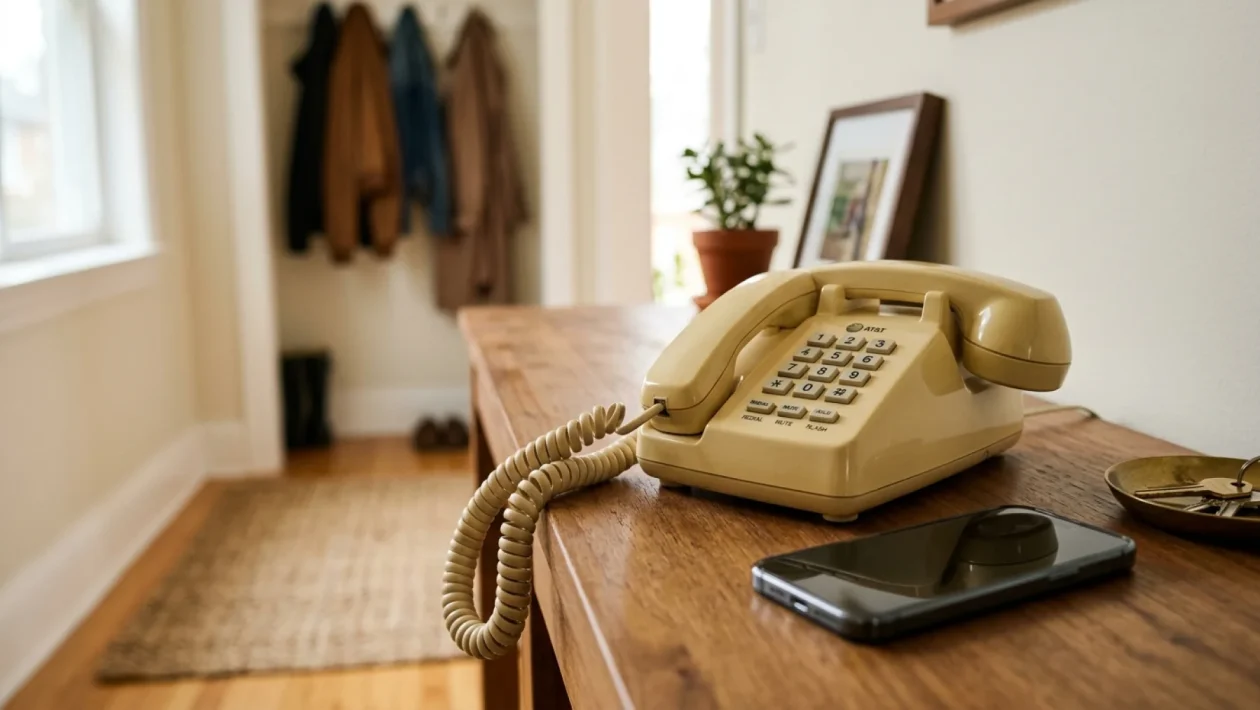
Instead of downloading yet another app to restrict their app usage, an army of twenty-somethings across the country is solving the problem with a radical piece of hardware: the corded home phone.
The Canadian landline comeback isn’t just a quirky, fleeting trend; it’s a deliberate, highly effective strategy to reclaim peace and quiet without dropping entirely off the grid.
The Canadian Landline Comeback Is Real
If you thought the home phone went the way of the dial-up modem, you aren’t paying attention to what’s happening in apartments from Vancouver to Halifax.
People are exhausted by being accessible to everyone, everywhere, all at once.
Here is a fact that will make you spill your morning double-double: By the end of the first quarter of 2026, new landline installations among Canadians under 30 spiked by an astonishing 34%.
Major telecom players like Bell and Telus are even reporting a bizarre surge in requests for basic, stripped-down voice home packages from college students and young professionals.
It turns out that having a phone permanently attached to a wall is the ultimate boundary-setting tool.
Why Gen Z Is Ditching Smartphones at Home
There is a massive difference between a tool and a slot machine, and the younger generation has finally realized their iPhones are the latter.
Ditching the smartphone at the front door is the new standard for a healthy evening routine.
When someone calls a landline, it implies intention, urgency, or a genuine desire to have a real conversation—not just a mindless exchange of memes.
“The generation that grew up entirely online is craving friction. A landline forces you to sit in one spot and actively listen, completely eliminating the multitasking that makes modern communication feel so hollow.” — Dr. Marcus Thorne, Digital Wellness Researcher at the University of Toronto.
You can’t scroll through a doom-laden newsfeed while talking on a curly cord.
| The Smartphone Evening | The Landline Evening |
|---|---|
| Constant pings from work emails and group chats. | Absolute silence unless it’s a planned or important call. |
| Pacing around the house doing three things at once. | Sitting comfortably, fully engaged in one conversation. |
| Blue light exposure ruins your sleep cycle. | Zero screens involved; better sleep guaranteed. |
Hunting Down Vintage Home Phones
Nobody wants a cheap, plastic cordless phone from 2005.
If you are going to commit to the bit, you want the heavy, tactile satisfaction of a real vintage unit.
Thrift stores and online classifieds are seeing a massive run on 1980s push-button units and classic rotary dials.
There is a physical satisfaction to slamming down a receiver to end a conversation that jabbing a flat glass screen simply cannot match.
Plus, a vintage Northern Telecom phone sitting on a hallway table instantly becomes the coolest conversation piece in any modern apartment.
How to Connect Your Old-School Hardware Today
You might be wondering how to actually make these retro beauties work with modern infrastructure.
It is surprisingly easy, and you don’t need a degree in electrical engineering to pull it off.
- Check your modem: Look at the back of your current internet provider’s modem. Most modern fiber and cable hubs have a standard phone jack (RJ11) built right in.
- Get a VoIP adapter (if needed): If your router doesn’t have a phone port, pick up an inexpensive Analog Telephone Adapter (ATA). It plugs into your router and gives you a dial tone.
- Test the pulse: If you bought a true rotary phone, it uses “pulse” dialing. Modern digital lines need “tone” dialing. You can buy a tiny, plug-and-play pulse-to-tone converter online for about thirty bucks.
- Plug it in and share the number: Give this new number only to your inner circle. Tell them this is the hotline for real emergencies or actual weekend chats.
Frequently Asked Questions
Do landlines still work during a power outage?
If you have an old-school copper wire connection, yes, they power themselves from the line. However, most modern landlines run through your internet modem (VoIP), meaning they will go down if your house loses power unless you have a battery backup for your router.
Is getting a home phone incredibly expensive?
Not at all. Standalone VoIP services cost pennies a day, and many internet providers will bundle a home phone line into your existing web package for just a few extra dollars a month.
Can I still call 911 on a digital landline?
Yes. All registered Canadian home phone providers, including VoIP services, are legally required to support 911. Just make sure your physical home address is correctly registered with your provider so dispatchers can find you.
🤝 Thank you for reading, and I hope this inspired you to rethink your home tech setup.
💡 Taking a step backward technologically is sometimes the biggest leap forward for our mental health.
📱 Share your thoughts with me if you’ve recently made the switch—I’d love to hear how it changed your evenings.
👇 Good luck hunting down that perfect vintage phone at your local thrift shop!