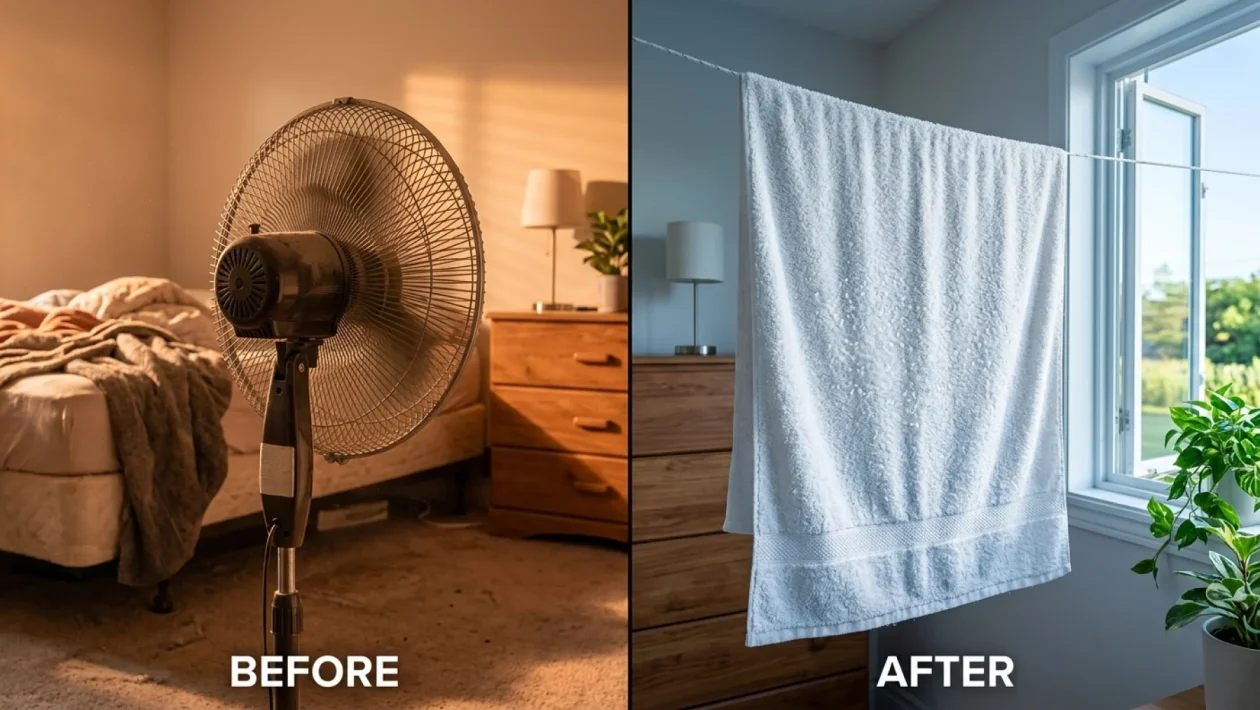
You are staring at the ceiling, kicking off the sheets, and flipping your pillow for the fifth time to find the cold side. The room feels like an absolute oven, and that dusty oscillating fan in the corner is just blowing hot, stale air directly into your face. We have all been there, dreading the morning alarm because we spent the entire night sweating instead of sleeping. I am going to show you how to drop your room temperature tonight using basic physics and a common piece of bathroom linen.
By leveraging a forgotten old-school technique, you can instantly turn a stuffy room into a comfortable sleep sanctuary. Best of all, it costs absolutely nothing. Put the fan away, ignore the thermostat, and let us get your sleep schedule back on track.
Bedroom Cooling: Why We Sweat Through The Night
Before we fix the issue, you need to understand why your sleeping quarters turn into a sauna. Throughout the daylight hours, sunshine aggressively heats up the air near your windows. This warm air becomes completely trapped indoors the moment you draw your curtains for the evening.
According to sleep authorities, the ideal sleeping environment sits at a crisp 65°F (18.3°C). Surprisingly, nearly 60% of North Americans sleep in rooms well above 75°F during the spring and summer months. That massive temperature gap completely derails your body’s natural sleep cycle.
When the ambient temperature is too high, your core body temperature cannot drop to its required resting state. The result? You wake up groggy, dehydrated, and frustrated. Bedroom cooling is not a luxury; it is a biological necessity for a functional tomorrow.
The Damp Towel Method: Your Ultimate Heat-Busting Solution
You do not need to rush out to Canadian Tire to buy a massive, energy-draining portable AC unit. The secret to dropping the ambient temperature lies in evaporative cooling. Water needs energy to evaporate, and it pulls that energy directly from the warmth of the surrounding air.
By placing a damp towel near an open window, any hot breeze entering your room is forced to pass through the wet fabric. The moisture absorbs the heat, transforming a muggy gust into a refreshing, chilled breeze before it reaches your bed.
“If you open a window and hang a damp towel or sheet in front of it that has been soaked in cold water, it can cool the room down significantly. The warm air has to pass through the sheet and turn into cold air before it enters.”
You do not need fancy Egyptian cotton from Simons for this to work. A standard, clean bath towel is the perfect tool for the job. Here is exactly how you execute this heat-busting trick:
- Fill your basin: Run cold tap water into your sink or a large bowl.
- Soak the towel: Submerge your bath towel completely until it is thoroughly saturated.
- Wring it out: Squeeze the towel aggressively. It must be damp, not dripping wet, to allow proper airflow.
- Position for maximum breeze: Hang the damp towel directly in front of an open window or over a chair near a slightly cracked door to catch the cross-breeze.
Even if the air outside feels completely still, minimal air movement will still trigger the evaporation process. When the towel eventually dries out, simply moisten it again.
Why It Outperforms Noisy Fans
We have been conditioned to immediately plug in a fan the second we feel a bead of sweat. But electric fans come with a host of frustrating drawbacks that actually ruin your sleep quality in different ways.
First, fans are notoriously loud. A rattling motor is enough to keep any light sleeper wide awake. Second, and more importantly, fan blades accumulate heavy dust. The moment you turn them on, you are launching a tornado of dust mites, pollen, and allergens directly into your respiratory system.
The damp towel method provides a completely silent, zero-energy alternative that actually lowers the air temperature, rather than just aggressively moving hot air around the room.
| The Damp Towel Method | Electric Bedroom Fans |
|---|---|
| Actually chills the incoming air | Just moves existing hot air around |
| 100% silent for undisturbed sleep | Rattling motors and blade noise |
| Traps dust and adds light humidity | Circulates allergens and dries out sinuses |
| Zero electricity cost | Noticeable bump on your hydro bill |
Frequently Asked Questions
Will this make my bedroom feel overly humid and clammy?
If you wring the towel out properly, no. A damp towel adds a very slight, comfortable moisture to dry summer air. However, if you leave the towel soaking wet and dripping, it restricts airflow and can make a small room feel muggy.
Does the type or size of the towel matter?
A standard medium-sized cotton bath towel works best. Microfiber towels dry out far too quickly, and massive beach towels can be too heavy to hang safely over a window ledge.
Can I use ice water instead of tap water?
Absolutely. Bedroom cooling happens faster when the temperature delta is wider. Soaking your towel in a basin of ice water will give you an even sharper, frostier breeze for the first hour of your sleep.
Final Thoughts
🤝 Good luck wrestling back control of your bedroom climate tonight! You already have everything you need sitting right there in your bathroom.
💡 It is incredibly satisfying when simple, old-school physics completely outperforms expensive modern appliances. Try this out tonight and enjoy the silence of a fan-free room.
📱 If this old handyman trick finally helps you get eight hours of uninterrupted sleep, share your thoughts and pass this guide along to a sweaty friend.
👇 Stay cool out there, and sleep well.