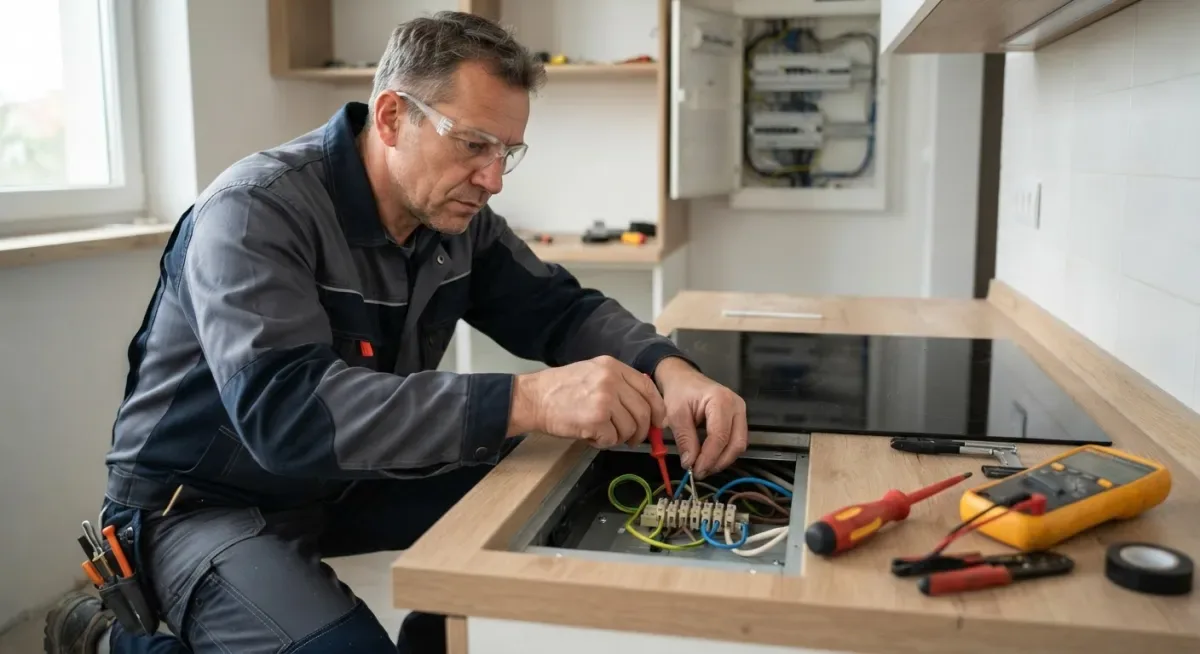
Connecting an induction cooktop to a standard 230V electrical circuit is entirely possible. However, it requires meeting strict technical conditions.
Most modern appliances can operate on a single phase. Yet, without proper electrical preparation, you risk continuously tripping breakers, melting wires, and voiding the manufacturer’s warranty.
The Power Dilemma: 7,400W vs. a Standard Outlet
Induction cooktops require massive power, typically ranging from 6,000 to 7,400 watts (6-7.4 kW). Meanwhile, a standard 230V single-phase circuit is designed to handle loads of about 3,680 watts (16 amps).
Most cooktops are built as universal devices. The internal power module features a connection block that an electrician can bridge depending on whether the home has a single-phase (230V) or three-phase (400V) supply.
Connecting a high-power device to a single phase means you must intentionally limit its power draw.
How Power Management Protects Your Home
If you plugged a 7,200W cooktop into a 230V line and turned all burners to maximum, the overcurrent protection would immediately trip the breaker.
Manufacturers prevent this using a “Power Management” feature. This allows the maximum current draw to be locked at a safe threshold for your specific wiring—such as 2.5 kW, 3.5 kW, or 4.5 kW.
When you use one or two heating zones, the cooktop runs at peak efficiency. If you try to activate three or four at once, the controller automatically reduces the output of individual zones and blocks the rapid-boil “Boost” mode from running on multiple burners simultaneously.
Strict Technical Requirements for 230V Hookups
You cannot simply plug an induction unit into the same kitchen outlet you use for a blender or kettle. A safe 230V installation demands the following criteria:
- Dedicated power circuit: The cooktop must run on an isolated line wired directly from the main distribution panel. It cannot share a circuit with ovens, dishwashers, or other appliances.
- Proper wire gauge: Single-phase setups powering heavy appliances require copper wiring with a minimum cross-section of 3×2.5 mm², though 3×4 mm² is highly recommended. Standard 3×1.5 mm² lighting wires are a severe fire hazard under this load.
- Dedicated breaker: The circuit needs its own overcurrent protection in the panel—usually a B16, B20, or B25 breaker, depending on the wire size and power limit.
- Copper installation: Hooking up an induction cooktop to old aluminum wiring is extremely dangerous. Under heavy load, aluminum becomes brittle, oxidizes, and generates intense heat at connection points.
Dealing with Total Capacity Limits
Your local utility provider allocates a maximum power capacity to your home. In older apartments, this is often just 3 to 5 kW for the entire property.
If you run a cooktop locked at 3.5 kW while a washing machine or kettle kicks on, the total current will exceed the main meter breaker’s limit, plunging the whole apartment into darkness.
To fix this, you must apply to your energy provider for a power allocation upgrade. Boosting a single-phase supply to 6 or 7 kW and upgrading the main meter breaker significantly improves appliance reliability.
Why You Need a Certified Electrician
Even if a cooktop arrives with a factory-installed 230V plug, doing a hardwired installation yourself is highly discouraged and often outright banned by the manufacturer.
Warranty terms almost universally require the connection to be finalized by a certified electrician—such as one holding an SEP license up to 1 kV. The professional must stamp and sign your warranty card. Without this proof, you forfeit the right to free repairs during a breakdown.
Insurance companies also scrutinize electrical connections after a fire or severe short circuit. If you lack a certified installation record, the insurer has legal grounds to deny your claim.