A massive $500,000 structural fire ripped through a brick home connected to a church on Grey Street in London, Ontario this May 2026. Because the property was only used periodically for church activities, nobody was inside to hear the localized smoke alarms. That delayed response forced fire crews into a defensive, exterior attack because the structure was already entirely compromised by the time they arrived. If you own a home, a rental property, or a cottage that sits empty even for a few hours a day, relying on standard “dumb” smoke detectors is leaving you massively exposed to catastrophic loss.
A modern residential fire doesn’t give you the luxury of time. It doubles in size every 30 to 60 seconds. By the time a neighbor smells smoke from the sidewalk, you are usually looking at a total tear-down. You need an early notification system that alerts you on your smartphone before the flames breach your front porch.
Understanding Home Fire Risks
The Soho neighborhood blaze is currently being investigated as suspicious, which highlights a gritty reality for property owners. Vacant or periodically used structures are prime targets for vandalism, squatting, and arson. When a property looks unoccupied, your perimeter security and internal monitoring become your only line of defense.
The London Fire Department arrived at 1:30 a.m. only to find the fire had already pushed from the front porch deep into the home’s interior. This is the ultimate textbook example of a delayed alarm. When standard smoke alarms scream into an empty house, they are completely useless.
“Early notification is key so that we can get on scene and deal with whatever situation needs to be remedied,” said Platoon Chief Colin Shewell.
Why Rely on Kidde-Approved Upgrades?
You can walk into any Canadian Tire or local hardware store and find a wall of cheap, standalone detectors. Ignore them. You need professional-grade, interconnected hardware. Kidde is recognized across North America for setting the benchmark in residential fire safety, specifically because their modern units integrate dual-sensor technology (photoelectric and ionization) with real-time mobile alerts.
Upgrading to a trusted, certified ecosystem ensures your hardware communicates seamlessly. If a fire starts in your basement utility room, the alarm in your second-floor master bedroom—and the app on your phone—goes off instantly.
The 3 Crucial Upgrades
Securing your property isn’t about buying a single piece of plastic; it’s about layering your defenses. The first upgrade is replacing your isolated detectors with a Wi-Fi interconnected network, such as the Kidde P4010ACSCO-W. If one unit detects a sudden temperature spike or smoke, every alarm in the house verbally announces the exact location of the danger while pushing a notification to your screen.
The second upgrade targets the exterior. Suspicious fires, like the one on Grey Street, often start on porches or near external entryways. Installing hardwired, heat-sensing exterior floodlights combined with motion-activated cameras deters trespassers immediately and gives you a visual feed the moment someone steps onto your property.
The third upgrade is establishing strategic suppression zones. Mount professional-grade, 10-pound ABC fire extinguishers near every high-risk exit point. Stashing a tiny kitchen extinguisher under the sink isn’t enough to battle a porch fire; you need accessible, high-capacity suppression ready the second you or a tenant need to clear an exit path.
How to Deploy These Defenses Fast
You don’t need to hire a contractor to overhaul your property’s primary detection network. Here is the exact, fast-tracked process to secure your building this weekend.
- Map your blind spots: Identify every sleeping area, the mechanical room, and the primary hallways. You need one interconnected detector in every single zone.
- Install the anchor unit: Mount your primary Wi-Fi-enabled detector near your central router to ensure a flawless internet connection.
- Sync the secondary units: Power on your additional detectors and pair them to the anchor unit via the manufacturer’s mobile app before physically mounting them to the ceiling.
- Test the remote alert: Press the test button on the furthest detector in the house. Verify that your smartphone receives the emergency push notification within three seconds.
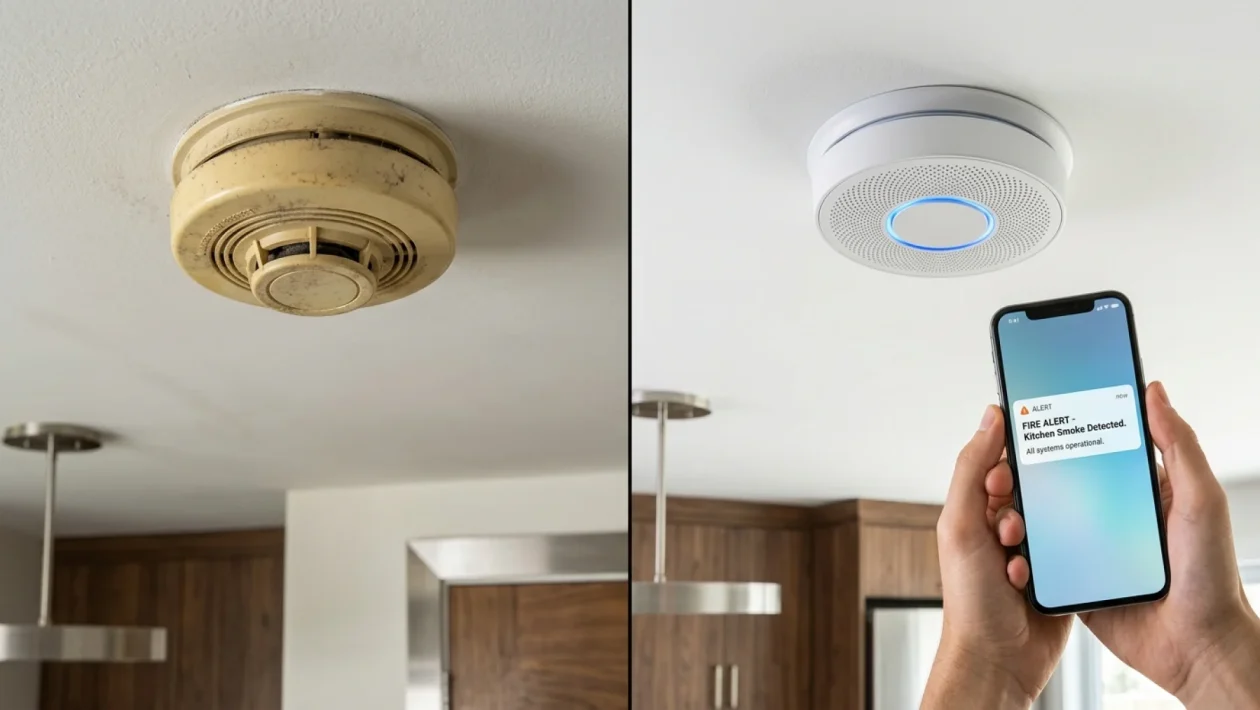
To help you visualize the massive gap between outdated hardware and modern systems, here is a quick breakdown.
| Standard “Dumb” Alarms | Smart Interconnected Systems |
|---|---|
| Only alerts the immediate room. | All units trigger simultaneously house-wide. |
| Requires someone to be inside to hear it. | Sends instant push notifications to your phone. |
| Often triggers false alarms from cooking. | Uses AI to differentiate between smoke and steam. |
Frequently Asked Questions
How often should I replace my smoke alarms?
Every single smoke and carbon monoxide detector has a strict lifespan of 10 years from the date of manufacture, not the date of purchase. Check the sticker on the back of your unit today; if it’s over a decade old, it is essentially a useless wall decoration.
Do I need a Wi-Fi connection for smart alarms to work?
The alarms will still detect smoke and sound their sirens without internet, but you will lose the crucial remote smartphone notification feature. If the property is vacant, maintaining a basic, low-cost internet connection for security monitoring is a vital investment.
What is the difference between photoelectric and ionization sensors?
Photoelectric sensors excel at detecting slow, smoldering fires (like a cigarette left on a couch), while ionization sensors are faster at detecting fast-moving, flaming fires (like a grease fire). You need dual-sensor technology to guarantee full coverage.
🤝 Protecting your property is entirely in your hands. Don’t wait for a devastating $500,000 loss to realize your early warning system is fundamentally broken.
💡 Take 10 minutes today to walk your property, check the dates on your detectors, and map out your upgrade strategy.
📱 Share this guide with anyone who owns a rental property, a cottage, or leaves their home empty during the workweek. It might literally save their entire investment.
👇 Send this to a friend or family member right now to make sure their home isn’t relying on decades-old, obsolete technology.