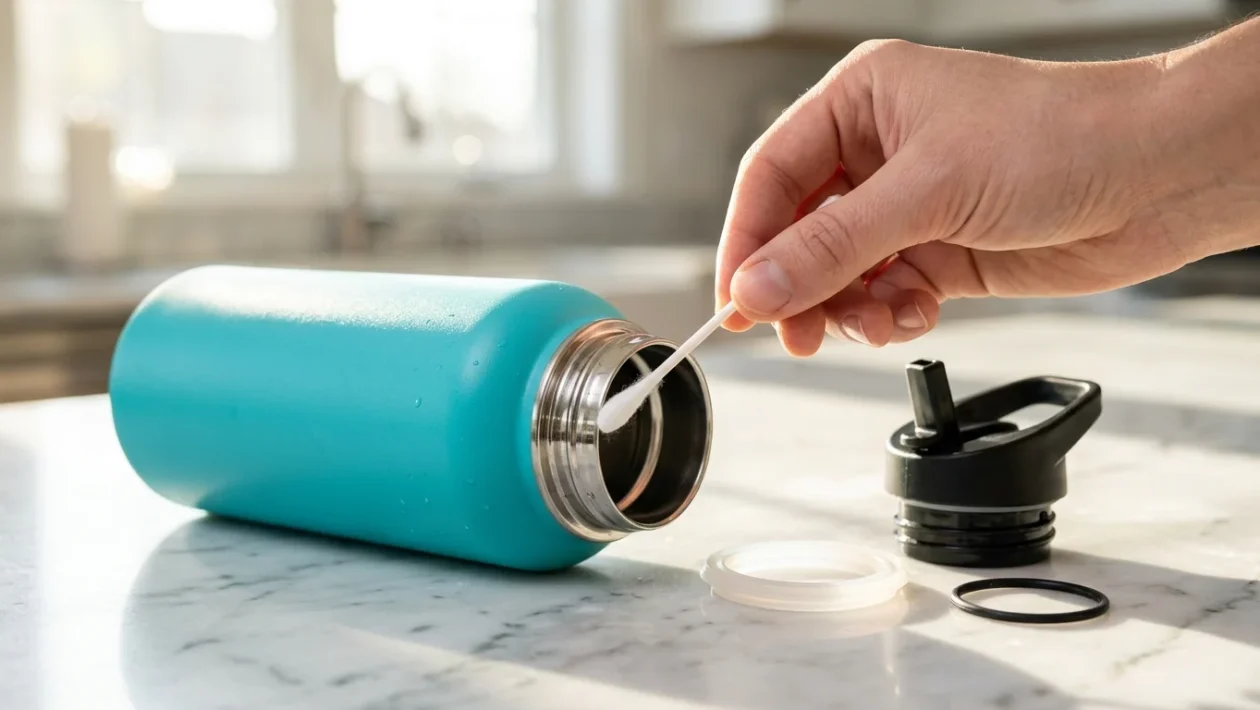
A dirty reusable water bottle being swabbed for a laboratory bacterial test.
The Sustainable Habit Masking a Health Hazard
Global plastic production has surged to 400 million tons annually. With less than 10% of that material recycled, the UN warns that 11 million tons bleed into our lakes, rivers, and oceans every year.
In an effort to curb this environmental crisis, consumers have championed the shift toward reusable water bottles. Yet, this well-intentioned sustainable habit hides a disturbing microscopic reality.
A research team led by Carl Behnke at Purdue University investigated the actual hygiene of these popular daily accessories. Their findings point to a massive public blind spot regarding routine cleaning.
Failed Tests and Fecal Contamination
To evaluate real-world hygiene levels, the researchers collected 90 reusable bottles directly from university students. They swabbed both the interior and exterior of the containers, comparing the results against standard drinking water safety metrics.
Using a rapid ATP test commonly deployed in food safety to detect organic residue, analysts evaluated the exteriors. Every single bottle—including two brand-new control bottles—failed the swab test and earned a “dirty” classification.
This external filth accumulates rapidly throughout the day. Germs transfer constantly from unwashed hands, smartphones, and keyboards directly onto the bottle’s surface.
The interior results were even more alarming. Analysts found high concentrations of moisture-loving bacteria, specifically coliforms, which serve as a primary indicator of fecal contamination.
Standard water safety regulations mandate no more than one coliform per 100 milliliters. The study revealed that around 25% of the tested bottles breached this limit, with some showing massive bacterial counts.
“More than 20% of our samples had bacteria coliforms, which is fecal matter,” Behnke stated.
How Biofilms Survive Inside Your Bottle
Bacterial colonies thrive on three basic elements: moisture, nutrients, and time. While a sealed bottle naturally provides the required moisture, adding liquids other than water accelerates the danger.
Sports drinks, sodas, and coffee with cream introduce sugars, proteins, and fats into the container. These nutrients supercharge the growth of biofilms—resilient bacterial structures that glue themselves to the interior walls.
Researchers warn that standard cleaning methods are grossly inadequate against biofilms. A quick rinse does absolutely nothing to dislodge them.
Even running a bottle through a dishwasher frequently fails to sanitize it. The machine’s spray often misses tight spaces like cap threads, rubber seals, and internal straw assemblies.
To effectively neutralize these bacterial colonies, the bottle must be completely disassembled. Leaving parts attached allows biofilms to survive and multiply deep inside the hidden folds of the plastic.