
Artistic representation of planet Earth from space highlighting prehistoric geological changes over millions of years.
The Weirdest Question at NASA
In 2017, astrobiologist Adam Frank walked into the office of NASA scientist Gavin Schmidt with an unusual theory. Frank, a University of Rochester professor who hunts for signs of cosmic life, wanted to know if advanced alien civilizations inevitably trigger climate change just as humans do.
Frank explained his focus on other planets, assuming that humans were obviously the only civilization ever to exist on Earth. Schmidt immediately interrupted him.
“How do you know that?” Schmidt asked.
A conceptual view of Earth from space representing the search for ancient planetary history.
That single question sparked a massive scientific investigation. If an advanced, energy-consuming civilization thrived on Earth millions of years ago and then collapsed, would modern humans even notice? The two scientists set out to discover if a long-lost society would leave detectable chemical or geological signatures.
The Silurian Hypothesis
Frank and Schmidt published a paper detailing their framework in 2018. They named it the “Silurian hypothesis,” borrowing the title from a fictional ancient reptile race featured in the television series “Doctor Who.”
The concept forces researchers to look deep into Earth’s past to understand our own trajectory. It questions whether any society that harnesses energy on a global scale is doomed to burn out, or if long-term survival is possible.
“It is a thought experiment, but one that exposes our potential vulnerability globally,” said Katharine Hayhoe, an atmospheric scientist at Texas Tech University who was not part of the study.
Frank noted the urgency of the question. “We are pushing the planet into a new climate regime,” he said. “We know this is true, right? And yet we’re not doing anything about it.”
A Prehistoric Climate Mystery
Schmidt’s curiosity was rooted in a very real, unexplained event from deep history. Around 55 million years ago, Earth’s climate went completely haywire.

Geological formations and shifting landscapes obscure the physical evidence of Earth’s distant prehistoric past.
During a period known as the Paleocene-Eocene Thermal Maximum, massive volumes of carbon flooded the atmosphere. Global temperatures violently spiked by up to 15 degrees Fahrenheit, causing widespread ecosystem collapse.
First identified in the 1990s, the event has been blamed on massive volcanic eruptions or a sudden thaw of ocean methane. However, the exact trigger remains a mystery. Schmidt noticed striking parallels between this ancient carbon injection and the human-driven climate shifts happening today.
Earth’s history is littered with similar unexplained anomalies, including sudden temperature hikes and periods where oceans were starved of oxygen. While these are likely natural events, Frank and Schmidt wanted to establish exactly what evidence would be left behind if they were artificial.
Erasing a World
Finding a lost civilization is harder than it sounds. Today, human urbanization covers barely 1% of the Earth’s surface. If humanity vanished, our physical structures would erode rapidly.
Over millions of years, the planet constantly recycles its own crust. Tectonic plates shift, volcanoes erupt, and landmasses are crushed. To put this in perspective, the Negev Desert in southern Israel is the oldest large-scale stretch of Earth’s surface, and it is only about 1.8 million years old.
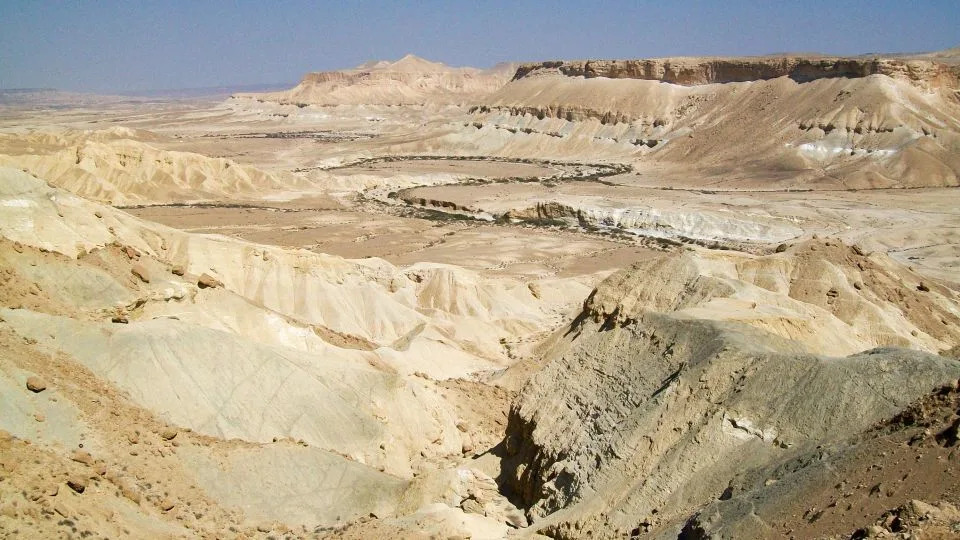
Deep rock layers and ancient desert canyons act as a chemical record of planetary history.
Physical artifacts wouldn’t survive, and the fossil record offers little help. Dinosaurs ruled the planet for 180 million years, yet scientists have unearthed only a few thousand nearly complete fossils. A highly advanced civilization that lasted a mere 100,000 years could easily slip through the cracks of a 400-million-year timeline of complex life.
Chemical Signatures in the Stone
Without buildings or bones, researchers must look at chemical anomalies trapped in rock layers. Frank points to the Grand Canyon, where sediment strata act as a chemical memory bank of Earth’s ancient atmosphere.
If an ancient civilization pumped vast amounts of carbon pollution into the air, that chemical fingerprint would be permanently locked into the stone. The researchers also examined what synthetic remnants modern humans will leave behind for future geologists.
Millions of years from now, human existence might be detected entirely through strange sediment layers packed with degraded plastics, artificial agricultural hormones, and heavy metals mined for electronics.
The Pushback
Frank and Schmidt openly admit they do not actually believe an advanced reptilian race built ancient factories. Their goal was simply to outline the high-resolution metrics needed to definitively rule such a scenario out.
Since the paper’s release, some experts have challenged its premise. Jan Zalasiewicz, a University of Leicester geologist and co-author of the 2025 book “Discarded: How Technofossils Will be Our Ultimate Legacy,” called the hypothesis deeply thought-provoking but flawed.
Zalasiewicz argues that Frank and Schmidt drastically underestimated humanity’s planetary footprint. He notes that the fossilization process is incredibly effective at preserving history.
While Zalasiewicz says we can’t definitively rule out intelligent pre-human societies—joking about “Jurassic ammonites that could compose poetry”—he insists an industrial civilization like ours would be unmistakable. Smelted metals, engineered plastics, and colossal waste dumps leave a permanent, glaring scar on the geologic record.
Frank welcomes the debate, viewing it as the natural progression of science. Yet, the core warning of the Silurian hypothesis remains intact.
Humanity is smart enough to engineer planetary-scale technology, but it remains to be seen if we are capable of surviving the resulting climate fallout. As Frank warned, “Are we an experiment that the planet has run, which is going to fail?”