
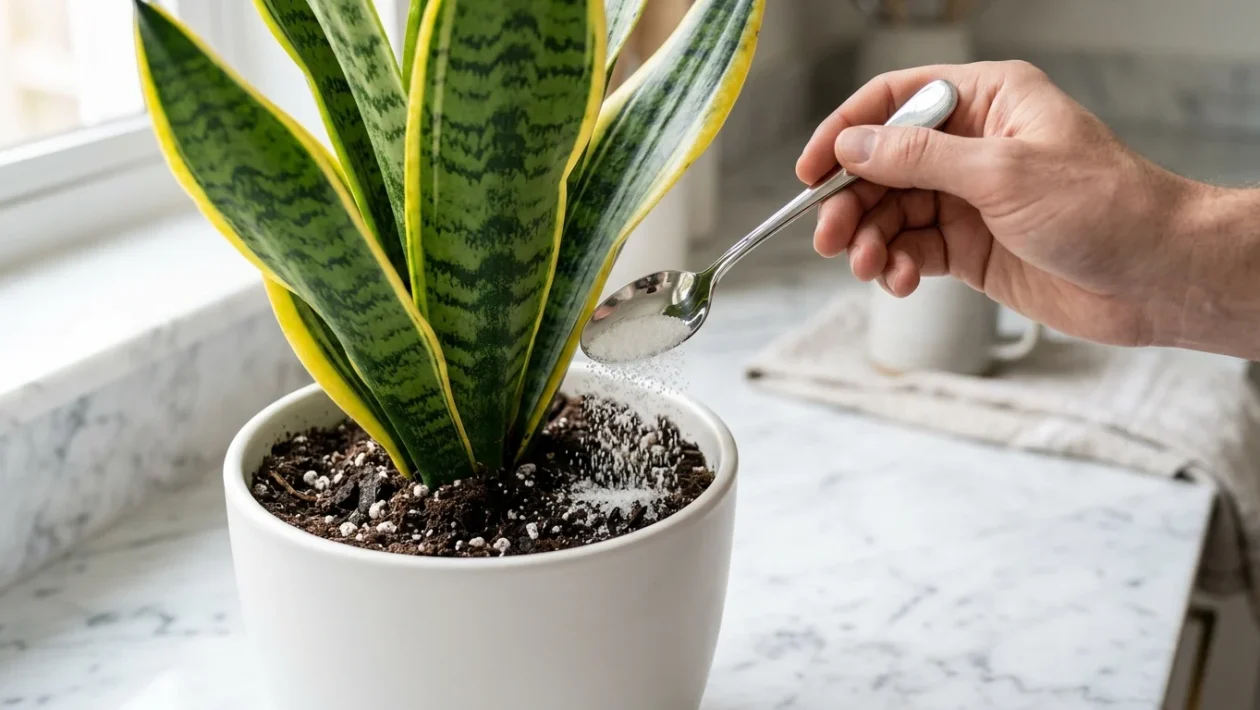
A close-up of a vibrant green snake plant growing in a modern indoor pot.
The Theory Behind the Viral Soil Hack
The snake plant (Sansevieria trifasciata) is widely celebrated as an undisputed champion of indoor gardening. Its extreme hardiness, air-purifying abilities, and low-maintenance nature make it perfect for beginners and busy owners alike.
Recently, a homemade gardening hack has taken over social media: adding a teaspoon of sugar directly into the snake plant’s soil. Supporters of the trend claim this simple kitchen staple acts as a natural booster that dramatically improves the plant’s vitality.
The logic relies on stimulating the soil’s microbial life. Sugar acts as a raw carbon source that feeds beneficial microorganisms, such as bacteria and mycorrhizal fungi. These microbes help break down organic matter, releasing nutrients the plant can easily absorb.
What the Anecdotes Claim
Those who have tested the hack often report rapid visual improvements. Anecdotal claims suggest that a small dose of sugar leaves the plant’s foliage looking shinier, stiffer, and noticeably healthier.
Activating this soil microbiota can also loosen the dirt, improving aeration. This is crucial for a snake plant, which is highly sensitive to overwatering and requires excellent oxygen flow around its root system.
Some growers also believe sugar water offers a temporary energy boost to plants suffering from environmental stress, recent repotting, or aggressive pruning.
The Scientific Reality
Despite the viral success of the trend, agronomic science tells a completely different story. Plant experts warn that the sugar trick is a highly volatile double-edged sword.
The main issue is that sugar is entirely non-selective. While it feeds beneficial soil fungi, it simultaneously fuels unwanted pathogens. These harmful microbes rapidly multiply, consuming vital oxygen and outcompeting the plant’s roots for essential nutrients.
Furthermore, plants simply do not possess a digestive system. They manufacture their own simple glucose through photosynthesis. The table sugar (sucrose) found in pantries is a complex polysaccharide that plants cannot efficiently process on their own.
Expert Warnings and Stunted Growth
Data collected by specialized science portals like Enviroliteracy shows that seeds watered with sugar water actually suffer stunted growth and lower germination rates compared to those given plain water. Excess sugar can also disrupt internal hormonal signals, significantly delaying critical stages like flowering.
Excessive sugar can even cause soil compaction. As the sugar ferments in the pot, it produces byproducts that suffocate the dirt, generating the exact opposite of the aerated environment the snake plant desperately needs.
Edgar Burgos, a plant merchant at the Mercado Nacional de Plantas in Bogotá, strongly advises against the practice. “If you notice a plant is sick or stressed, the best approach is to identify the underlying cause and address it directly,” Burgos explained. “Relying on temporary solutions could complicate the situation in the long run.”
How to Apply the Trick (If You Must)
If you choose to ignore the botanical warnings and test this viral method on your snake plant, strict moderation is the only way to minimize the risks.
- Keep the dose minimal: Use a maximum of one teaspoon of white or brown sugar (under 5 grams).
- Target the edges: Sprinkle the sugar lightly around the outer perimeter of the soil. Never dump it directly against the base of the plant.
- Water sparingly: Add just enough water to slowly dissolve the sugar. Snake plants tolerate drought but will quickly rot in a soggy, sugary puddle.
- Limit the frequency: Do this no more than once a month. Increasing the frequency will exponentially raise the risk of developing soil pathogens.


