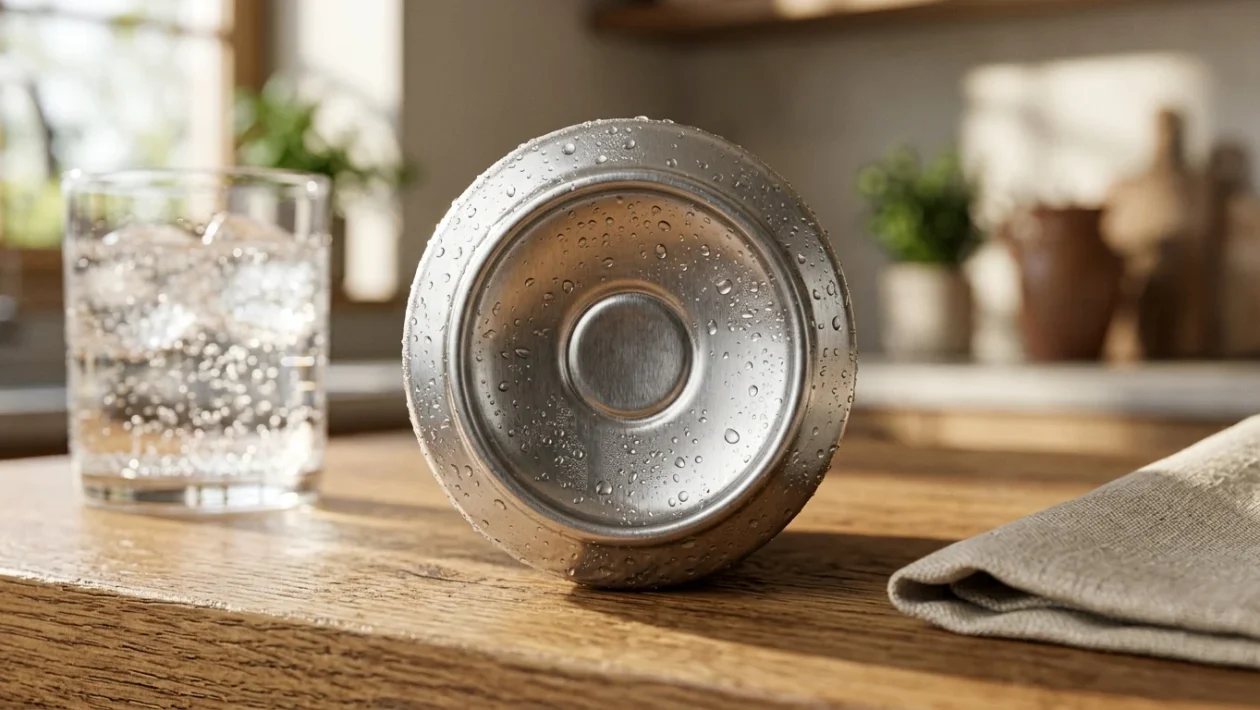
Close-up of the curved, concave aluminum base of a modern soda can.
Soda and beer cans feature a uniquely curved, concave bottom. This specific shape is not an aesthetic choice, but rather a highly calculated engineering solution.
The curvature is specifically designed to handle the immense internal pressure of carbonated gas. It allows the thin metal container to hold pressurized liquids without deforming or bursting.
The Physics of the Curved Base
Carbonated beverages push aggressively against the walls of their containers. The concave base acts as a flexible membrane to counteract this force.
As the internal gas pushes outward, the inward curve actually increases the container’s overall structural rigidity. This critical effect prevents the metal bottom from bulging outward or collapsing.
Before settling on this design, engineers tested other geometric shapes, including spheres and rectangular prisms. Both alternatives failed in practical application.
Why Cylinders Beat Spheres and Squares
The cylindrical design, combined with rounded bottom edges, distributes force perfectly evenly across the entire surface. This structural integrity allows manufacturers to use less aluminum without sacrificing safety.
Key Advantages of the Cylinder Shape:
- It utilizes up to 91% of available storage space, compared to a sphere’s 74%.
- It eliminates the weak, vulnerable corners found in rectangular containers.
- Labeling can be printed in a single fluid step, whereas angular shapes require four separate passes.
- The smooth round shape glides flawlessly through high-speed production lines without jamming on machinery rails.
Massive Material Savings at Scale
Producing a standard 33 cl cylindrical can requires approximately 310 square centimeters of material. A rectangular version of the exact same volume demands 340 square centimeters.
This difference might seem small, but the impact is massive at an industrial scale. Factories worldwide produce roughly 15,000 cans every single second.
Today, 70% of the aluminum used in these containers comes directly from recycled materials. The industry has also continuously optimized the shape to cut waste.
Over the last 60 years, engineers managed to shrink the diameter of can lids by six millimeters. This single, barely noticeable adjustment saves an estimated 90 million kilograms of aluminum every single year.