
The Bright Angel rock outcrop in Mars’ Jezero Crater where Perseverance found carbon
The harsh surface of Mars is a wasteland of relentless radiation and toxic chemistry known to destroy delicate molecules. Complex carbon, the fundamental building block of life, should not survive exposed to these elements.
Yet, NASA’s Perseverance rover just rewrote the rules. Without digging or drilling, the rover detected a massive cache of complex carbon resting directly on the bare face of a Martian rock.
A pale band of rocky outcrops on the barren Martian surface.
Jezero’s Ancient Lakebed
Billions of years ago, Jezero crater was a thriving lakebed where rivers deposited sediment into a sweeping delta. Perseverance has crawled across this dried-up basin since 2021, analyzing rocks for any chemical trace of ancient biology.
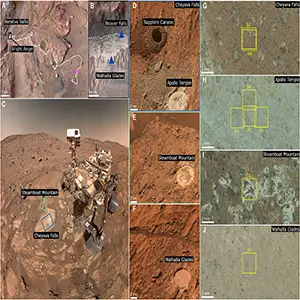
Ashley Murphy, a geologist at the Planetary Science Institute (PSI) in Arizona, led the recent analysis. The team focused on the Bright Angel outcrop, a pale band of stone at the edge of the ancient delta where water once pooled.
One specific rock slab, dubbed Cheyava Falls, had already captured the attention of scientists. Its surface is speckled with dark-rimmed spots that resemble fossilized marks left by Earth-bound microbes, prompting a 2025 study to label it a potential sign of past life.
An Unprecedented Carbon Haul
Perseverance analyzes Martian rocks by firing light at them and measuring the reflection to identify internal molecules. When the rover scanned two hardened mudstones at the Bright Angel site, it consistently detected carbon.
This was not standard carbon, but macromolecular carbon—large, complex chains of carbon atoms clustered together. The rover logged hundreds of hits across the two rocks, marking the largest haul of complex carbon ever discovered on Mars.
The Shallowest Detection on Record
Finding complex carbon is significant, but finding it exposed is an anomaly. The molecules were sitting right on the natural rock surface, hidden beneath nothing but a thin layer of dust.
Kyle Uckert, an astrobiologist at NASA’s Jet Propulsion Laboratory (JPL), confirmed this is the shallowest detection of organic matter ever made on Mars.
Given the brutal radiation and surface chemistry, any complex molecules should have been obliterated long ago. Scientists suspect the carbon was either recently uncovered before the environment could destroy it, or shielded by nearby minerals.
Close-up of a weathered, textured rock surface on Mars.
Biological or Geological Origins?
While complex carbon forms the backbone of all known living things, its presence alone does not guarantee biology. The chemical signal Perseverance captured looks identical whether it originated from a living organism or a geological process.
On Earth, this specific carbon fingerprint is found in ancient microbial mats and coal. However, it can also form inside meteorites or in rocks altered by hot underground water, entirely independent of biology.
“Macromolecular carbon on Mars does not prove the existence of life there,” Murphy noted.
A Planet-Wide Pattern
This discovery was not a localized fluke. The macromolecular carbon appeared repeatedly across the Bright Angel rocks, attached to various minerals in different settings.
More than 2,200 miles (3,540 kilometers) away, NASA’s Curiosity rover has spent years extracting similar organic molecules from the floor of Gale crater. The fact that carbon is spread so widely suggests the raw ingredients for life once spanned a massive portion of the planet.
Stranded Evidence
This combination of the richest carbon cache yet, found adjacent to microbe-like rock patterns, offers the strongest hint of ancient Martian life to date. But confirming a biological origin requires bringing a piece of Mars back to high-tech laboratories on Earth.
The Cheyava Falls sample was originally scheduled for a return mission in the 2030s. However, the U.S. program designed to retrieve it has been scrapped.
While China plans to launch its own sample return mission in 2028, it is targeting an entirely different, easier-to-reach site. For now, the most compelling evidence of extraterrestrial life remains sealed inside a titanium tube, stranded on the surface of Mars.