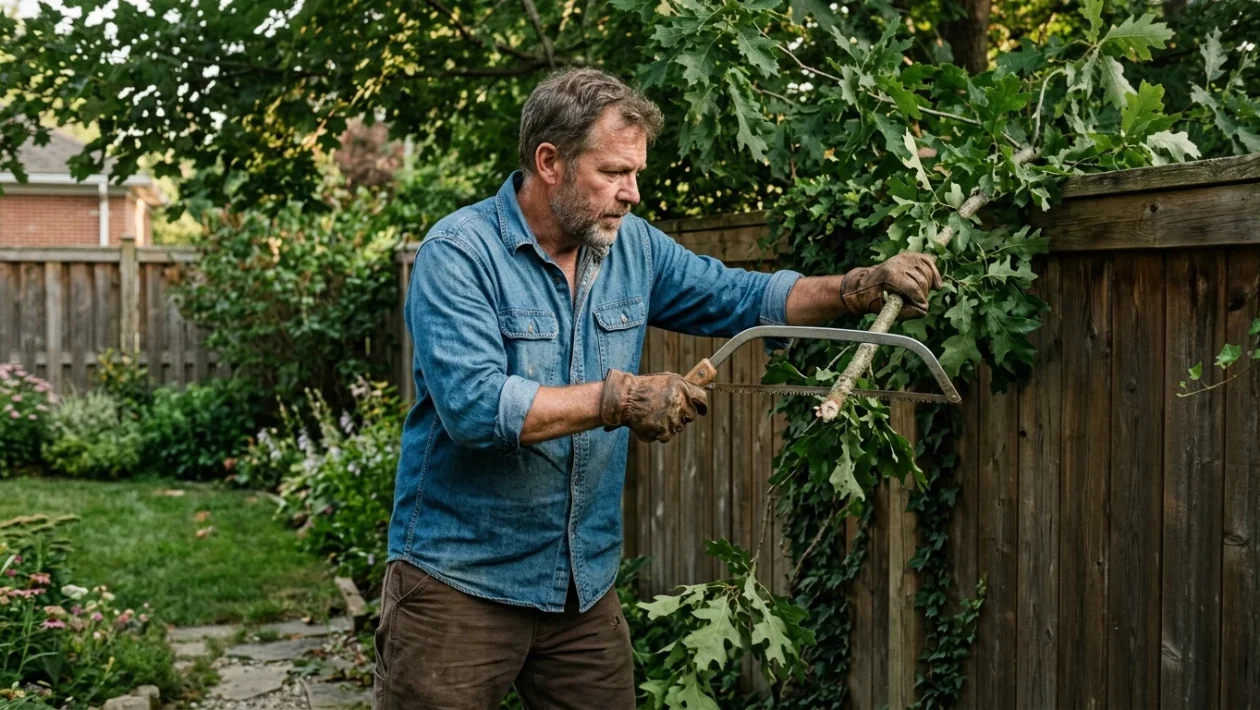
A homeowner pruning overgrown tree branches along a residential wooden fence.
Nature does not respect property lines. When a neighbor’s tree extends its canopy over your fence, it can easily shade your garden or block your driveway.
A homeowner pruning overgrown tree branches along a residential fence.
You might be tempted to grab a saw and start hacking away. But before you take action, you need to understand the legal ground rules of property maintenance.
Know Your Trimming Rights
In the United States, property law generally falls on your side. You are legally allowed to trim any branches that cross your property line.
The law actually considers whatever hangs over your yard to be your responsibility. However, your right to prune comes with strict limitations.
You cannot cross the property line to cut the tree. More importantly, you cannot prune so aggressively that you kill or destabilize your neighbor’s tree. If your trimming causes the tree to die, you could be legally liable for the replacement cost.
Who Pays When a Branch Breaks?
Ignoring an overhanging branch carries a serious financial risk. If a heavy limb snaps and damages your roof or fence, you are typically liable for the cleanup and repairs.
Because the overhanging portion was on your side of the property line, it was technically your responsibility to maintain it.
There is one major exception. If your neighbor knew the tree was dead, diseased, or hazardous and chose to do nothing, liability shifts back to them. Proving this negligence, however, often requires prior documentation.
Talking to Your Neighbor
Communication is always cheaper than legal fees. You are entirely within your rights to ask your neighbor to handle the overgrown branches.
Just remember they have no legal obligation to prune anything on your side of the boundary.
Check your local ordinances or homeowners association rules before starting the conversation. Often, the best solution is a straightforward compromise, such as splitting the cost of a professional arborist.
Smart Planting Prevents Disputes
The easiest way to handle tree boundary disputes is to prevent them entirely. If you are planting a new tree, carefully calculate its mature canopy size.
Keep trees and large shrubs far enough from the fence line to allow for easy maintenance. This ensures your landscaping remains a point of pride, rather than a legal liability.