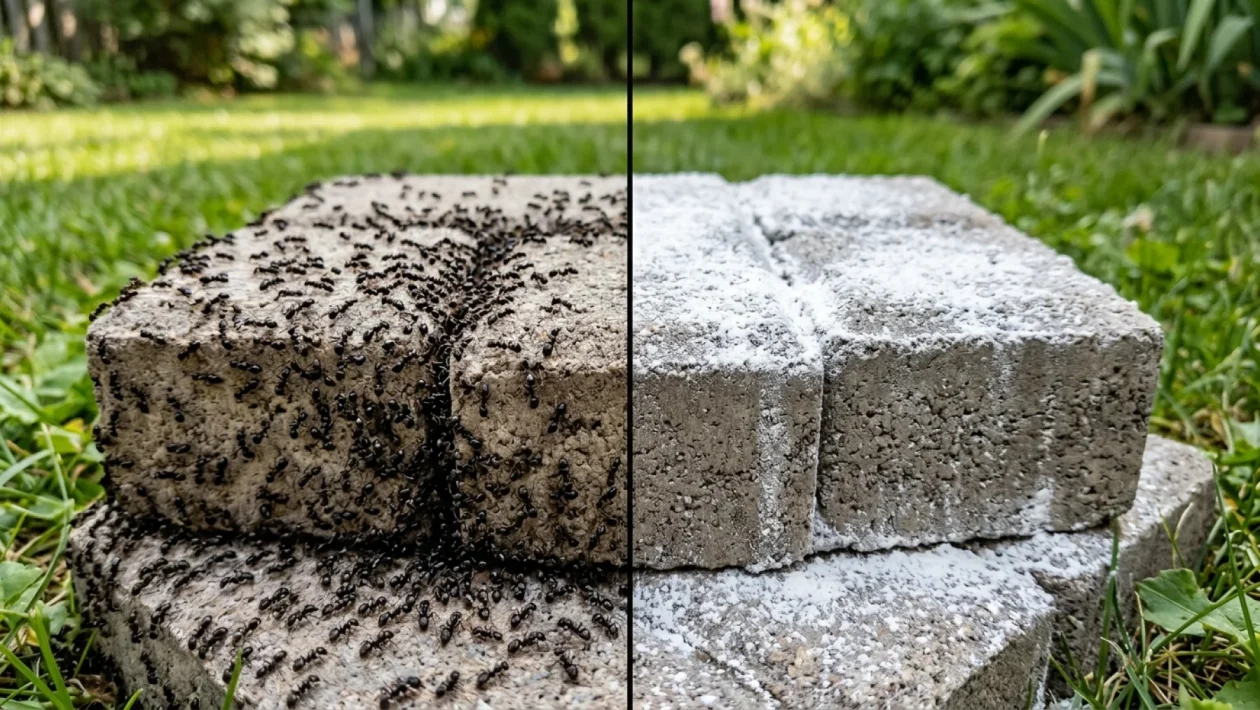
You fire up the grill, set down a platter of burgers, and within sixty seconds, a highway of six-legged party crashers is marching across your patio stone. You’ve probably tried the classic DIY remedies—drowning them in boiling water or soaking your interlocking brick in white vinegar. But here is the hard truth: those methods are temporary bandaids. The ants simply regroup, find a new route, and come back with a vengeance. If you want to wipe out the colony for good, you need to ditch the salad dressing and reach for a bag of ancient, crushed sea fossils.
I’m talking about diatomaceous earth. I’ve spent years testing every yard remedy on the market to keep my outdoor spaces clean. This is the only natural solution that actually wins the turf war without poisoning your lawn.
Why White Vinegar Always Fails Outdoors
Let’s put the great vinegar myth to rest right now. Pouring white vinegar around your patio furniture might make you feel productive, but it’s a severely flawed long-term strategy. Vinegar simply disrupts an ant’s pheromone trails temporarily.
It does not kill the colony, and it certainly doesn’t reach the queen hiding deep beneath your topsoil. A single pavement ant colony can house upwards of 10,000 to 30,000 workers. Spraying a handful of scouts with acidic liquid is like trying to empty a swimming pool with a shot glass.
Plus, the moment the morning dew hits or a quick July sprinkler runs, your vinegar barrier is completely washed away. You are essentially doing yard work for nothing.
The Diatomaceous Earth Advantage
Despite its heavy-duty name, diatomaceous earth (DE) isn’t dirt or toxic chemicals. It is a completely organic powder made from the microscopic, fossilized remains of ancient aquatic organisms called diatoms.
You can grab a food-grade bag of this stuff in the garden center at your local Canadian Tire or Home Depot for under twenty bucks. To the naked eye, it looks exactly like soft baking flour. But to an ant, it’s a field of razor-sharp glass.
“Diatomaceous earth works mechanically, not chemically. It physically scores the waxy outer layer of an insect’s exoskeleton, causing them to rapidly dehydrate and die. Pests literally cannot build a resistance to it.”
Because it’s mechanical, it remains lethal as long as it stays dry. Let’s look at how it actually stacks up against the old kitchen vinegar trick.
| White Vinegar | Diatomaceous Earth |
|---|---|
| Masks scent trails temporarily | Physically destroys the exoskeleton |
| Evaporates and washes away quickly | Remains active indefinitely if dry |
| Requires direct contact to work | Workers carry it deep into the nest |
How This Natural Powder Actually Destroys Yard Ants
Applying DE isn’t just about dumping a mountain of powder on an anthill. Precision is key. If you pile it too high, the ants will realize it’s a barrier and simply walk around it.
Here is my bulletproof method for deploying this natural destroyer around your backyard setup:
- Track the scouts: Before you apply anything, spend five minutes watching the ants. Identify exactly where they are emerging from, usually a crack in the concrete or a gap in the driveway stones.
- Wait for dry conditions: DE is practically useless when wet. Check the forecast and choose a dry stretch of weather to apply your treatment.
- Create a fine dusting: Using a duster tool or an old makeup brush, apply a nearly invisible layer of DE across their trails and directly into the nest entrance.
- Reapply after heavy rain: Once the powder gets soaked, it loses its cutting edge. Let the ground dry completely, then add a fresh dusting if the ants are still active.
Frequently Asked Questions
Is diatomaceous earth safe for dogs and kids?
Yes, as long as you purchase “food-grade” diatomaceous earth. It is completely non-toxic and safe to use around pets. However, because it is an extremely fine dust, you should avoid breathing it in directly during application as it can irritate your lungs.
How long does it take to kill the colony?
You will start seeing a massive reduction in patio traffic within 48 hours. Because worker ants track the powder back into the nest on their legs and bodies, it usually takes about a week to wipe out the entire colony permanently.
Does DE work on other yard pests?
Absolutely. It is highly effective against earwigs, beetles, and even fleas hiding in your grass. It is an incredibly versatile weapon to keep handy in your garage all season long.
🤝 Listen, dealing with backyard pests shouldn’t feel like a frustrating part-time job. By swapping out useless kitchen liquids for a proven mechanical barrier, you instantly reclaim your outdoor space.
💡 Make sure you pick up a bag of food-grade DE this weekend. It takes barely ten minutes to apply, and it will save you months of annoyance on the patio.
📱 Good luck out there, and don’t let a few bugs ruin your barbecue season. Hit me up in the comments below and share your thoughts on how this trick worked for your yard!