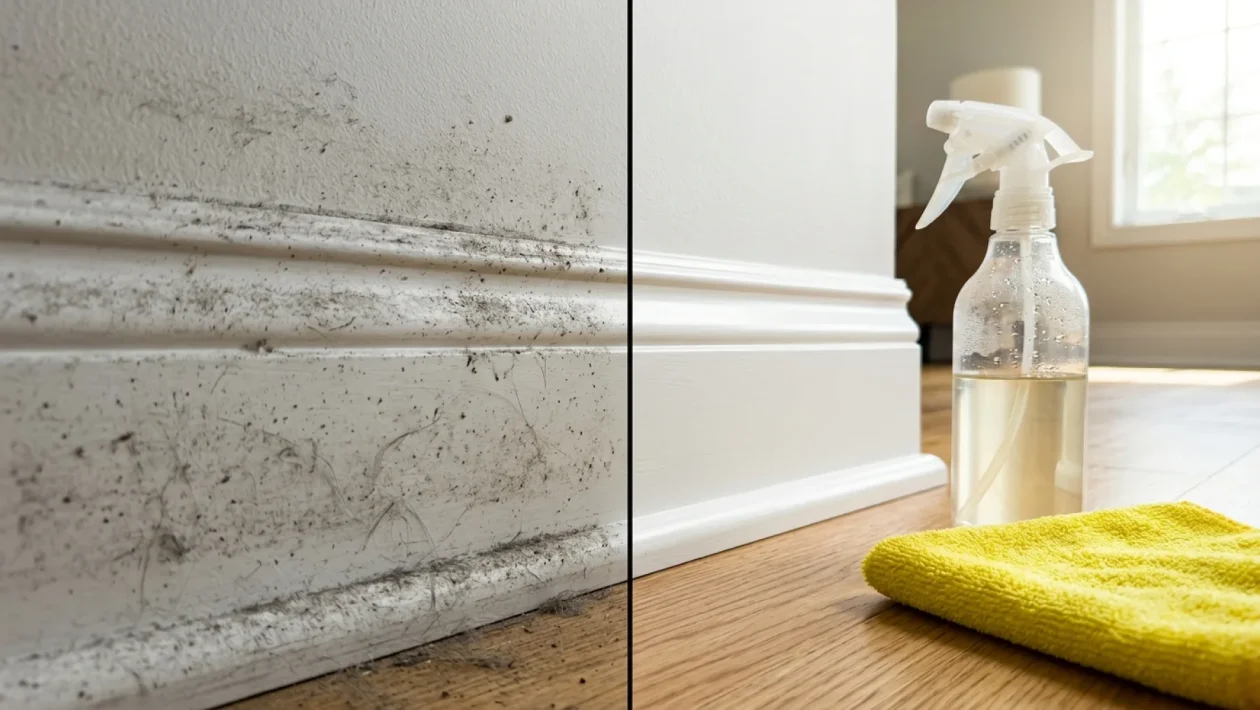
Look down at your walls right now. You scrub the floors and wipe the kitchen counters, but those little trim boards at the bottom of your drywall are secretly hoarding dust, pet hair, and grime. It is the most neglected real estate in your entire house. Ignoring it makes an otherwise spotless room look instantly dingy and uncared for. Fortunately, the ultimate solution is already sitting right inside your pantry.
You do not need to drop cash on a specialized chemical cleaner to fix this. Vinegar on baseboards is the undisputed champion of home maintenance. Today, I am going to show you exactly how to tackle this annoying chore quickly, safely, and highly effectively.
Why this household staple is king of the floorboards
White vinegar has quietly become the MVP of the modern utility closet. It boasts incredible natural degreasing properties that cut right through stubborn buildup. Over time, baseboards accumulate a stubborn, sticky layer of humidity, dirt, and dust that dry rags simply smear around.
Here is a harsh reality: according to indoor air quality researchers, household dust contains microscopic mites and allergens, making your baseboards a literal breeding ground for poor air quality. Vinegar breaks down that sticky barrier at a molecular level.
You also do not need anything fancy. A standard, heavy-duty jug of Allen’s White Vinegar from your local Canadian Tire will do the exact same heavy lifting as premium boutique brands. It cuts the grease, neutralizes damp odours, and leaves your trim looking freshly painted.
What spraying your trim actually means for your home
Cleaning your baseboards is about a lot more than just passing the white-glove test. These trim pieces serve a highly functional purpose in your home. They protect the delicate bottom edge of your drywall from vacuum collisions, mop water, and general foot traffic.
When you allow grime and moisture to sit on this wood or MDF trim, it degrades the paint and invites mold. Spraying them with a protective, purifying acid like vinegar means you are actively extending the lifespan of your building materials. You are performing vital preventative maintenance, pure and simple.
The step-by-step application method
Do not just blindly spray liquids onto a wall coated in loose dirt. If you do, you will end up creating a muddy paste that stains your paint. Here is the bulletproof process to get it right the first time.
- Take a small dry brush or a stiff broom and sweep the top ledge of the baseboard to remove loose, dry dust.
- Mix equal parts warm water and standard white vinegar in a spray bottle.
- Lightly mist a clean microfiber cloth with the solution, rather than spraying the wall directly, to prevent pooling on your floors.
- Firmly wipe down the baseboards, letting the mild acidity lift the adhered dirt.
- For aggressively stained areas, add a single drop of neutral dish soap to the cloth and scrub gently.
Make this a routine habit. Hitting your trim with this method once a month prevents the dirt from ever reaching that impossible, sticky stage.
The chemistry breakdown: Cost and safety
If you are still wondering why you should ditch the commercial sprays, let us look at the hard numbers. As we navigate household budgets in July 2026, efficiency is everything.
| Cleaning Solution | Verdict & Cost Breakdown |
|---|---|
| White Vinegar & Water | Costs pennies per spray. 100% non-toxic, safe for pets, and naturally neutralizes odors. |
| Commercial Chemical Sprays | Costs upwards of $8 per bottle. Often leaves a sticky residue that attracts more dust. |
Warning: The one mixture you must avoid
While vinegar is incredibly safe on its own, it is still an active chemical compound. You can safely mix it with a basic dish detergent to boost its cleaning power, but you have to draw the line there.
Never mix vinegar with bleach or chlorine. Combining an acid with bleach creates toxic chlorine gas, which is incredibly dangerous in enclosed spaces like hallways and bathrooms.
“Baseboards act like a shelf for every airborne particle in your home. Cutting through that built-up grime requires mild acidity, which is exactly why diluted white vinegar outperforms expensive, heavy detergents every single time.” – Mark Henderson, Residential Cleaning Authority.
Frequently Asked Questions
Can I use apple cider vinegar instead?
Technically yes, but it is not recommended. Apple cider vinegar contains natural sugars and a darker pigment. This can leave a slight residue or even stain white painted trim. Stick to standard, clear white vinegar for cleaning.
Will my house smell like a pickle jar?
Only for a few minutes! The distinct smell of vinegar evaporates entirely as soon as the liquid dries. Once the moisture is gone, it takes all the trapped household odors away with it, leaving your room smelling like absolutely nothing.
🤝 Good luck tackling those floors this weekend. Once you see how bright and clean your hallways look, you will never ignore this simple chore again.
💡 Make sure to share your thoughts with your neighbors or family members who might be wasting money on expensive, toxic cleaning supplies.
📱 Save this guide on your phone so you have the exact mixing ratios handy the next time you are standing in the cleaning aisle.
👇 Grab that spray bottle, put on some good music, and go give your home the baseline respect it deserves!