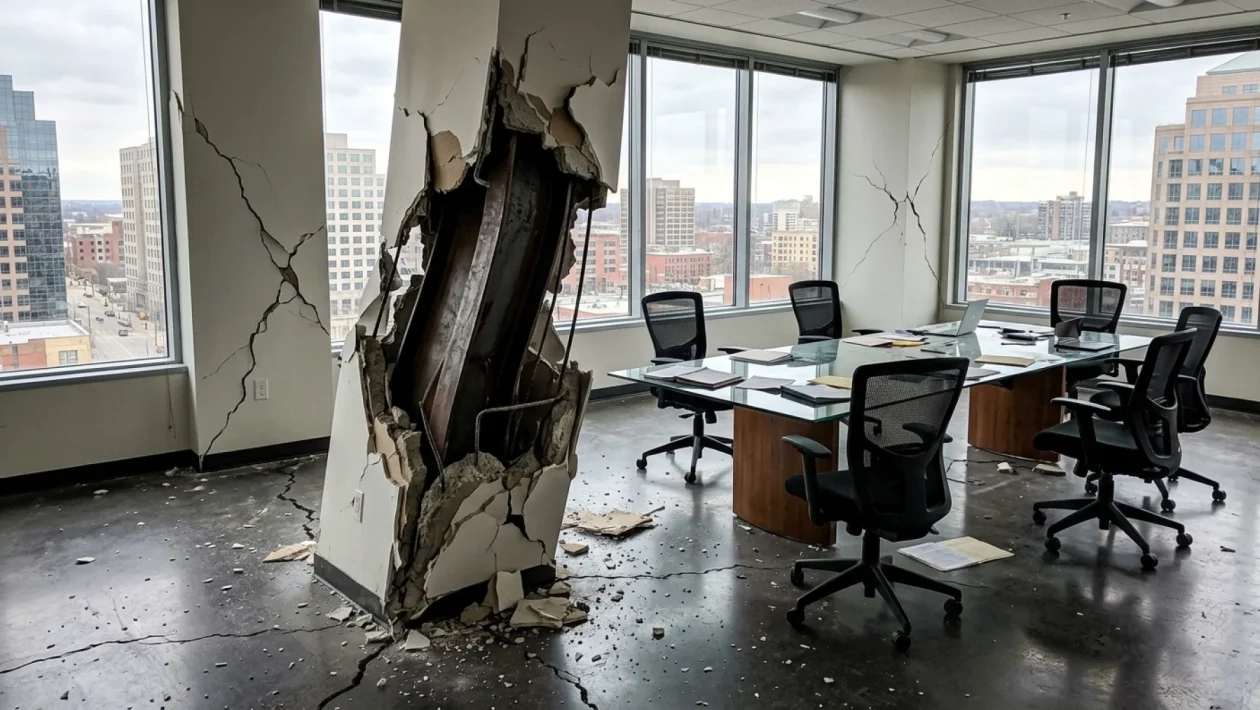
When a 40-story commercial tower literally groans under its own weight, you do not stick around to send that last email. The recent New York evacuation was not an overblown fire drill—it was a terrifying, real-time structural failure that almost ended in catastrophe.
A massive midtown office building physically buckled this week, sending thousands of workers scrambling for the stairwells in a sheer panic. We are going to break down exactly what causes a concrete and steel giant to warp, why support columns give out, and how you can spot the silent warning signs before the floor drops out from under your own desk.
New York evacuation: The anatomy of a midtown emergency
Picture this: It is July 2026, you are sitting in an air-conditioned boardroom to escape the brutal summer heatwave, and the drywall suddenly snaps like a gunshot. That is exactly the nightmare scenario that kicked off the chaos in Manhattan.
Complete structural failures in modern high-rises are incredibly rare, but when they happen, they happen dangerously fast. It is a sobering reality when you consider a recent American Society of Civil Engineers report estimating that nearly 30% of aging commercial structures suffer from some form of deferred structural maintenance.
This midtown disaster was not a case of a building harmlessly settling into its foundation. A primary load-bearing column severely compromised, causing the floors above to dip dramatically and forcing first responders to clear the grid.
Why an office building buckled under pressure
I have spent years around heavy-duty commercial job sites, swapping blueprints with veteran framing crews from top-tier Canadian builders like EllisDon and PCL Construction. If there is one thing every builder deeply respects, it is the unforgiving, relentless nature of dead loads.
Buckling usually happens when a vertical support column loses its mechanical ability to handle compression. Add in extreme summer thermal expansion, compromised fireproofing, or a hidden water leak rusting out a core steel beam over the decades, and you have a recipe for sudden disaster.
“Commercial steel doesn’t just snap out of nowhere; it yields and warps. When a primary column buckles, it violently transfers massive weight to secondary supports that were never designed to hold it.” — Dr. Aris Thorne, Structural Engineer
Once that load shifts, the building’s skeleton gets pushed right past its breaking point. That rapid, uncontrolled weight transfer is exactly what forced authorities to trigger the massive New York evacuation.
How to spot structural red flags in your own workplace
You do not need a civil engineering degree to notice when a building is crying out for help. Most catastrophic failures exhibit clear physical symptoms weeks, or even months, before a beam actually buckles under pressure.
The real trick is knowing the difference between normal building wear and a structural death trap. Let’s break down what you should actually be looking for when you walk into the lobby.
| Cosmetic Nuisance (Usually Safe) | Structural Red Flag (Evacuate) |
|---|---|
| Hairline vertical cracks in the drywall tape | Diagonal, stair-step cracks in concrete blocks |
| Doors sticking on a humid summer day | Doors and windows suddenly jamming out of nowhere |
| Slight floor creaks in much older buildings | Noticeable sagging, sloping, or “spongy” floors |
Surviving a structural failure: Your escape game plan
If you ever hear the deep, echoing pop of steel buckling or feel the floor drop, your survival muscle memory needs to kick in immediately. Here is the exact protocol to follow if your building begins to fail.
- Drop the gear: Leave your laptop, your expensive jacket, and your coffee on the desk. Milliseconds matter when gravity is working against you.
- Stay away from the core: Avoid areas where the ceiling or floor is actively groaning, cracking, or visibly bowing downward.
- Hit the stairs: Never use the elevator during a structural crisis. Elevator shafts are incredibly vulnerable to warping, which will trap you between floors.
- Create serious distance: Once you make it outside, move at least two city blocks away. A collapsing commercial high-rise creates a massive, deadly debris field.
Frequently Asked Questions
What exactly does “buckling” mean in construction?
Buckling is a sudden, critical failure where a structural member—like a heavy steel column—bends or bows sideways under immense compression. Unlike a simple surface crack, buckling physically alters the shape of the core support.
Can a buckled high-rise building be saved?
Sometimes, but it is an incredibly expensive and dangerous engineering feat. Crews have to install temporary hydraulic shoring to safely carry millions of pounds of weight while the damaged column is cut out and entirely replaced.
Who officially makes the call for a structural evacuation?
Typically, the building’s facility management or automated seismic sensors trigger the initial internal alarm. Once on-site, the fire department incident commander and city structural engineers take absolute authority over the scene.
🤝 Thank you for reading, and I hope this breakdown gives you a bit more confidence the next time you walk into a towering glass box for a meeting.
💡 Awareness is your absolute best tool, so take a quick glance at those concrete pillars in your underground parking garage tomorrow morning.
📱 Share your thoughts in the comments below if you have ever worked in an office building that felt a little too shaky for comfort.
👇 Stay safe out there, keep your eyes open, and never, ever ignore what a building is trying to tell you!