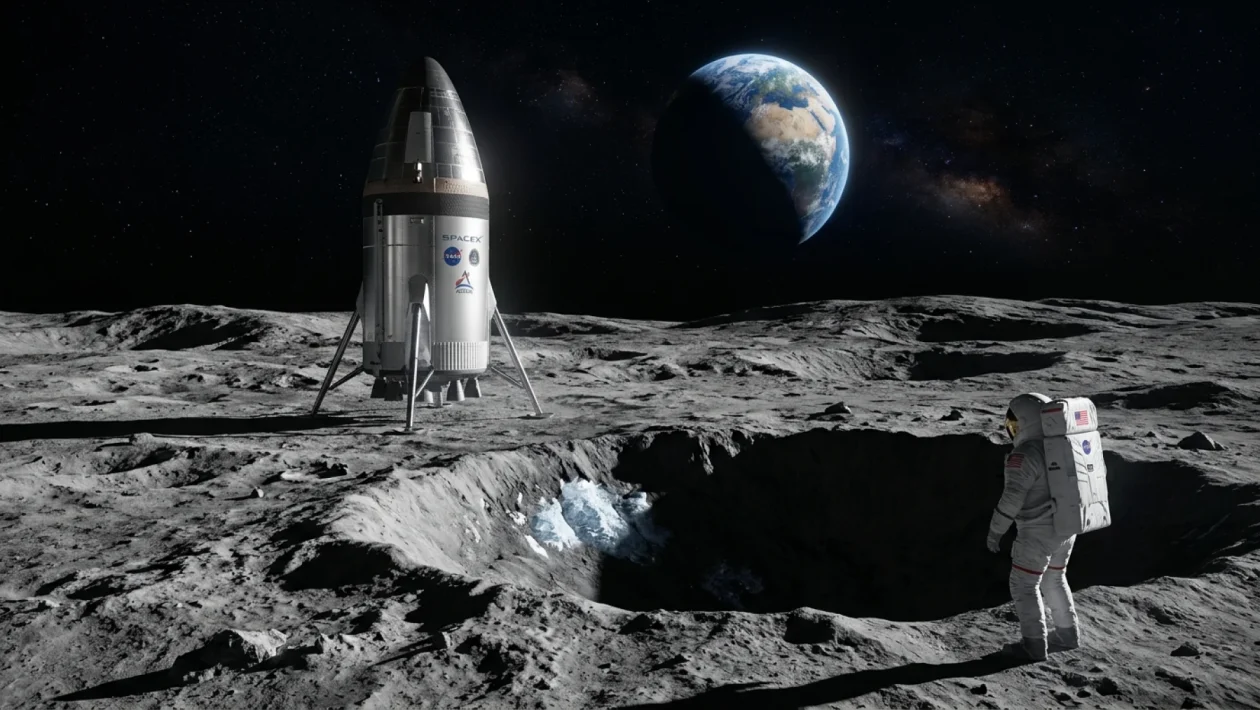
Look up tonight. The glowing silver orb hanging in our night sky is no longer just a dead rock—it is an active construction zone. It is officially May of 2026, and the countdown clocks in Houston, Cape Canaveral, and Boca Chica are running incredibly hot.
Humanity is about to step foot on another celestial body for the first time in over half a century. But this is not your grandfather’s Apollo mission.
We are targeting the treacherous, permanently shadowed regions of the lunar south pole. The stakes are impossibly high, the engineering is entirely unproven, and the Artemis 3 mission is about to redefine our place in the cosmos.
The Artemis 3 Mission: Why We Are Going Back
The goal of Artemis 3 is not simply to plant a flag and take a triumphant photograph. We are going back to secure a foothold for deep space exploration.
Astronomers and planetary scientists have confirmed that the deep craters at the lunar south pole contain billions of tons of ancient water ice. That ice is the holy grail of space exploration.
With the right technology, that frozen water can be separated into hydrogen and oxygen. Suddenly, the Moon is not just a destination; it becomes an interplanetary gas station.
To pull this off, NASA is collaborating closely with international partners. While the Canadian Space Agency (CSA) prepares the robotic Canadarm3 for the upcoming Lunar Gateway space station, this specific mission focuses purely on boots on the regolith.
Decoding The 2026 Launch Window
If you have been following the space industry, you know that getting to the launch pad has been a grueling journey. Originally slated for 2025, the mission faced massive engineering bottlenecks.
Designing modern life-support spacesuits capable of surviving a staggering 500-degree Fahrenheit temperature swing between the sunlit ridges and the frozen crater floors took longer than expected.
Now, as we push into the spring of 2026, those hurdles have finally been cleared. The thermal shielding is locked in, and the orbital mechanics align perfectly for a late-year launch.
The Earth and the Moon are separated by roughly 238,900 miles. Navigating that void requires a perfectly timed launch window to ensure maximum fuel efficiency and sunlight exposure for the landing zone.
The Exact Moon Landing Timeline
Executing the moon landing timeline is a breathtaking ballet of orbital mechanics. It requires multiple rocket launches, orbital refueling, and pinpoint docking maneuvers.
Here is the exact step-by-step sequence of how humanity will return to the lunar surface:
- The Propellant Depot Launch: SpaceX will launch a series of Starship tankers into Earth orbit to fill a massive floating fuel depot.
- The Lander Launch: The uncrewed SpaceX Starship Human Landing System (HLS) launches, docks with the depot, fuels up, and flies empty to a lunar halo orbit.
- The Crew Departure: Four astronauts blast off from Earth inside the Lockheed Martin Orion capsule, riding atop NASA’s monstrous Space Launch System (SLS) rocket.
- The Lunar Handshake: Orion docks with the waiting Starship HLS in orbit around the Moon. Two astronauts transfer into the massive SpaceX lander.
- The Descent: Starship detaches and descends to the treacherous lunar south pole, leaving the other two crew members orbiting in Orion.
Once on the surface, the two astronauts will spend roughly six days conducting moonwalks, collecting ancient ice samples, and testing habitat technology.
How The SpaceX Starship Mechanics Will Deliver Us Safely
The most mind-bending element of this mission is the lander itself. The SpaceX Starship mechanics represent a radical departure from the tiny, spider-like Apollo Lunar Module.
Starship is a towering skyscraper of stainless steel. Landing this 160-foot behemoth vertically on an uneven, rocky crater ridge requires next-generation thrust vectoring and autonomous radar guidance.
Because the crew cabin is located at the very top of the vehicle, the astronauts will not climb down a ladder. Instead, they will ride a motorized elevator down to the lunar surface.
| Feature | SpaceX Starship HLS (Artemis) |
|---|---|
| Vehicle Height | 164 feet (50 meters) |
| Livable Volume | Massive (Multi-story layout) |
| Lunar Access | Motorized external elevator |
| Landing Zone | Lunar South Pole |
The scale of this vehicle is entirely unprecedented. It is designed to carry immense payloads, paving the way for heavy rovers and base-building equipment on future flights.
“We are trading the flat, forgiving plains of the Apollo era for a treacherous landscape of eternal shadows and ancient ice. This isn’t a repeat; it’s an evolution. Starship changes the entire math of deep space exploration.”
Artemis 3 Moon Landing Frequently Asked Questions
Who are the astronauts flying on Artemis 3?
NASA has selected a diverse cadre of highly trained astronauts for the Artemis program. While the specific four-person crew for the surface mission will be formally assigned as we get closer to launch day, the mission guarantees that the first woman and the first person of color will walk on the Moon.
Why did the mission get delayed to 2026?
Space is profoundly unforgiving. The delay from 2025 to late 2026 allowed SpaceX to finalize the complex ship-to-ship cryogenic fuel transfer in Earth orbit. It also gave Axiom Space the necessary time to rigorously test the new mobility joints on their lunar spacesuits.
Will I be able to see the landing live?
Absolutely. Unlike the grainy, ghostly footage of 1969, Artemis 3 will be broadcast in stunning high-definition 4K video. Advanced communication relays orbiting the Moon will beam the historic elevator descent directly to our smartphones and televisions in real-time.
🚀 Keep looking up as the year progresses, because the night sky is about to get incredibly exciting.
🔭 Whether you are an amateur astronomer or just someone who loves a good space mystery, 2026 is the year science fiction becomes our daily reality.
🌌 The universe is calling, and humanity is finally answering with a roaring rocket engine. We want to know how you are preparing for this historic launch.
👇 Drop a comment below, share your thoughts on the massive Starship lander, and tell us who you would take with you on a trip to the Moon!