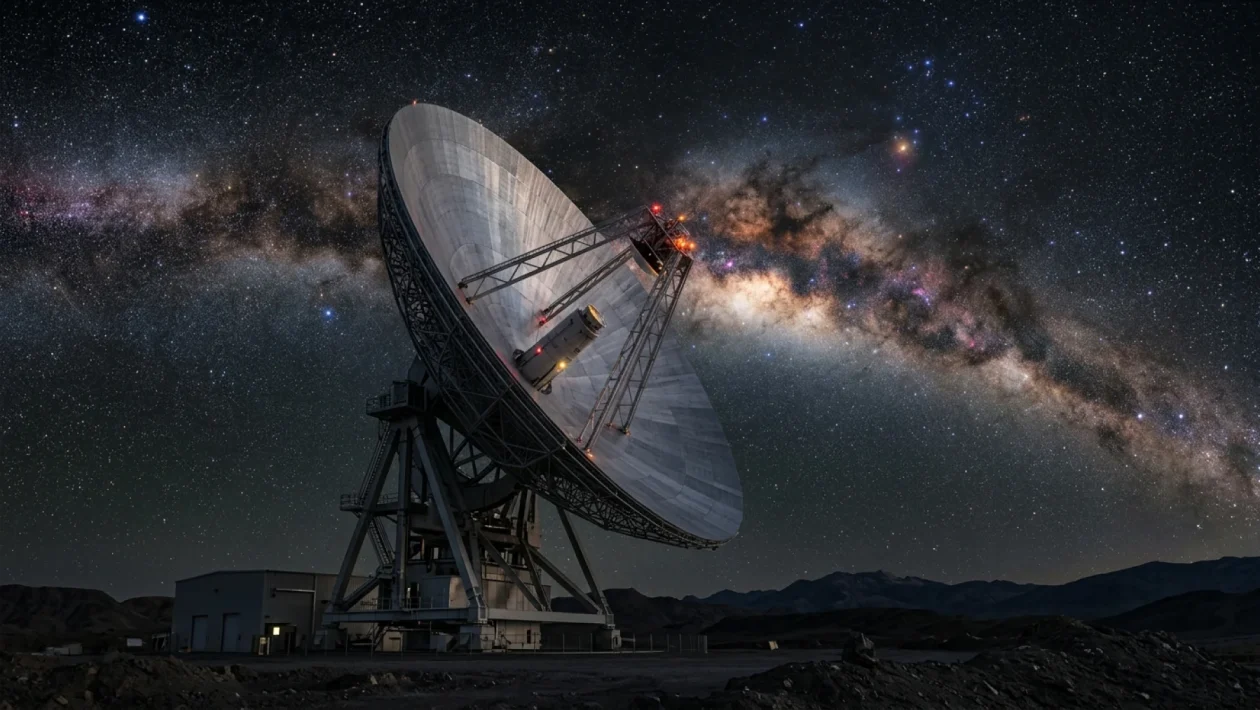
Right this second, a robotic explorer billions of miles away is screaming into the cosmic void, and Earth is listening. We aren’t just blindly guessing where our spacecraft are; we are locked onto them with pinpoint precision. The secret behind this interstellar eavesdropping is the Deep Space Network. It is the absolute backbone of our solar system exploration, allowing us to steer rovers on Mars and pull mind-bending, high-res photos from the James Webb Space Telescope. If this system goes offline, humanity goes completely blind in space.
The Deep Space Network: Earth’s Interplanetary Switchboard
NASA operates three ultra-secure, hyper-sensitive radio telescope facilities placed exactly 120 degrees apart around the globe. This strategic placement in California, Spain, and Australia ensures that as the Earth rotates, we never lose sight of a spacecraft. Our planet is constantly turning, but there is always a giant ear pointed at the heavens.
These aren’t your average rooftop satellite dishes. We are talking about colossal, 70-meter (230-foot) antennas that weigh millions of pounds. They are engineering marvels that push the absolute limits of modern physics.
To put that into perspective, the massive Canadian Space Agency (CSA) robotic arms up on the space station are spectacular, but they operate just 250 miles above us. The antennas of the Deep Space Network are routinely snatching invisible whispers from metal boxes over 15 billion miles away in interstellar space.
“Catching a signal from the edge of the solar system is like trying to hear a single snowflake hit the ground from three thousand miles away. The energy reaching our antennas is literally 20 billion times weaker than the power it takes to run a digital watch,” explains a senior astrophysics communications director at NASA’s Jet Propulsion Laboratory.
Tracking Live Interplanetary Missions: The Physics of Cosmic Eavesdropping
Communicating with deep space isn’t like hopping on a quick video call. It requires a staggering exercise in patience and orbital mechanics. We are fighting against the vastness of the universe itself.
Radio waves travel at the speed of light, which clocks in at a blistering 186,000 miles per second. But the solar system is unimaginably huge. When engineers at SpaceX or NASA send a simple software update to a distant probe, they have to wait hours just for the delivery receipt.
Here is a quick look at how long it takes to hear back from our most famous cosmic outposts as we cruise through May 2026.
| Target Spacecraft | One-Way Signal Time to Earth |
|---|---|
| James Webb Space Telescope | ~5 seconds |
| Mars Perseverance Rover | ~11 minutes |
| Voyager 1 (Interstellar Space) | ~22.5 hours |
Right Now: How You Can Watch The Antennas Live
You don’t need a top-secret security clearance to watch humanity talk to the stars. NASA has made this entire communication grid completely transparent through a live public dashboard.
It is called “DSN Now,” and it is easily one of the most addictive websites on the internet for space nerds. You can literally watch which antenna is talking to which spacecraft in real-time. It turns the terrifying void of space into a bustling, interactive map.
Here is how you can track the cosmic traffic yourself:
- Open the NASA DSN Now web portal on your browser or mobile device.
- Look for the wavy transmission lines animating on the screen; a downward wave means we are receiving cosmic data, while an upward wave means Earth is actively sending commands.
- Click on any specific dish on the globe to reveal the exact spacecraft it is communicating with, the distance of the probe in miles, and the real-time speed of the data transfer.
Frequently Asked Questions About Deep Space Tracking
What happens if a spacecraft flies behind the sun?
This tense orbital event is known as solar conjunction. The sun unleashes massive amounts of radioactive interference, making communication completely impossible. Teams simply park the rovers, put probes in a protective safe mode, and wait out the two-week blackout until the planetary geometry clears.
Can the Deep Space Network detect alien life?
While its primary job is to track human-made probes, these highly sensitive radio dishes are occasionally used by radio astronomers to listen for anomalous cosmic radio bursts. However, they are finely tuned to the exact frequencies of our own spacecraft, so they aren’t actively sweeping the dial for extraterrestrial broadcasts.
🚀 Keep looking up, because the staggering amount of data pouring down from the heavens right now is fundamentally changing how we understand the universe.
🔭 Every time you scroll past a stunning new galaxy photo on your feed, remember the giant, silent dishes here on Earth that caught those invisible waves.
🌌 As we push even deeper into the cosmos this year, our invisible, light-speed tether to these distant robotic explorers only becomes more vital to our survival and curiosity.
👇 Share your thoughts with us below, and let us know which deep space mission you are going to track live tonight!