Forget the clunky, sparking metal boxes you grew up watching in 80s sci-fi flicks. The androids walking out of the May 2026 Tokyo Humanoids Summit look, move, and act unnervingly like us. We are staring right down the barrel of a complete workforce revolution, and the ultimate solution to our massive global labor shortage is finally standing on its own two feet.
As a guy who loves rolling up his sleeves and looking under the hood of new machinery, I can tell you this tech isn’t a gimmick. We are witnessing absolute mechanical wizardry. The days of basic assembly line arms are over, and a new era of highly capable, lifelike machines has arrived.
Humanoid Robots: The Ultimate Mechanical Evolution
Humanoid robots are no longer just expensive university science projects. They are built to navigate a world designed entirely for humans. Think about it—our stairs, our doors, and our tools all require a two-legged, two-armed operator.
Up here in Canada, we’ve seen incredible industrial automation from homegrown powerhouses like Clearpath Robotics and automotive giant Magna International. But the tech unveiled in Tokyo this spring represents a massive leap forward. We are talking about machines with synthetic skin, facial expressions, and hydraulic joints that rival human muscle.
Why These Machines Are Dancing On Stage
If you think a robot busting a move is just a cheap party trick to get applause, you are entirely missing the bigger picture. When these androids are dancing, they are actively demonstrating cutting-edge dynamic balancing. Shifting weight from one mechanical leg to another without tipping over is an engineering nightmare.
Dancing requires real-time processing of gravity, momentum, and spatial awareness. Every time a robot dips, spins, or side-steps on that stage, millions of micro-calculations are firing off per second. If it can dance flawlessly, it can confidently carry a stack of drywall through a messy construction site.
Threading Needles: The Holy Grail Of Micro-Precision
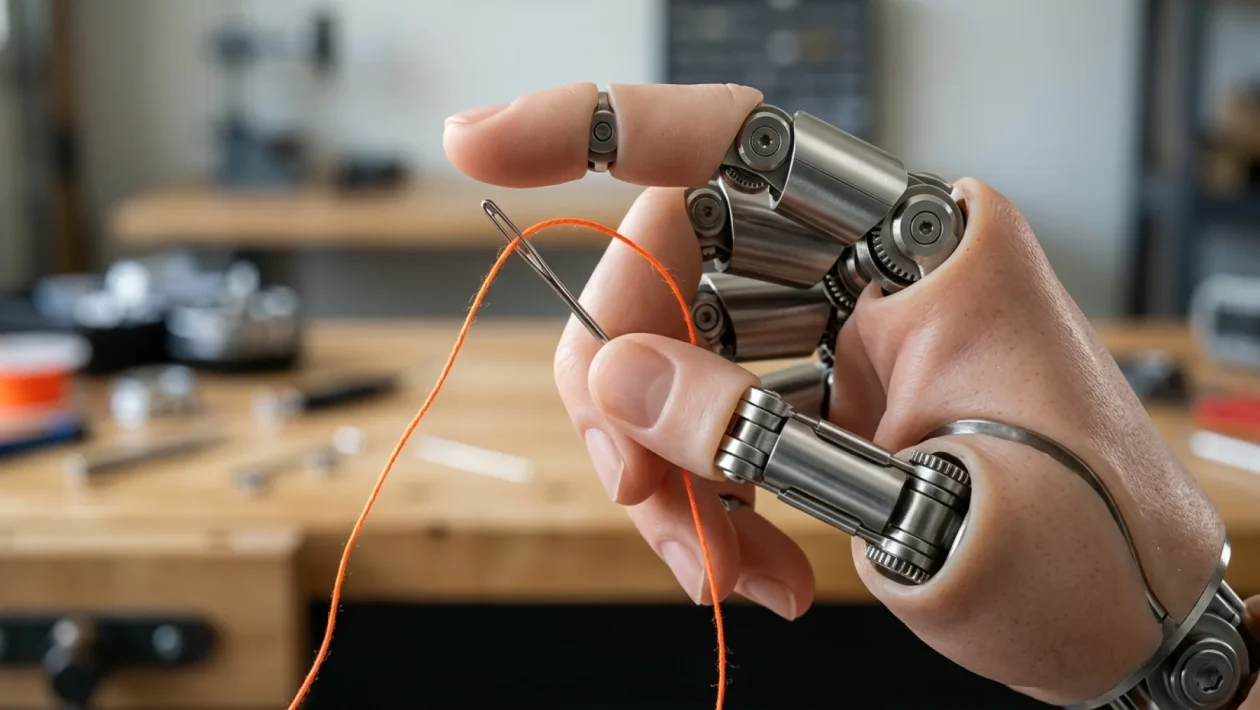
While the footwork is impressive, the true jaw-dropper at the summit was watching these machines tackle microscopic tasks. Threading needles is a task that frustrates the best of us on a Sunday afternoon, yet these metallic hands are doing it with zero hesitation.
How exactly do developers train a massive metal machine to perform with a tailor’s delicate touch? It comes down to a strict, rigorous training loop:
- Human operators wear highly sensitive haptic gloves to perform the exact task thousands of times.
- The micro-movements and pressure data are fed directly into a massive AI simulation environment.
- The AI filters out human errors—like hand tremors—and creates a perfectly optimized motion path.
- The refined data is deployed directly into the robot’s servo motors for flawless real-world execution.
Achieving this level of precision means a robot can do far more than mend your torn jeans. It means they are ready for delicate microchip assembly and eventually, assisting in complex surgical procedures.
Igniting A Tech War For The Future
Make no mistake, this flashy Tokyo showcase is actively igniting a tech war with massive economic stakes. The nation that successfully scales this technology essentially controls the future of global manufacturing.
“The race for humanoid dominance isn’t just about cool tech; it is about securing the ultimate, tireless workforce. The nation that perfects this essentially owns the 21st-century supply chain,” notes Dr. Alan Davies, a leading North American robotics analyst.
The numbers back this up with terrifying speed. Recent industry projections show the global humanoid robot market is expected to skyrocket to a staggering $38 billion by 2035. This is the new space race, and no superpower wants to be left grounded.
Between Japan And China: Who Owns The Innovation?
The tension in the room at the summit was palpable as developers openly postured between Japan and China. Both nations are throwing billions into research and development, but their strategies are fundamentally different.
Japan is playing the long game of perfection and human integration. They want robots that feel natural in healthcare and domestic settings, heavily focusing on lifelike androids like Professor Hiroshi Ishiguro’s famous Geminoid. China, on the other hand, is moving with terrifying speed toward mass-producible, robust industrial units.
| The Japanese Approach | The Chinese Strategy |
|---|---|
| Ultra-lifelike aesthetics and synthetic skin. | Utilitarian, durable metal and plastic frames. |
| Hyper-focus on delicate tasks and elderly care. | Focus on heavy lifting and factory floor integration. |
| Slower rollout, emphasizing perfect human interaction. | Rapid mass production and aggressive global pricing. |
Frequently Asked Questions
Are these humanoid robots fully autonomous?
Not entirely, but they are getting close. Right now, most require heavily pre-programmed AI environments or remote human supervision for highly complex tasks. However, their ability to adapt to sudden obstacles is improving every single month.
How much will one of these androids cost?
Early production models are currently sitting in the hundreds of thousands of dollars. But just like flat-screen TVs, as Chinese and Japanese manufacturing scales up over the next decade, experts predict the cost of a basic unit will drop to the price of a mid-sized car.
Will they take over Canadian trade jobs?
If you’re a skilled plumber or electrician, your job is safe for a very long time. Trades require intense critical thinking and physical adaptability in unpredictable environments. These robots will initially take over highly repetitive, dangerous, or physically grueling factory jobs.
🤝 Good luck trying to wrap your head around how fast this world is changing! As a guy who loves seeing a well-oiled machine in action, I can honestly say the next few years of this robotics rivalry are going to be wild to watch.
💡 Whether you’re excited for a robotic helping hand in the garage, or a little creeped out by how human they look, this tech is officially out of the laboratory and in our lives.
📱 If you found this breakdown helpful, share your thoughts with a buddy who loves tinkering with new gadgets.
👇 Keep your eyes peeled on the news, folks, because this mechanical space race is only just getting started!