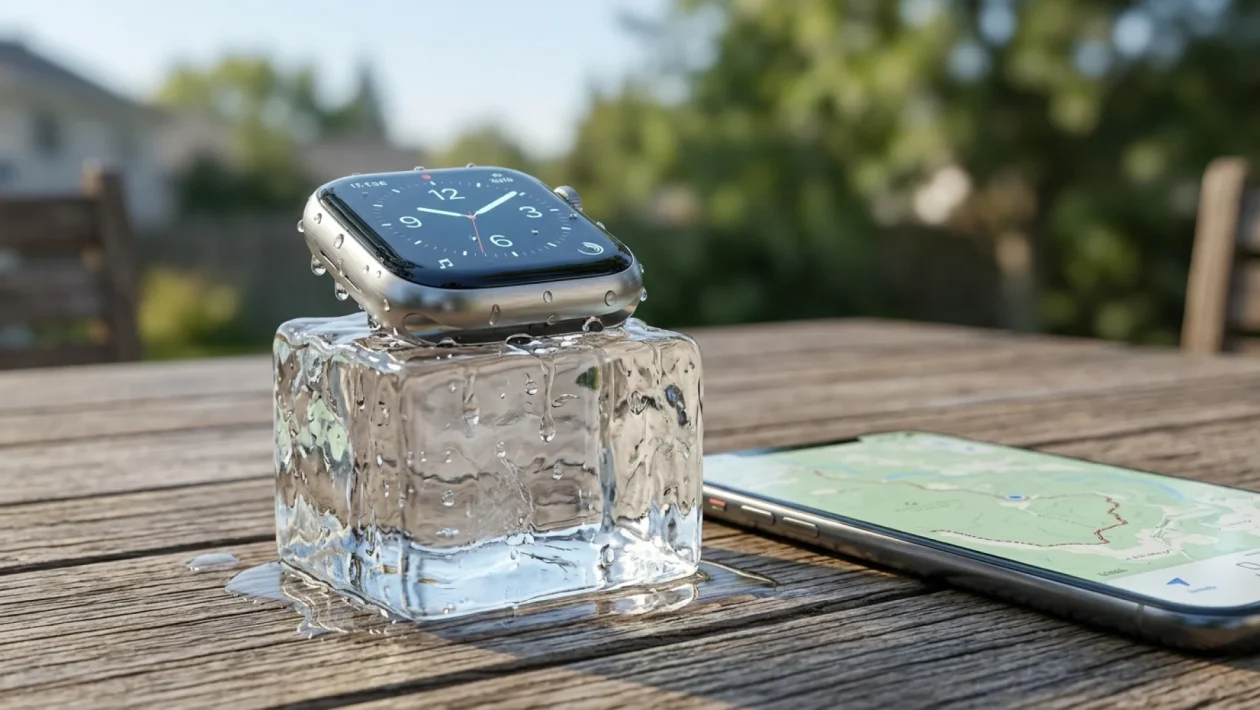
Look at your smartwatch. That second ticking by is quietly stretching out right in front of your eyes. Not by enough to score you an extra hour of sleep this weekend, but enough to set off massive alarm bells across the global scientific community. We are physically altering the spin of our own planet.
By drastically warming the globe and melting the polar ice caps, humanity is shifting so much physical weight across the Earth’s surface that we are literally hitting the brakes on its momentum. It is a terrifying testament to human impact.
If you thought climate change was just about tweaking your thermostat or planting a few extra trees, think again. We are fundamentally rewriting the mechanics of time, and the consequences are about to bleed into the high-tech gadgets you rely on every single day.
Earth’s rotation slowdown
To understand what is happening under our boots, you need to picture a classic figure skater pulling off a high-speed spin on the ice. When they pull their arms in tight, they spin like a top. When they throw their arms wide open, their rotation instantly drops. Earth’s rotation is doing the exact same thing.
For decades, researchers knew climate shifts could gently nudge planetary physics. But a massive joint study from the University of Vienna and ETH Zurich just confirmed that what we are seeing today is off the charts. We are fundamentally shifting where the Earth holds its “weight.”
Here is exactly how our carbon footprint is acting as a planetary brake pedal:
- The polar ice melts: Ancient, dense ice sheets in places like Greenland and the Antarctic rapidly turn into liquid water.
- The mass migrates: All that freed-up water does not just sit at the poles; it flows outward, migrating down toward the Earth’s equator.
- The waistline expands: The planet essentially gains a heavier “midsection,” pushing mass further away from its central axis.
- The deceleration hits: Just like the figure skater spreading their arms, this outward shift of mass causes the entire planet to noticeably decelerate.
The sheer scale of this weight transfer is almost impossible to wrap your head around. To trigger the slowdown we are currently tracking, it requires moving roughly 1,000 gigatons of ice from the poles into the oceans. If you took that much frozen water and stacked it directly over New York City, it would form a solid cube towering 10 kilometers into the sky—stretching higher than Mount Everest.
Why melting polar ice is lengthening our days
Time has never been perfectly rigid. Historically, the gravitational pull of the Moon and the shifting of magma deep inside the Earth’s core have caused tiny hiccups in our 24-hour cycle. But humanity has officially entered the chat, and we are overpowering nature.
Right now, our climate-induced melting is lengthening each day by about 1.33 milliseconds per century. That number sounds incredibly tiny, but in the grand scheme of geological time, it is a violent, sudden spike.
By analyzing the fossilized shells of ancient marine organisms—which act like microscopic hard drives recording historic ocean levels—scientists made a chilling discovery. The current rate at which our days are stretching is entirely unprecedented over the last 3.6 million years.
| Planetary Shift Factor | Impact on the Earth |
|---|---|
| Historical Moon Gravity | Slow, natural deceleration over millions of years. |
| Modern Ice Cap Melting | Violent, rapid mass redistribution altering daily timechecks. |
If we keep burning fossil fuels at our current clip through 2026 and beyond, climate change will soon outpace the Moon as the single biggest factor dictating the length of a day on Earth.
Messing with your GPS
So, why should a regular guy care about a fraction of a millisecond? Because the modern world is completely addicted to hyper-precision.
Your smartphone, the Garmin navigation strapped to your dashboard, and the complex logistics networks keeping North American grocery shelves stocked all run on exact timing. Satellites orbiting the Earth calculate your exact position down to the inch by measuring the time it takes for a signal to bounce back and forth.
When the planet’s rotation shifts, the Earth physically rotates out of sync with those orbital satellites. If our timekeeping networks do not constantly account for the slowing spin, your digital map will confidently drive you directly into a lake.
“A millisecond might sound like a minor detail, but for ultra-precise systems like GPS navigation or spacecraft navigation, it is absolutely critical.”
That stark warning comes straight from Professor Benedikt Soja of ETH Zurich. The tech industry is now forced to constantly update and patch global timekeeping systems just to compensate for the fact that humanity is melting the poles.
Frequently Asked Questions
Will I ever naturally feel the days getting longer?
No, the human brain cannot process a shift of a few milliseconds per century. You won’t feel the planetary slowdown while drinking your morning coffee, but the ultra-sensitive computer networks you rely on absolutely will.
Is this the same thing as a Leap Second?
Yes and no. Leap seconds have historically been added to our global clocks to keep human time aligned with the Earth’s natural, slightly irregular rotation. However, this climate-driven slowdown is permanently fundamentally changing the baseline math required to keep our clocks accurate.
Can we reverse the slowdown?
Stopping the slowdown means stopping the mass migration of water. If we can halt the warming of the atmosphere and stabilize the polar ice caps, we can stop the Earth from hitting the brakes any harder. But the ice that has already melted into the oceans isn’t climbing back up to the poles anytime soon.
🤝 Here is the bottom line: We often talk about climate change as a problem for the atmosphere, but the reality is much heavier. We are physically reshaping the planet’s mechanics.
💡 Think about it the next time you fire up your maps app for a road trip. The very fact that the satellite knows where you are means engineers are actively compensating for melting glaciers thousands of miles away.
📱 I want to hear your take! Does knowing that we are physically slowing down the Earth’s spin change how you view our climate impact? Drop a comment below and share your thoughts!