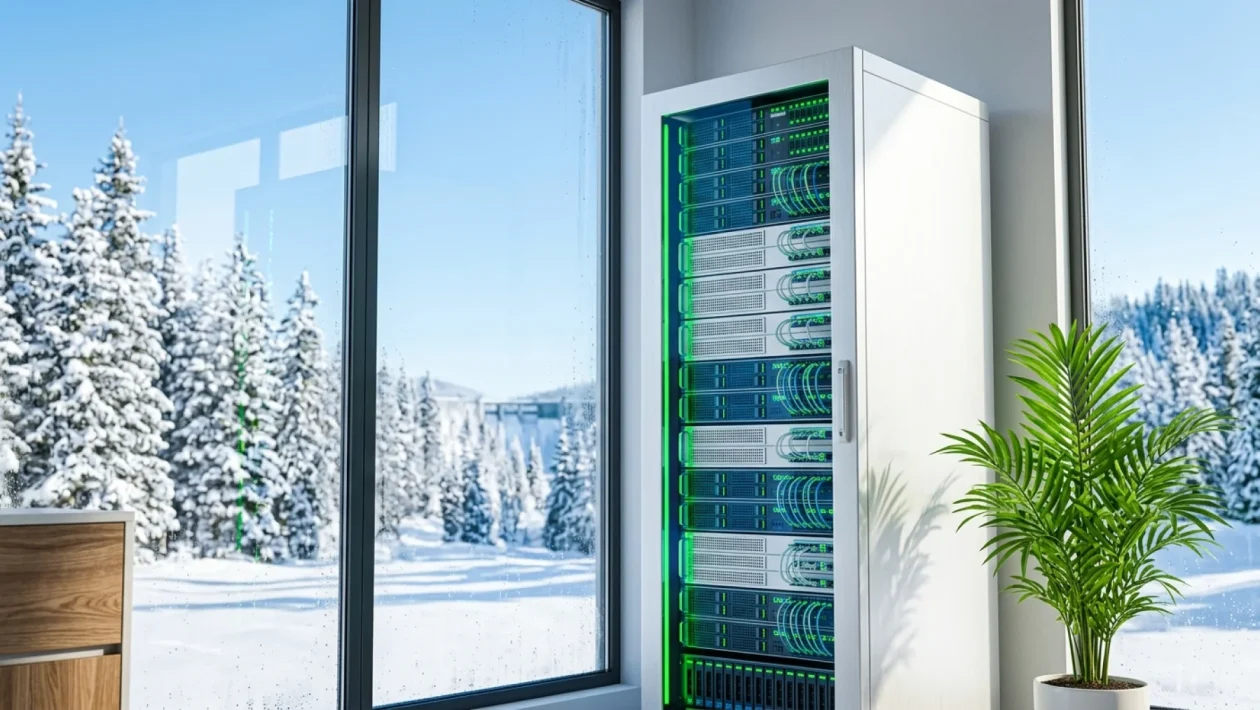
Every time you ask an AI to draft an email, stream a 4K movie, or back up your smartphone, a server rack somewhere gets hot. Really hot. Globally, our digital habits are chewing through massive amounts of electricity, but the solution isn’t to stop using the internet—it’s to rethink where the hardware lives. Green data centers in Canada are stepping up to solve the tech industry’s massive carbon footprint problem. By leveraging our natural geography and abundant renewable power, we are quietly transforming into the world’s premier destination for sustainable computing.
Cold Climates: Why Mother Nature is the Ultimate Cooling System
Cooling down thousands of humming servers traditionally requires massive, power-hungry air conditioning units. Up here in the Great White North, we take a more practical approach: we just let the outside air do the heavy lifting.
This technique, known in the industry as “free cooling” or “air-side economization,” allows facilities to use naturally frigid outside air to regulate server temperatures. It is a wildly effective way to cut down on electricity usage.
Here is a staggering reality check: cooling can account for up to 40% of a traditional data center’s total energy consumption. By simply building in a colder Canadian latitude, a facility slashes that number drastically, keeping operational costs low and environmental benefits high.
Clean Grids: Tapping into Canada’s Hydro-Powered Backbone
A cold breeze is great, but the actual power source plugged into the wall matters even more. Location dictates your carbon footprint, and in provinces like Quebec and British Columbia, the energy grid is already overwhelmingly green.
Canadian operators like QScale and eStruxture are making serious waves by leveraging networks like Hydro-Québec. They are powering massive artificial intelligence and cloud operations with up to 99% renewable hydroelectricity.
“You simply can’t claim to be a sustainable tech company if your cloud is running on a coal-fired grid. Moving heavy compute loads to regions with abundant, renewable hydropower is the absolute fastest way to decarbonize IT infrastructure,” says Sarah Jenkins, Lead Architect at the Sustainable Cloud Alliance.
When you stack up the old way of doing things against this new northern approach, the winner becomes obvious pretty quickly.
| Traditional Data Facility | Canadian Green Data Center |
|---|---|
| Relies heavily on fossil-fuel grids | Powered by 90%+ renewable hydro/wind |
| Requires mechanical AC cooling | Utilizes free air or direct liquid cooling |
| High long-term operational costs | Lower, stable long-term energy bills |
A Sustainable Tech Boom: How Facilities Actually Make the Switch
Building a greener digital footprint doesn’t happen overnight. It requires a fundamental, nuts-and-bolts shift in how we design and manage these massive digital fortresses.
As we navigate through the spring of 2026, the demand for high-density computing is only accelerating. If a tech company wants to transition to a truly sustainable model, here is the proven, step-by-step playbook:
- Audit current workloads: IT managers must first identify legacy servers that are chewing up power without delivering adequate performance.
- Migrate to renewable zones: Physically relocate high-density compute tasks—especially heavy AI training models—to hydro-powered tech hubs in Canada.
- Implement liquid cooling: Swap outdated fans for direct-to-chip liquid cooling systems, which capture and remove heat far more efficiently than air ever could.
- Recycle the exhaust heat: Capture the excess heat generated by the servers and route it into local district heating grids to warm nearby greenhouses, pools, or office buildings.
Frequently Asked Questions
Are green data centers actually reliable?
Absolutely. Sustainability never means sacrificing uptime. These modern facilities use massive battery banks and localized micro-grids to ensure full power redundancy. They consistently achieve the exact same 99.999% uptime guarantees as their older, fossil-fueled counterparts.
Why is Canada specifically favored for AI workloads?
Artificial intelligence training requires incredibly dense, high-powered server racks that generate extreme amounts of heat. Canada offers a unique combination of cheap, clean hydroelectricity and naturally low ambient temperatures. This makes it the most cost-effective and environmentally friendly place on earth to run these demanding computations.
💡 Building a sustainable digital future is no longer just a nice PR talking point—it is a critical, unavoidable infrastructure requirement.
🤝 By leaning into what we already have in abundance—cool air and clean water—Canada is proving that high-tech progress doesn’t have to come at the expense of our environment.
📱 If you are managing IT infrastructure or simply care about the hidden footprint of your daily digital life, it is definitely time to look north for the solution.
👇 Share your thoughts in the comments below, and good luck on your journey toward a greener, smarter tech setup!