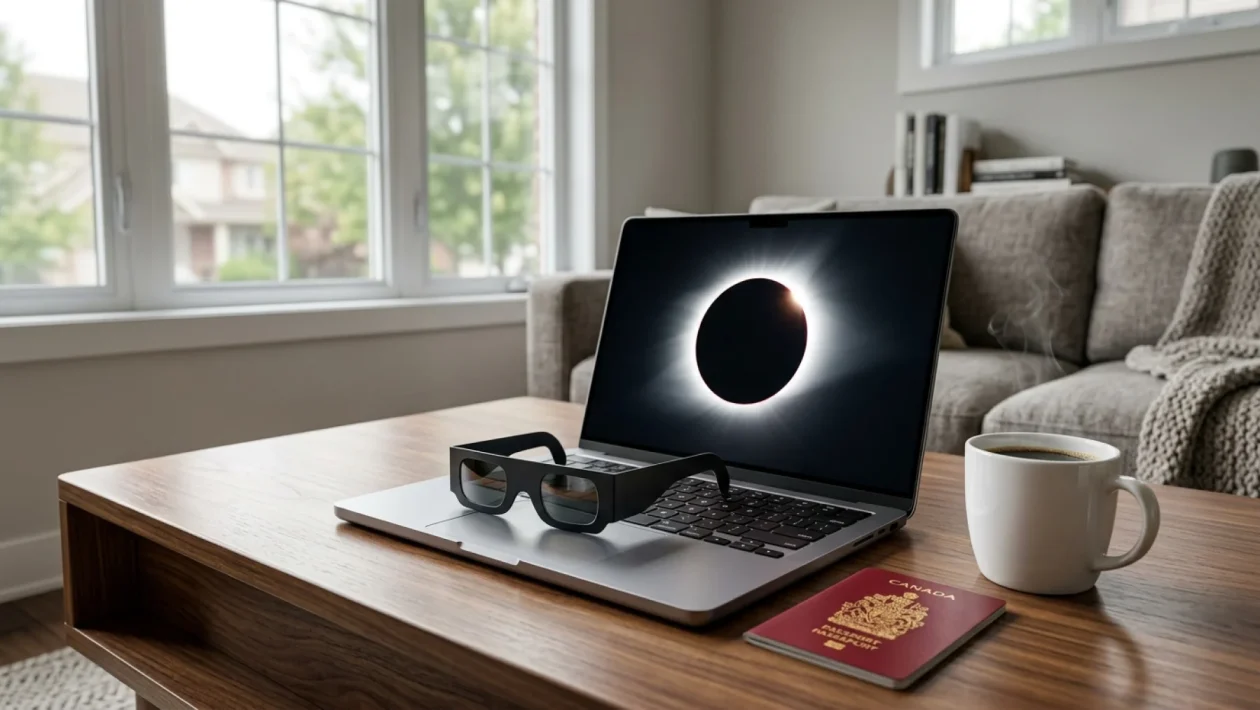
Listen up, because the clock is ticking. It is already May 2026, and in just a few short months, the sky over Europe is going to go pitch black in the middle of the afternoon. If you caught the eclipse fever that swept North America recently, you already know the unmatched thrill of seeing the sun completely vanish. This August 12th, the universe is putting on another blockbuster show, and whether you are hopping on a flight or watching from your couch in Calgary, you need a solid game plan. Let’s break down exactly how you can get in on the action without frying your retinas or missing the main event.
2026 Solar Eclipse: Why This August Event Is a Massive Deal
You might be wondering why a European eclipse matters to us on this side of the pond.
The 2026 Solar Eclipse is carving a spectacular path of totality right through Greenland, Iceland, and straight across Spain. Here is a mind-blowing hard fact: this is the very first total solar eclipse visible from mainland Spain since 1905!
For over a century, the Iberian Peninsula has been waiting for this exact moment.
The European Space Agency (ESA) is going all out, treating this like the astronomical Super Bowl. Millions of people will be looking up simultaneously, creating a shared human experience that simply does not happen every day.
The Ultimate Guide to Securing Your Gear and Safe Viewing
I cannot stress this enough: you do not mess around with eye safety.
Looking directly at the sun will cause permanent, severe damage to your eyes. Standard polarized sunglasses will not cut it, even if you paid top dollar for them at MEC.
You absolutely must use ISO-certified eclipse glasses for the partial phases of the eclipse. You only take them off during those brief, magical seconds of totality when the moon completely covers the sun.
| Viewing Method | The Verdict |
|---|---|
| In-Person (Spain/Iceland) | Unbeatable live experience. Requires flights, hotels, and ISO-certified glasses. |
| ESA Livestream (Home) | Zero cost. Completely safe. No travel stress. Perfect for North American viewers. |
Experiencing Europe’s Rare Phenomenon: The Spanish Connection
Spain is the undisputed VIP lounge for this astronomical event.
The path of totality sweeps from west to east, right over the mainland and out toward the Balearic Islands. The ESA is setting up shop at the Javalambre Astrophysical Observatory in Teruel to capture crystal-clear views from the path of totality.
Meanwhile, the city of León is hosting massive public viewing parties to bring the science directly to the streets.
“A total solar eclipse is one of those rare moments when millions of people can look at the sky at the same time and feel both awe and curiosity. It connects us to the Universe and reminds us that the desire to explore and understand is one of humanity’s greatest strengths.” — Prof. Carole Mundell, ESA Director of Science
If you were lucky enough to score an Air Canada flight across the Atlantic for this August, you are in for an unforgettable treat.
Watching Online or Abroad: How to Catch the ESA’s Historic Livestream
Not flying to Europe? No sweat.
The ESA is hosting a massive international livestream on August 12th. Hosted by renowned space scientist Dr. Maggie Aderin, the broadcast will feature top experts breaking down the deep-space science behind the spectacle.
Here is your foolproof plan to catch the digital show:
- Check the timeline: Verify the exact broadcast time and convert it to your local North American time zone so you do not tune in late.
- Find the stream: Bookmark the ESA’s Web TV or their official YouTube channel right now.
- Cast it big: Do not watch this hunched over your phone. Cast the livestream to the biggest television in your house for maximum impact.
- Download the extras: Grab the free educational kits from the ESA website to entertain the kids while you wait for totality to hit.
The broadcast will also highlight active ESA missions, like Solar Orbiter and Proba-3, showing off exactly how scientists study the sun’s volatile atmosphere.
Frequently Asked Questions About the August Eclipse
When exactly is the 2026 Solar Eclipse?
The eclipse takes place on August 12, 2026. The path of totality will move across Greenland, Iceland, and Spain, offering distinct viewing windows depending on your exact location.
Can I watch the eclipse safely without glasses?
Absolutely not. You must wear certified eclipse glasses at all times during the partial phases. You can only remove them safely during the brief window of 100% totality, putting them back on immediately as the sun re-emerges.
Where is the best place to stream the event?
The European Space Agency (ESA) is providing a free, high-definition livestream on their Web TV and YouTube channel, broadcasting live in English from a top-tier observatory in Spain.
🤝 Good luck getting your gear ready, whether you are packing your bags for a Spanish vacation or prepping the living room for a livestream watch party.
💡 Remember the golden rule: eye safety comes first. Do not ruin a great day by cutting corners on your protective eyewear.
📱 If you found this breakdown helpful, be sure to share your thoughts and forward this guide to your fellow space nerds!
👇 Drop a comment below and let me know: are you flying out for totality, or watching the ESA feed from the comfort of home?