You are paying top dollar for high-speed internet, yet your streaming still buffers the second you walk into the basement. Weak WiFi is the modern homeowner’s ultimate headache. Before you run out and drop hundreds of dollars on a fancy new mesh network or an expensive extender, look in your pantry. The ultimate solution to your connectivity nightmare is sitting right next to the plastic wrap. By using a simple piece of aluminum foil, you can physically force your internet signal exactly where you want it.
WiFi Router Foil: The Science Behind The Kitchen Staple
Most standard internet modems broadcast their signal in a massive 360-degree sphere. That means half of the internet you are paying for is likely being blasted straight into your neighbor’s yard or directly into a brick wall.
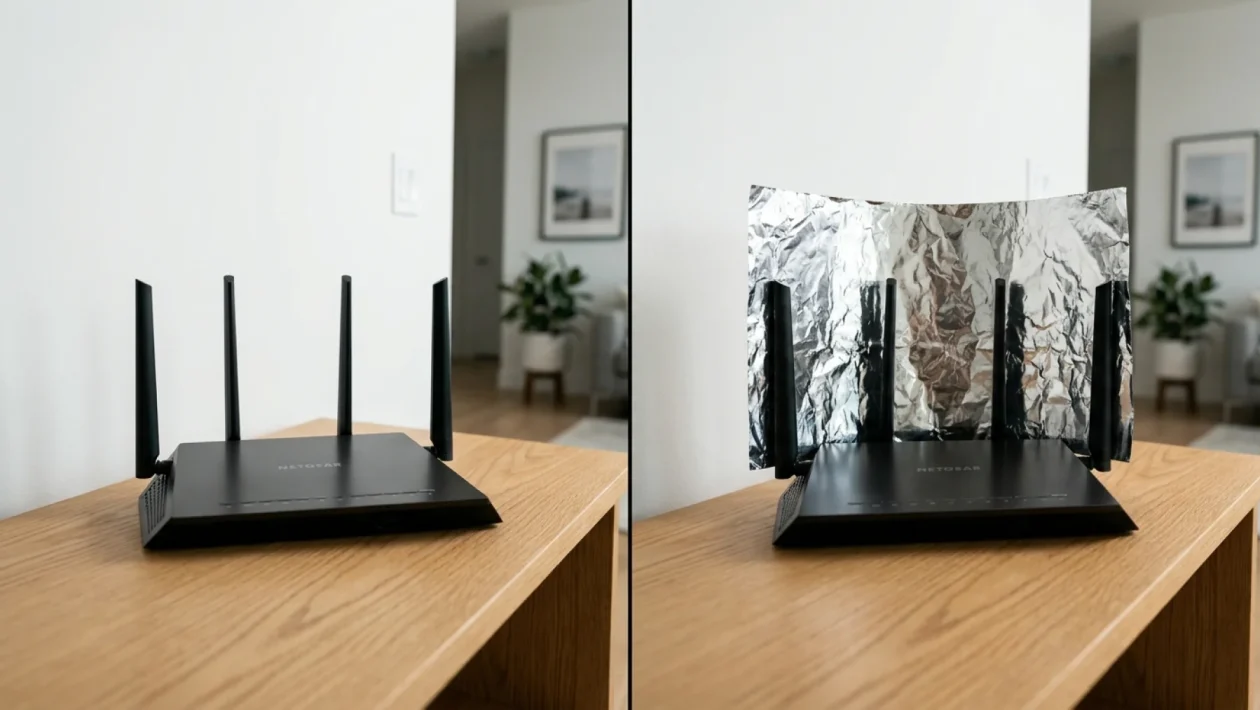
Aluminum acts as a highly effective reflector for electromagnetic waves. By placing it behind your antennas, you stop the signal from leaking backward. Instead, you push that wasted energy forward into your actual living space.
This isn’t just an urban legend. Back in 2017, researchers at Dartmouth University conducted a comprehensive study on wireless signal reflection. They found that using a metal reflector behind a router could improve signal strength by up to 50% in targeted areas.
If you are renting a standard modem from Canadian giants like Rogers or Bell, you don’t need to hack their hardware to get better performance. You just need to control the environment around it.
Eliminates Dead Zones: Bouncing The Signal Exactly Where You Need It
Thick drywall, metal appliances, and solid wood furniture are notorious for eating your internet signal. When you apply the foil method, you are essentially building a miniature satellite dish for your home.
The curved metal catches the 2.4 GHz and 5 GHz radio frequencies and bounces them into a focused beam. This allows you to specifically target that upstairs home office or the back patio where your connection always drops.
“Think of your router’s signal like a bare lightbulb in a dark room. When you add a curved piece of metal behind it, you turn that scattered glow into a focused flashlight beam.”
Keep in mind that while you are enhancing the signal in one direction, you are actively reducing it in the opposite direction. It is a strategic trade-off.
| The Foil Method | The Verdict |
|---|---|
| Cost | Practically free (pennies per sheet). |
| Speed Boost | Typically a 10% to 20% improvement in targeted rooms. |
| Drawback | Reduces WiFi coverage directly behind the foil barrier. |
Boosts Speed: A Step-By-Step Guide To A Faster Connection
You do not need an engineering degree to pull this off. Here is exactly how to optimize your network in under five minutes.
- Unplug your equipment: Always disconnect the power from your router before moving it around to avoid electrical surges.
- Measure and cut: Tear off a sheet of standard kitchen aluminum foil that is roughly 20 by 30 centimeters.
- Create the curve: Bend the foil gently so it mimics a shallow “C” shape or a parabolic dish.
- Position the shield: Stand the curved foil directly behind the router. The open side of the curve should face the exact direction where you need better internet.
- Test the speed: Plug the router back in, walk to your notorious dead zone, and run a speed test on your phone.
It really is that simple. You are just physically telling the invisible waves where to go.
Frequently Asked Questions
Will this cause my router to overheat?
It can, but only if you do it wrong. Never wrap the modem tightly in foil. Routers generate heat, and wrapping them will trap that heat, potentially frying the internal components. The foil should stand behind the unit like a freestanding wall, not like a tailored suit.
Does this work better than buying a WiFi repeater?
It depends on your house layout. Foil is a fantastic, free stopgap measure for minor dead zones. However, if you live in a sprawling 4,000-square-foot home, you will eventually need to upgrade to a proper hardware solution. This is a brilliant temporary fix, not a permanent infrastructure upgrade.
Can I use a pop can instead of tin foil?
Yes. An empty, washed-out aluminum beer or soda can cut in half vertically works on the exact same scientific principle. It is just a bit sharper and harder to manipulate than a flexible sheet of kitchen foil.
🤝 It is incredibly satisfying to fix a frustrating tech problem with something you already have in the kitchen drawer. Taking control of your home network doesn’t always require a call to customer support.
💡 Give this a try this weekend before you spend your hard-earned money on expensive gadgets. You might just be shocked by how fast your streaming becomes.
📱 If this little trick saved your home office setup, share your thoughts with us online! Good luck, and happy browsing.