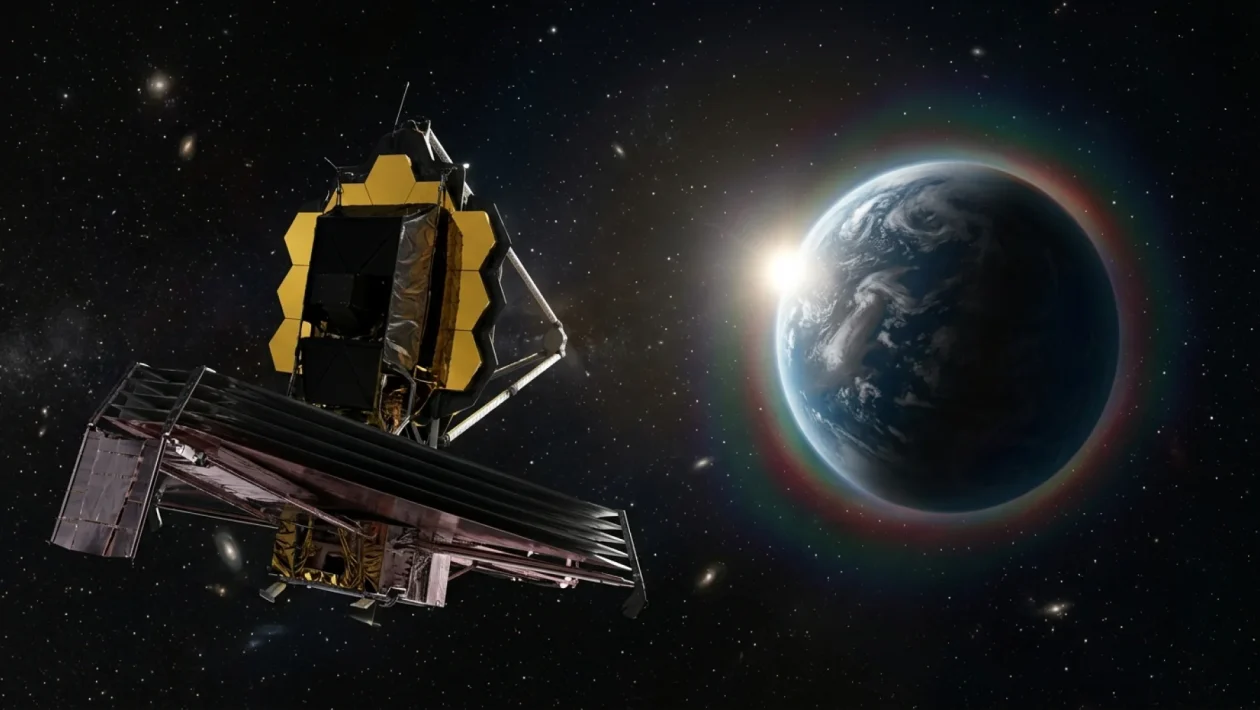
Right now, floating a million miles away in the freezing vacuum of space, a giant golden eye is staring intensely at a speck of light 120 light-years away. That speck is an alien world, and the light filtering through its atmosphere is carrying a chemical secret that could permanently alter the trajectory of human history. We aren’t listening for radio signals or looking for flying saucers anymore. Instead, astrophysicists are hunting for invisible chemical fingerprints floating in the skies of distant worlds.
As we navigate through the spring of 2026, the sheer volume of data beaming back to Earth is staggering. The quest to answer “Are we alone?” has shifted from philosophical late-night dorm room debates to cold, hard atmospheric chemistry. If alien life exists in our galactic neighborhood, we are finally holding the exact tool needed to prove it.
The James Webb Telescope: A Time Machine Built for Chemistry
To understand how we can sniff out alien oceans from 700 trillion miles away, you have to understand the machine doing the heavy lifting. The James Webb Space Telescope (JWST) is the most audacious engineering marvel in the history of spaceflight. Unlike Hubble, which primarily looked at visible light, Webb is an infrared powerhouse.
Infrared light cuts through cosmic dust, revealing the hidden chemical makeup of the universe. It’s exactly what you need to peer into the atmosphere of a planet orbiting a completely different sun. And it doesn’t do it alone. Thanks to the Canadian Space Agency (CSA), Webb is equipped with the Fine Guidance Sensor—a crucial instrument that keeps the telescope locked onto a target with the precision of holding a laser pointer steady on a dime located hundreds of miles away.
Cracking the Code: What Are Biosignatures?
When scientists talk about Webb exoplanet biosignatures, they are talking about atmospheric gases that have no business existing together unless something living is constantly pumping them out. Take Earth, for example. Our atmosphere is loaded with oxygen and methane. If all life on Earth suddenly vanished, those gases would quickly react with each other and disappear.
Life is the engine that keeps our atmosphere out of chemical equilibrium. Webb is hunting for that exact same imbalance on other planets. Scientists are desperately looking for traces of methane, carbon dioxide, and specifically, a compound called dimethyl sulfide (DMS). Here on Earth, DMS is only produced by biological life—mostly marine phytoplankton.
“We are no longer looking at exoplanets as just dots on a graph. With Webb, we are watching alien weather patterns, reading their atmospheric chemistry, and searching for the very exhaust fumes of biological life.”
— Dr. Sarah Thompson, Exoplanet Atmospheric Specialist
Targeting the Perfect Exoplanet
You can’t just point a ten-billion-dollar telescope anywhere. You need the perfect target. Astronomers focus on exoplanets situated in the “Goldilocks Zone”—the precise orbit around a star where it’s not too hot and not too cold, allowing liquid water to exist on the planet’s surface.
One of the most thrilling targets of 2026 is K2-18b, a massive “Hycean” world. This means it likely features a thick, hydrogen-rich atmosphere blanketing a globe-spanning liquid water ocean. Let’s look at how it stacks up against our own pale blue dot.
| Planetary Feature | Earth | Exoplanet K2-18b |
|---|---|---|
| Distance from Sun | 93 million miles | 120 light-years (700 trillion miles) |
| Dominant Surface | 71% Water Ocean | Potential Globe-Spanning Ocean |
| Atmosphere Type | Nitrogen & Oxygen | Hydrogen-Rich |
How We Actually Detect an Alien Biosignature
The concept of reading an alien atmosphere sounds like science fiction magic, but it actually relies on a brilliant technique called transmission spectroscopy. Here is exactly how NASA and global astronomers pull off this cosmic magic trick:
- Wait for the Transit: Astronomers wait for the exact moment the target exoplanet crosses directly in front of its host star.
- Capture the Starlight: As the starlight hits the planet, a tiny fraction of that light filters through the edges of the planet’s atmosphere before continuing its journey toward Earth.
- Split the Light: Webb’s spectrographs act like high-tech prisms, breaking that filtered starlight into a rainbow barcode.
- Read the Missing Lines: Different chemical molecules (like water, methane, or CO2) absorb very specific colors of infrared light. By looking at which colors are “missing” from the barcode, scientists know exactly which gases are floating in the alien sky.
Frequently Asked Questions
Can the James Webb Telescope see the actual surface of an exoplanet?
No, even with Webb’s unprecedented power, exoplanets are simply too far away and too small to photograph directly like we do with Mars or Jupiter. Webb sees these planets as single pixels of light. The magic happens by analyzing the spectrum of that light, not by taking a high-definition photograph of alien continents.
What happens if a definitive biosignature is found?
If scientists confirm a gas like dimethyl sulfide on an exoplanet, it won’t be an overnight press conference. The data will undergo months of rigorous peer review by independent global teams. Once verified, it would strongly suggest the presence of a vast biological ecosystem, fundamentally shifting our understanding of life in the universe.
Why are we focusing on red dwarf stars?
Red dwarf stars are much smaller, cooler, and dimmer than our Sun. Because they are so small, an exoplanet transiting in front of them blocks a larger percentage of the star’s light. This makes the crucial chemical atmospheric signatures much easier for Webb’s sensors to catch and analyze.
🚀 Keep looking up! We are living through a golden era of space exploration, where the boundaries of what we thought was impossible are being shattered daily.
🔭 Every time a new batch of data hits the servers, we inch closer to realizing that our universe is far more dynamic, wild, and potentially crowded than we ever imagined.
🌌 Share your thoughts on this cosmic hunt, and let us know which exoplanet you think might be hiding the universe’s best-kept secret!
👇 Dive into the cosmos and stay tuned—the next great discovery might be just one transit away.