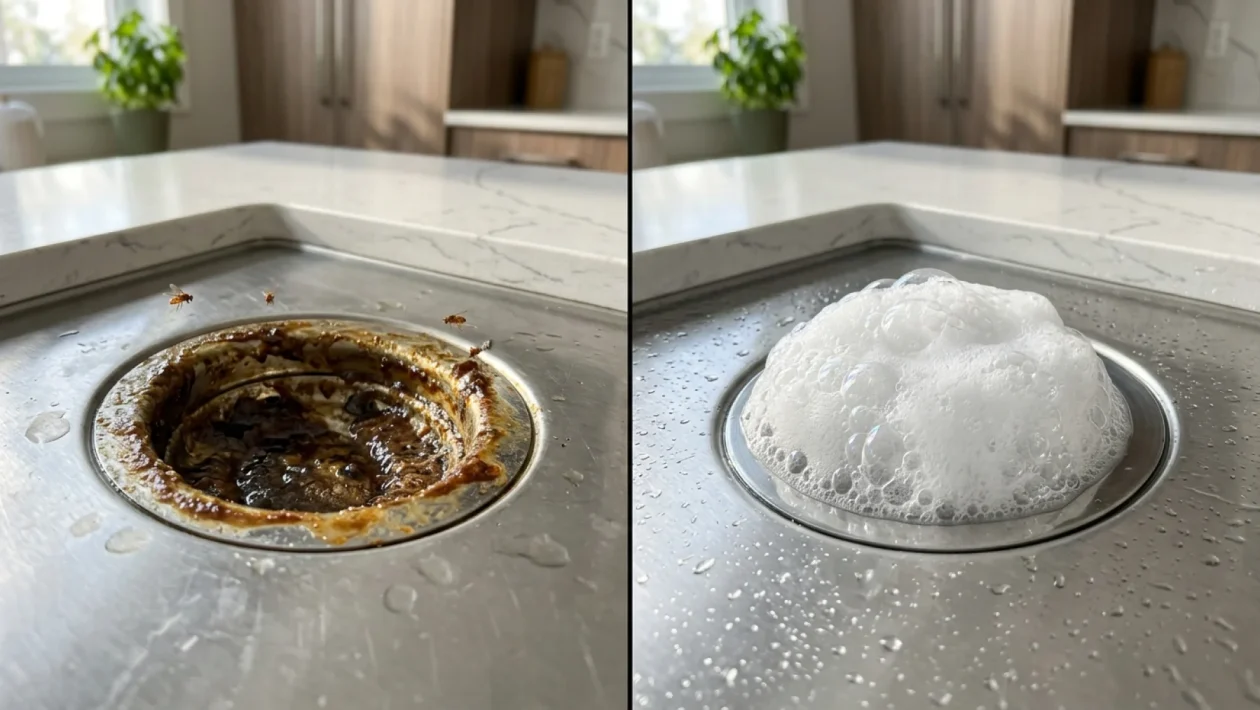
You step up to your kitchen sink to rinse out a coffee mug, and suddenly you are blasted by a smell that belongs in a city sewer. Sink drain odors are the ultimate buzzkill, turning your pristine kitchen into a fast-food buffet for swarms of annoying fruit flies.
Before you run off to Canadian Tire to dump half your paycheck on aggressively toxic pipe gels, let me stop you right there. The secret to a perfectly clean drain isn’t the strength of the chemical you pour, but how long the cleaning agent actually stays inside the pipe.
I am going to show you how a single cup of sodium percarbonate and a basic grocery bag will completely obliterate that nasty sludge in exactly five minutes.
Sink Drain Odors Banished: Why Your Pipes Smell So Bad Right Now
It is July 2026, and the elevated indoor temperatures are causing the grease, oil, and food scraps stuck inside your plumbing to decompose at an alarming rate. This forms a hardened, rancid layer of sludge that standard running tap water simply cannot budge.
Plumbing data reveals a shocking reality: an estimated 70% of persistent kitchen odors originate directly from the decomposing biofilm located in just the top four inches of your drain pipe.
That sticky, rotting layer is the exact food source attracting every fruit fly in a ten-mile radius. If you want to permanently banish the smell, you have to melt away that grease.
The 5-Minute Foam Method: Creating A Chemical Reaction That Does The Heavy Lifting
Here is where the real magic happens. When you combine sodium percarbonate with boiling water, it instantly creates a massive, expanding foam. But letting that foam wash straight down the drain is a rookie mistake.
We are going to trap it. By intentionally sealing the drain hole, we force that intense, oxygenated foam to sit and expand against the pipe walls, aggressively breaking down the stubborn grime.
“Most homeowners waste their hard-earned money on liquid cleaners because the fluid flows straight past the problem area. Dwell time is everything; trapping a foaming agent against the pipe walls is what actually rips off the hardened bio-sludge.” – Master Plumber, Dave Harris
Destroys Grease And Fruit Flies: The Ultimate Step-By-Step Attack Plan
Ready to roll up your sleeves and get this sorted? It is incredibly easy, but you need to follow these precise steps to maximize the foam’s effectiveness.
- Prep and Ventilate: Open your kitchen window and turn on your stove’s exhaust fan. Sodium percarbonate releases steam when it reacts, and you want fresh air circulating.
- Plug the Hole: Remove your metal sink strainer. Crumple up some toilet paper, stuff it inside a small plastic sandwich bag, and jam it firmly into the drain hole to create a watertight seal.
- Add the Powder: Pour exactly one paper cup’s worth of sodium percarbonate directly into the drain basin, right on top of your makeshift plug.
- Activate the Foam: Slowly pour boiling water over the powder. The second the foam erupts, slap another plastic bag or a damp cloth over the top of the drain to trap the chemical reaction inside.
- Wait and Rinse: Walk away for exactly 5 minutes. Afterward, remove the bags, give the basin a quick scrub with a bristle brush, and flush the entire system with plenty of warm tap water.
Still on the fence about ditching your store-bought liquids? Let’s look at the financial and practical breakdown:
| Commercial Liquid Pipe Gels | The 5-Minute Foam Method |
|---|---|
| Highly toxic, expensive ($10-$15 per bottle) | Incredibly cheap ($3 per massive bag) |
| Washes away too quickly to dissolve hardened fat | Expands and clings to pipes for maximum cleaning |
Frequently Asked Questions
Is sodium percarbonate safe for my kitchen plumbing?
Absolutely. Unlike highly corrosive liquid drain cleaners that can literally eat away at older PVC or metal pipes, this oxygen-based powder is surprisingly gentle on your plumbing infrastructure while remaining absolutely ruthless on organic matter.
How often should I repeat this process?
To keep the fruit flies permanently locked out and your sink smelling perfectly fresh, make this a weekly habit. A quick 5-minute foaming session every Sunday morning will keep your pipes pristine all year long.
🤝 Look, home maintenance does not have to be complicated or require a cabinet full of hazardous, expensive chemicals. A simple understanding of how things work goes a long, long way in keeping your home in top shape.
💡 Try this out tonight and watch how fast your kitchen transforms back into a place you actually want to cook in. Your nose, your wallet, and your sanity will immediately thank you.
📱 Share your thoughts and let me know exactly how much hidden gunk this method pulled out of your sink basin! Good luck, and keep those drains flowing smoothly.