Your house is a brick oven, every portable air conditioner at Canadian Tire is completely sold out, and staring at your July 2026 hydro bill feels like a punch to the gut. You don’t need another noisy box fan pushing hot air around your living room. The ultimate solution is a high-pressure plumbing setup currently taking China by storm, designed to turn your roof into a massive, energy-efficient outdoor cooler.
We are talking about a system that blasts microscopic water droplets down the side of your home, effectively cooling the surrounding air by up to 8 degrees Celsius. It requires a fraction of the electricity of a traditional A/C compressor and tackles urban heat directly at the source.
The Chinese Cooling Method: What Exactly Is It?
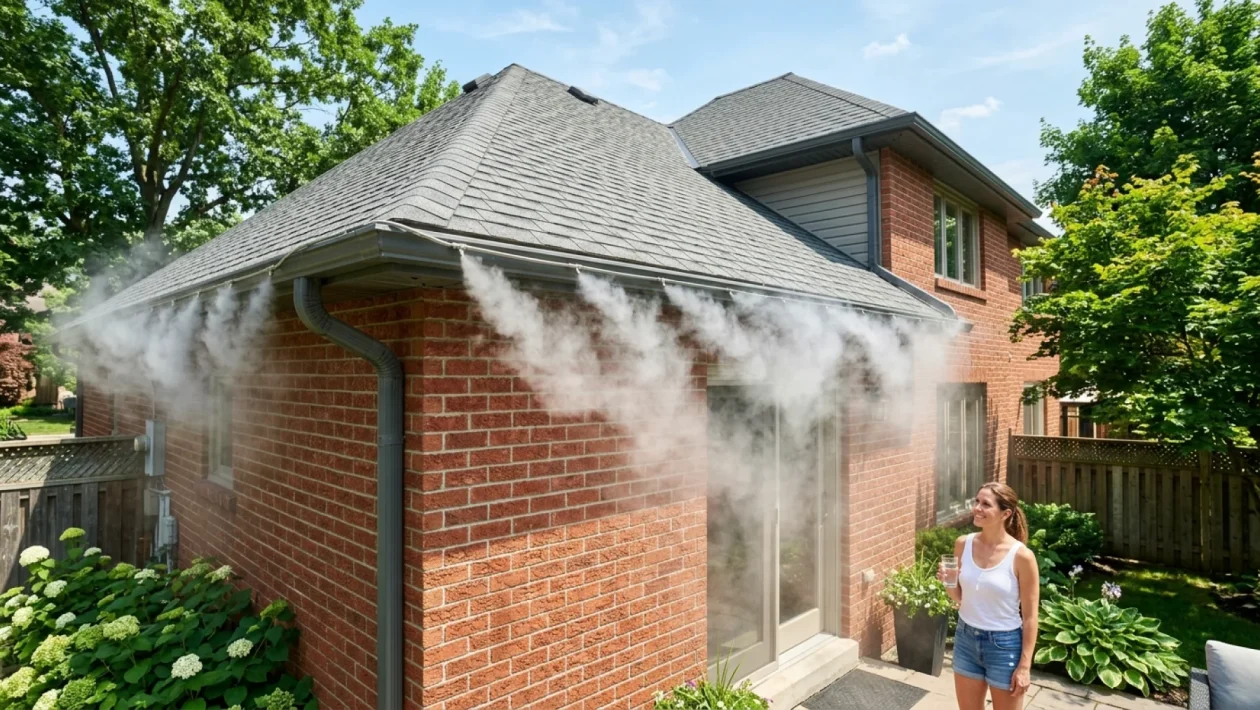
If you scroll through social media right now, you might see footage from the Chinese city of Yuncheng showing massive apartment buildings draped in what looks like thick, rolling clouds. It looks like a special effect, but it is actually a hardcore, highly practical urban cooling strategy.
Instead of relying on millions of individual air conditioning units pumping hot exhaust back into the streets, these buildings use a network of specialized high-pressure nozzles installed along the roofline. These nozzles blanket the building’s facade in a thick, artificial fog.
This isn’t just about cooling the people inside. It cools the brick, the concrete pavement below, and the ambient outdoor air, preventing these surfaces from acting like giant thermal batteries that radiate heat into the night.
Dropping Temperatures by 8 Degrees: The Science of Evaporation
So, how does spraying water actually delete heat from the air? The secret weapon here is evaporative cooling. It is the exact same biological mechanism your body uses when you sweat.
- Pressurization: A heavy-duty pump forces water through micro-nozzles at incredibly high pressure.
- Atomization: The water is shattered into microscopic droplets, creating a fine mist rather than a heavy spray.
- Flash Evaporation: Because the droplets are so tiny, they evaporate almost instantly upon hitting the hot summer air.
- Heat Extraction: The chemical process of turning liquid water into gas requires energy, which it steals directly from the surrounding air heat, plummeting the local temperature.
Here is a staggering fact: According to thermodynamic engineers, evaporating just one gallon of water removes 8,000 BTUs of heat from the air. That is nearly the equivalent cooling power of a standard bedroom window A/C unit running for a full hour!
“When you rely on high-pressure misting in a dry climate, you are fundamentally changing the micro-climate of your property. You aren’t fighting the heat; you are literally absorbing it out of the atmosphere.”
While A/Cs Sell Out: Why This System Changes the Game
With record heatwaves hammering North America, local hardware stores like RONA and Home Depot are seeing their cooling aisles cleared out in hours. Second-hand markets are flooded with desperate buyers. But traditional A/Cs have a fatal flaw: they use massive amounts of electricity.
Where a traditional A/C relies on a power-hungry compressor, a roof misting system relies primarily on a simple water pump and gravity. This makes it incredibly efficient for outdoor public spaces, patios, and large housing complexes.
| Cooling Method | The Bottom Line |
|---|---|
| Roof Misting System | Ultra-low electricity usage, cools outdoor areas, requires steady water supply. Best in dry heat. |
| Traditional A/C | High power consumption, indoor use only, dumps heat outside. Works in all humidities. |
There is a catch, however. Evaporative cooling demands dry air to work efficiently. If you live in the arid heat of Calgary or Kamloops, this system is a silver bullet. But if you are sweating through a brutally humid July in Toronto, the air is already too saturated to absorb much more water, making the misting effect far less impressive.
FAQ Section
Is it safe to use tap water for these systems?
While tap water works, experts strongly warn against it due to the high volume required during droughts. For a system to be truly sustainable, it should be hooked up to a robust rainwater harvesting setup or greywater recycling system.
Will a roof misting system cause mold on my siding?
If calibrated correctly, no. True high-pressure systems (running at 1,000 PSI or more) create “dry mist.” The water droplets are so small they flash-evaporate before they ever physically wet the surfaces or the ground below.
Can I build one myself?
You can buy basic low-pressure misting kits for your patio, but they will leave your deck soaking wet. A true roof-level cooling system requires professional-grade, high-pressure pumps and stainless steel lines to achieve that instant evaporation.
🤝 Share your thoughts below! Have you ever tried an outdoor misting system during a brutal heatwave, or are you strictly loyal to your indoor A/C?
💡 If you live in a dry climate, this might just be the weekend project that saves your sanity and your wallet next time the mercury spikes.
📱 Pass this along to that one friend who is constantly complaining about their summer hydro bills.
👇 Good luck staying cool out there, and remember: sometimes the best way to beat the heat is to work with nature, not against it.