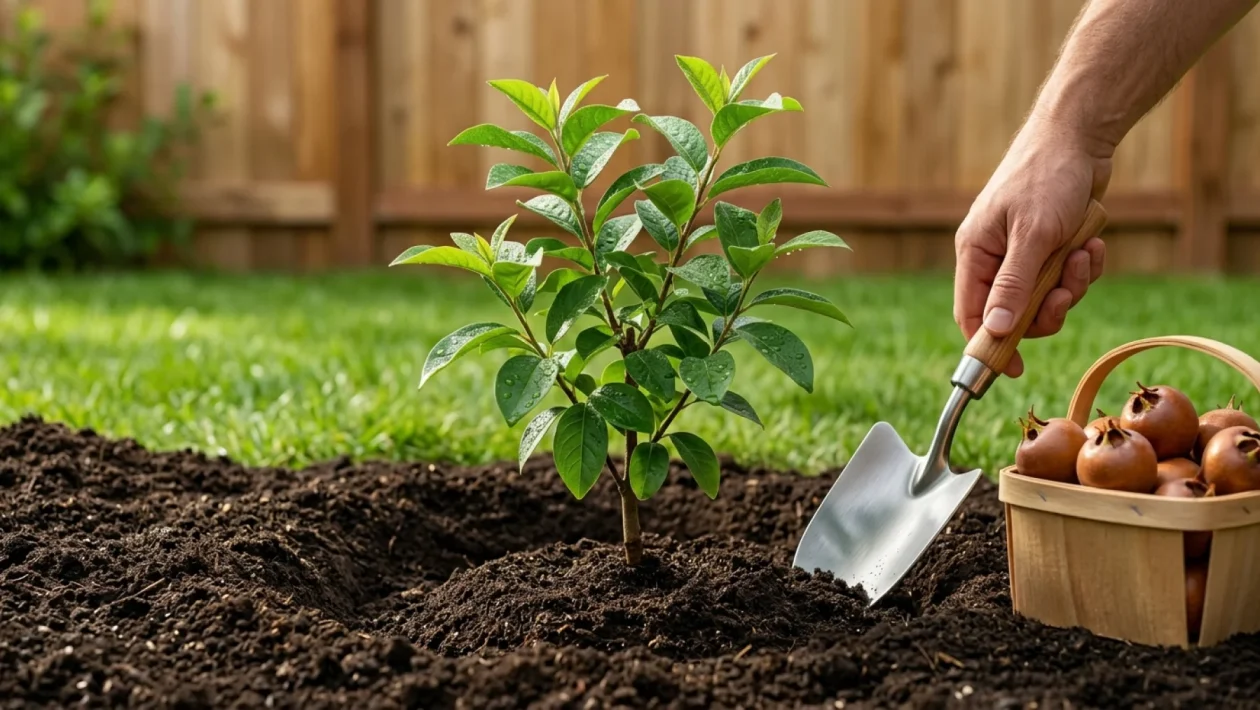
You’re staring at your backyard wondering why you’re waiting until autumn or spring to get fruit trees in the ground. The reality is, if you hold off, you’re throwing away an entire growing season of root establishment. Enter the common medlar (Mespilus germanica). It’s an absolute tank of a fruit tree that thrives in our rugged North American climates, easily shrugging off temperatures down to a bone-chilling -20°C.
By taking aggressive action this July, you completely bypass the standard waiting game. With the right technique, you can force this tree to anchor down immediately and set yourself up for a surprising harvest in record time.
Medlar Tree Planting: Why This Ancient Survivor Belongs In Your Yard
Let’s get straight to it: the medlar isn’t the fragile, fussy ornamental you’re used to nursing through the frost. It’s a rugged, low-maintenance beast of a tree that demands very little of your time once it takes hold.
Ask any old-school orchard expert browsing the aisles at Sheridan Nurseries, and they’ll tell you this compact tree is the ultimate secret weapon for smaller, modern yards. It tops out at a manageable size, pumps out beautiful spring blossoms to attract pollinators, and requires almost zero pruning.
Here’s a wild fact: Medlars have been actively cultivated for over 3,000 years, yet fewer than 5% of modern North American gardeners have them in their rotation today. You are tapping into a forgotten piece of agricultural history.
The Ultimate July Move: Breaking The Traditional Planting Rules
Conventional landscaping wisdom screams at you to plant fruit trees strictly from November to April. We’re throwing that archaic rulebook out the window.
When you execute your medlar tree planting right in the middle of summer, the naturally warm soil acts like a high-speed incubator for root growth. You are capitalizing on the peak energy of the season.
“Planting a dormant tree in cold soil is safe, but getting a medlar into warm July earth with aggressive hydration forces explosive root development. You’re effectively buying an entire year of maturity in just a few weeks.” – Dr. Arnie Veen, Pomology Specialist.
The catch? You can’t just toss a sapling into the dirt and walk away to grab a beer. Summer planting requires a highly specific, tactical battle plan.
Securing A Massive Fruit Harvest: Soil, Water, And Mulch
You want heavy fruit production fast? You need to nail the installation on day one. Here is your fail-proof blueprint for a mid-summer planting operation.
- Pick the spot: Find a location with full sun to light shade, keeping it shielded from harsh winter winds. Give the tree 3 to 4 meters of horizontal breathing room.
- Dig deep: Excavate a hole at least 50 centimeters deep to fully decompact the subsoil. Mix your native dirt with a heavy dose of ripe compost or aged manure.
- Set the collar: Drop the root ball in, ensuring the root collar sits perfectly level with the surrounding ground. Burying the trunk spells instant death.
- Flood the zone: Hit the base immediately with 10 to 15 liters of water. Shallow watering is the enemy here; you must soak it to the absolute core.
- Lock in moisture: Lay down a massive layer of heavy mulch right up to (but not touching) the trunk to prevent brutal summer evaporation.
Next Fall’s Payoff: Bletting And Enjoying Your Early Yield
If you follow those steps and keep the roots heavily watered during dry spells, you’ll likely see your first actual medlars appear by the very next autumn. It’s an incredibly fast turnaround for a hardwood fruit tree.
| Summer Strategy | Expected Outcome |
|---|---|
| 15 Liters of water + thick mulch layer | Vigorous summer root expansion |
| Planting midday in direct, blistering sun | Total tree shock and failure |
| Frequent, shallow misting with a hose | Weak, surface-level roots |
| Applying heavy compost deep in the hole | Accelerated fruit production by Year 2 |
Harvesting these little brown fruits requires a unique process called “bletting.” You simply leave them hanging on the branches until the first hard frost hits, or pick them raw and let them soften in a wooden crate in your garage.
Once soft, the pulp is incredible. It tastes exactly like spiced apple butter or complex cinnamon applesauce. It is absolutely perfect for rich jams, jellies, or just eating straight out of the skin with a spoon.
Frequently Asked Questions
Can a medlar tree actually survive our winters?
Absolutely. The common medlar is built like a tank and is hardy right down to -20°C. Just be careful not to confuse it with the Japanese loquat (often called a Japanese medlar), which is highly sensitive to frost and will not survive a hard freeze.
Why is my newly planted tree wilting in the July heat?
You’re almost certainly underwatering it. A fresh summer plant needs a massive, deep soak—up to 15 liters per session. Never let the surrounding weeds compete for that moisture. Grab a heavy-duty hoe from Lee Valley Tools and keep that base perfectly clear.
Do I need to plant two medlar trees to get fruit?
Not at all. Medlar trees are self-fertile. A single tree will produce a fantastic, heavy harvest all on its own, making it the perfect standalone feature for a smaller property.
🤝 Good luck getting your hands dirty this weekend! Taking a chance on an ancient, resilient fruit tree is honestly one of the most rewarding backyard projects you can tackle.
💡 Remember, the absolute secret sauce is just keeping those roots cool and drowning in moisture while the fierce July sun beats down on the canopy.
📱 If you pull this off properly, you’ll be eating homegrown medlar jam while your neighbors are still waiting for their spring-planted trees to simply wake up.
👇 Drop a comment below and share your thoughts—are you going to plant a medlar this summer, or are you sticking to the standard apples and pears?