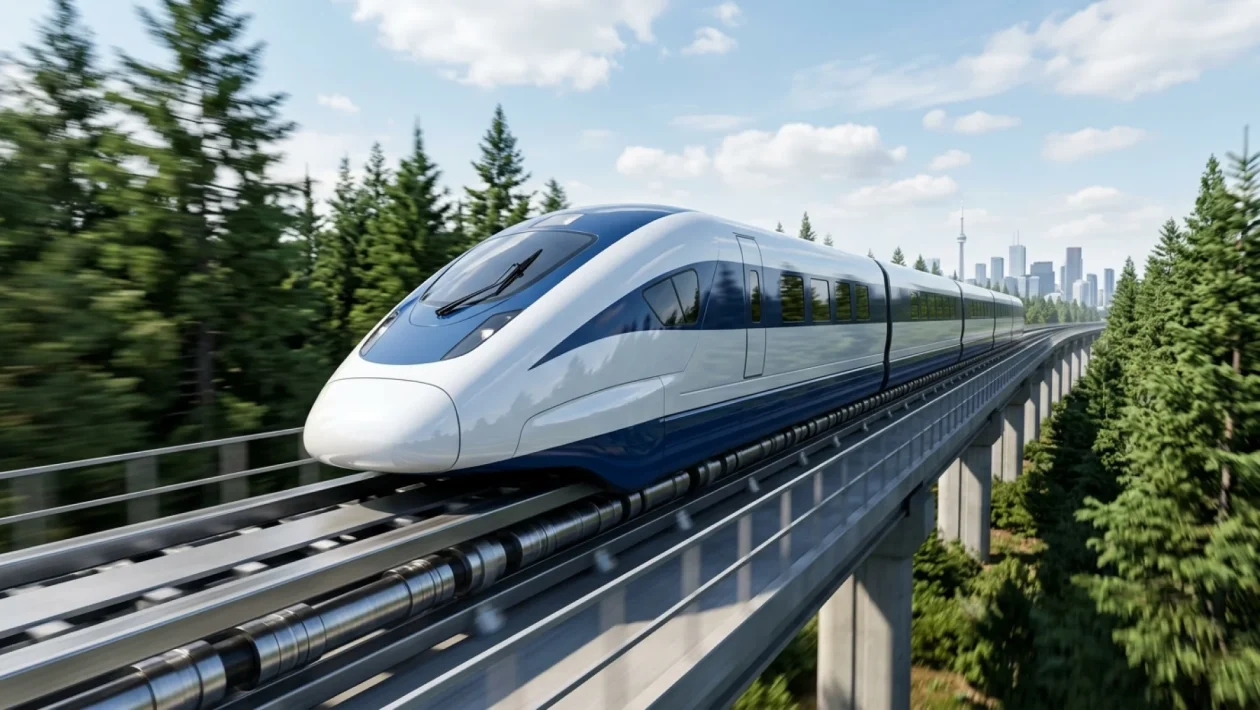
Picture yourself boarding a train in downtown Toronto and stepping off in Montreal just over an hour later. No airport security lines, no waiting on the tarmac, and absolutely zero turbulence. We have all endured the soul-crushing crawl of a heavily delayed VIA Rail train or a cramped domestic flight, wondering why North American travel feels stuck in the past. The solution is already ripping through the Japanese countryside at mind-bending speeds, defying gravity and redefining modern transit.
Japan has officially shattered the limits of physical infrastructure with its Superconducting Maglev (SCMaglev). This isn’t just a fast locomotive; it is a levitating bullet that entirely eliminates ground friction. By throwing out the old steel-on-steel playbook, engineers have unlocked travel times that compete directly with the airline industry.
Maglev Train Tech Hits 603 km/h
To understand the sheer magnitude of this breakthrough, you have to look at the raw numbers. During testing, a Japanese Maglev prototype clocked a staggering, record-breaking speed of 603 km/h. At that pace, you are traveling faster than a single-engine Cessna aircraft, but safely guided along a terrestrial track.
The impact on travel times is hard to wrap your head around. Over in Europe, analysts calculated that if this Japanese technology were dropped into the Iberian Peninsula, the busy route between Madrid and Barcelona would be utterly crushed in just 75 minutes. That cuts current high-speed rail times in half.
Applying that same math to our own backyard changes everything. A 75-minute rail commute from Toronto to Montreal, or Vancouver to Seattle, completely eliminates the need for short-haul flights. Why book a ticket on Air Canada when a train gets you from city center to city center faster, cheaper, and with vastly more legroom?
Why Floating Commutes Are A Reality
So, how exactly does a massive, multi-ton commuter train achieve the velocity of a commercial jet without rattling its passengers to the bone? The secret sauce is Electrodynamic Suspension (EDS), a system that literally forces the train to fly just above the ground.
The transition from a rolling vehicle to a hovering spacecraft is a marvel of modern physics. Here is exactly how the Maglev pulls it off:
- The train initially rolls out of the station on heavy-duty rubber wheels, building up momentum like a standard transit vehicle.
- Once the speedometer crosses the 150 km/h threshold, the track’s figure-eight metal coils activate the superconducting magnets.
- The intense magnetic force violently repels the train, lifting the entire convoy precisely 100 millimeters into the air.
- With the wheels retracted and zero physical friction holding it back, the train is propelled forward purely by alternating magnetic currents.
Because the train is hovering, there are virtually no mechanical vibrations. You could balance a cup of hot coffee on your tray table at 500 km/h, and it wouldn’t spill a drop.
Could Replace North American Flights
If the technology is this good, why aren’t we currently hovering our way to work? As with most mega-engineering projects, the physics are brilliant, but the financials are brutal.
Japan’s current Chuo Shinkansen line project, designed to connect Tokyo, Nagoya, and eventually Osaka, is carrying an eye-watering price tag of roughly 55 billion euros. To put that into perspective, that is roughly five times the entire annual transport budget of a country like Spain.
“When you eliminate friction, you eliminate the mechanical limits of traditional rail. The real hurdle isn’t physics anymore; it’s navigating the astronomical costs of custom, underground infrastructure.”
You cannot just drop a Maglev train onto existing tracks. The system requires a completely proprietary guideway. In Japan’s case, 80% of the new route has to be buried deep underground to navigate mountains and dense urban sprawl, driving civil engineering costs through the roof.
| Traditional High-Speed Rail | SCMaglev Technology |
|---|---|
| Uses existing steel tracks and networks. | Requires 100% new, proprietary guideways. |
| Max speeds top out around 320 km/h. | Cruising speeds easily exceed 500-603 km/h. |
| Lower energy consumption per trip. | Massive electrical power needed for levitation. |
| Cheaper to build, moderate maintenance. | Astronomical upfront costs, zero track wear. |
Despite these hurdles, the United States is already running feasibility studies for Maglev corridors between New York and Washington, D.C., as well as massive routes in California. If North America wants to heavily reduce its carbon footprint and unclog its airspace by the 2030s, this is the silver bullet.
Frequently Asked Questions
When will Japan’s Maglev line open to the public?
The initial Tokyo-to-Nagoya segment was slated for 2027. However, massive construction complexities and environmental evaluations have pushed the realistic operational date well past 2037.
Is magnetic levitation safe for passengers?
Incredibly safe. The magnetic fields are strictly contained, and the wraparound design of the guideway makes traditional derailments virtually impossible. Japan’s older Shinkansen lines have run for six decades without a single fatal passenger accident, and the Maglev is engineered to exceed that standard.
Can existing trains be upgraded to Maglev?
No. Maglev is a completely different mode of transit. It requires entirely new infrastructure, vastly different power grids, and specialized tunnels that can handle the massive air displacement created by traveling at 600 km/h.
The Future is Floating
💡 Make no mistake, the era of domestic short-haul flights is living on borrowed time. Once the first commercial Maglev line proves its financial viability, the global transit landscape will shift overnight.
📱 Share your thoughts with us below. Would you give up your airline miles for a guaranteed 75-minute floating commute between major North American cities?
🤝 Good luck to the aviation industry, because once passengers experience frictionless travel at 603 km/h, nobody is going back to the middle seat of a commercial jet.
👇 Keep an eye out for upcoming pilot projects in the US, and cross your fingers that Canadian infrastructure planners are taking detailed notes.