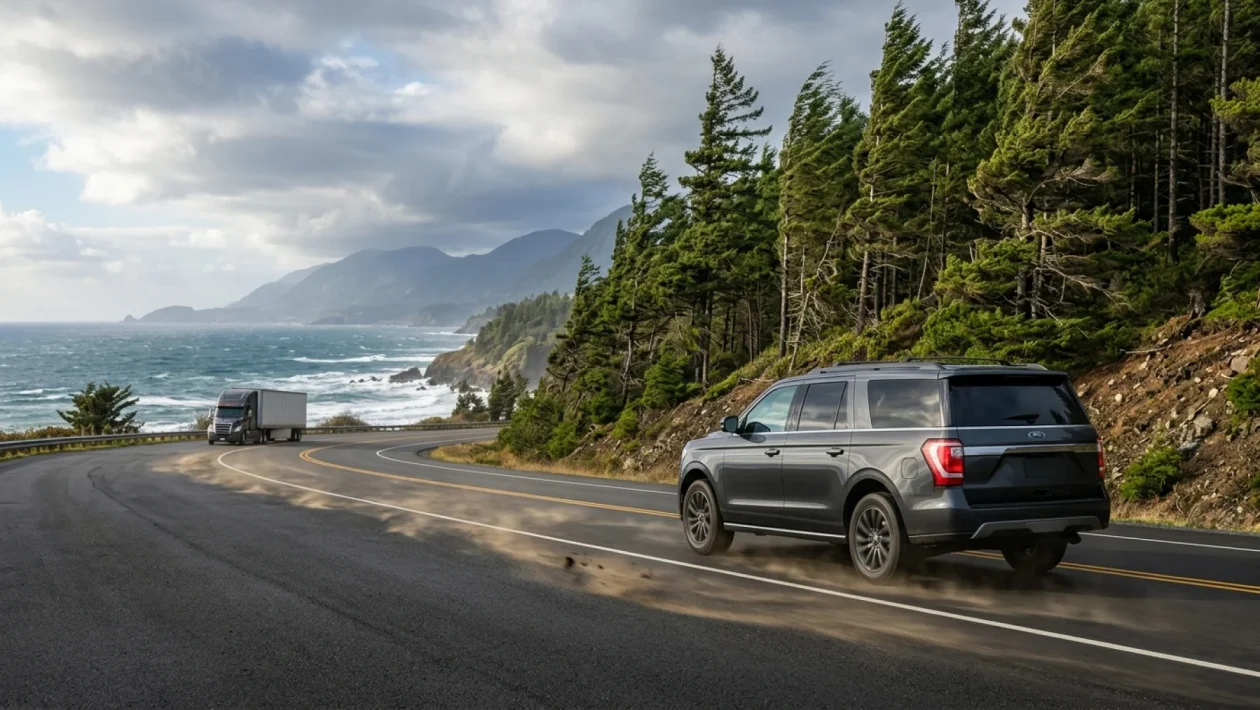
You’re cruising down the Trans-Canada Highway when suddenly, an invisible wall of air slams into your vehicle, threatening to shove you right into the ditch. This isn’t just a breezy spring afternoon; this is the reality of severe crosswinds that routinely flip fully-loaded transport trailers like discarded toys. If you want to keep your rubber firmly glued to the asphalt when the gales kick up, you need a bulletproof strategy behind the wheel.
High wind driving separates the attentive drivers from the dangerous ones in a matter of seconds. We are looking at exactly how to anchor your vehicle, read the road, and make it home in one piece when Mother Nature throws a tantrum.
High Wind Driving: Mastering the Physics of the Road
Driving in intense winds fundamentally changes how your vehicle interacts with the pavement. Your car is suddenly acting like a massive sail, catching every rogue gust sweeping across the open plains or coastal highways.
The key here is understanding your center of gravity. Higher vehicles naturally catch more wind, creating a lever effect that lifts the windward tires off the road. When you are fighting a crosswind, your steering input must be incredibly precise.
To maintain maximum traction, ensure your tires are in top condition. Dropping by a trusted Canadian shop like Kal Tire to check your tread depth and inflation before a big road trip can literally be the difference between holding your lane and ending up in the median.
Surviving Wreckhouse Gales on the Trans-Canada
If you drive in Atlantic Canada, you already know the name. The Wreckhouse area in southwestern Newfoundland is globally infamous for its punishing winds. Just recently, in May 2026, the RCMP had to lock down westbound lanes of the TCH after a massive transport trailer was blown completely onto its side.
Here is a staggering hard fact: Wreckhouse winds funneling down from the Long Range Mountains can routinely exceed 200 km/h—matching the destructive force of a Category 3 hurricane.
When you enter a known high-wind corridor like this, you cannot rely on autopilot. You must actively scan the horizon for blowing dust, bending trees, or leaning transport trucks. If the big rigs are pulling over, that is your immediate cue to follow suit.
“When you’re dealing with Wreckhouse-level gusts, your steering wheel feels like it’s connected to a wild animal. You don’t fight it with jerky movements; you manage it with smooth, deliberate corrections,” says retired Canadian long-haul veteran Mark Davies.
Preventing Rollovers When the Gusts Hit Hard
Whether you are hauling a fifth-wheel camper or just trying to get your SUV past an eighteen-wheeler, rollover prevention requires proactive driving. You cannot wait until the wind lifts your tires to react.
Follow this exact process to stabilize your vehicle when extreme gusts hit:
- Decelerate smoothly: Lift your foot off the gas immediately. Do not slam on the brakes, as this can cause a loss of traction. A slower vehicle is exponentially easier to control in a crosswind.
- Establish a firm grip: Keep both hands anchored securely at the 9 and 3 o’clock positions on your steering wheel. You need maximum leverage to counter sudden wind blasts.
- Anticipate the wind blocks: When passing a large truck or emerging from an underpass, prepare for a sudden, violent shift in wind force. Lean slightly into the wind to maintain your lane position.
- Increase your following distance: Give yourself at least five seconds of space behind the vehicle in front of you. Debris can fly across the highway instantly.
Understanding your vehicle’s specific vulnerability is crucial. Check this quick breakdown to know your risk level before you hit the ignition.
| Vehicle Profile | Wind Vulnerability Risk |
|---|---|
| Transport Trailers & Motorhomes | Extreme (High rollover risk) |
| Cargo Vans & Large SUVs | High (Significant lane-shift risk) |
| Mid-Size Sedans & Coupes | Moderate (Lower center of gravity) |
Frequently Asked Questions
Is it safe to drive alongside transport trucks in high winds?
Absolutely not. If a sudden gust hits, an empty or lightly loaded trailer can tip over in a fraction of a second. Always stagger your position on multi-lane highways and pass large trucks quickly and decisively when it is safe to do so.
What should I do if the wind feels too strong to safely steer?
Pull over safely. Find a designated rest stop or a wide shoulder well away from traffic. Turn your hazard lights on, keep your seatbelt fastened, and wait for the squall to pass. No destination is worth a rollover.
🤝 Good luck out there, and remember that Mother Nature always has the right of way, no matter what you drive.
💡 Share your thoughts in the comments below if you’ve ever battled the treacherous Wreckhouse winds or survived a massive highway gale.
📱 Check your weather apps and provincial highway advisories before you head out so you’re never caught off guard by extreme gusts.
👇 Stay safe, keep your hands at 9 and 3, and I’ll catch you on the next road trip!