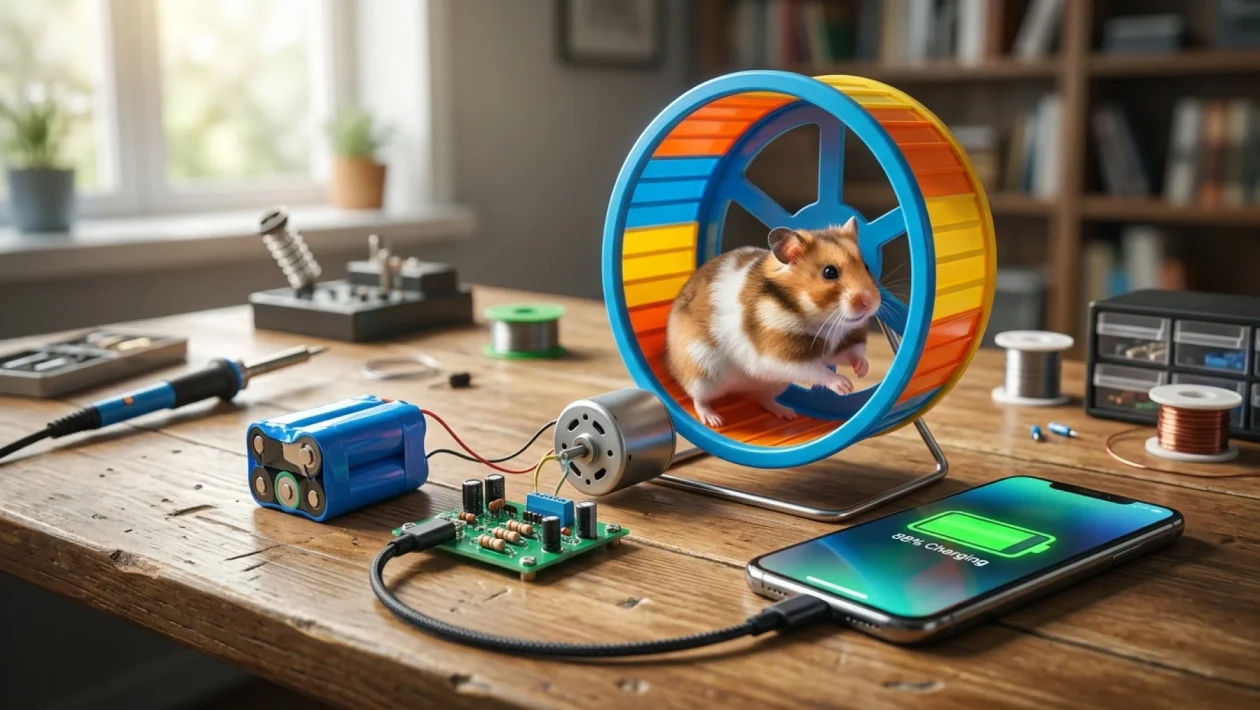
If you have ever shared a room with a hamster, you know the absolute torture of the midnight squeak. You are trying to sleep, and your tiny furry roommate is training for an ultramarathon on a plastic wheel. But instead of throwing a pillow over your head, what if you could harvest that endless kinetic energy? A clever YouTuber named Guillem—known online as Flamethrower—did exactly that by transforming his brother’s noisy pet into a literal power plant. As we hit May 2026 and off-grid living becomes increasingly popular, this bizarrely brilliant DIY project proves that usable electricity is hiding right under our noses.
Hamster Wheel Power: The Mechanics Behind The Magic
The principle driving this rodent-powered rig is the exact same one used in the world’s largest hydroelectric dams. By spinning a turbine—or in this case, a basic 5-volt DC motor attached to the wheel’s axle—you generate an electrical current. It sounds simple on paper, but capturing Hamster Wheel Power requires a bit of finesse.
In North America alone, over one million households currently host one of these hyperactive little furballs. That is a massive amount of untapped, squeaky energy. The challenge is that a standard motor needs to hit roughly 10,000 RPM to generate a standard 15-watt phone charge.
Since a supersonic hamster does not exist, Guillem had to get creative with his circuitry. A raw motor simply cannot output the sustained voltage needed to push past a modern smartphone’s battery resistance.
Turning A Tiny Rodent: Your Biological Mini-Generator
To turn a completely biological entity into a reliable generator, you need to manage the erratic spikes of energy. Hamsters sprint, stop, sniff, and sprint again. To capture this chaotic movement, the system relies on a very specific flow of energy.
- The Kinetic Spin: The rodent runs, rotating the wheel which is physically linked to the spindle of a small DC motor.
- The Voltage Boost: An energy harvester module captures the tiny trickle of electricity and mathematically steps it up to a usable voltage.
- The Smart Brain: A Maximum Power Point Tracking (MPPT) system balances the input and output in real time so the circuit does not fry.
- The Storage: The stabilized energy is dumped into salvaged battery cells before finally making its way to your device.
Into A Free Phone Charger: The Scavenged Electronics
You do not need a massive budget to build a setup like this. In fact, a quick trip down the electrical aisle at Canadian Tire for some basic wiring, combined with a few scavenged parts, is all it takes to build a free phone charger. Guillem actually powered his rig using old lithium-ion cells ripped from a dead electric scooter.
Recycling old tech is the ultimate handyman move. By using parts destined for the landfill, the project becomes genuinely sustainable.
| Component Needed | Where To Source It |
|---|---|
| 5V DC Motor | Broken RC cars, old DVD drives, electronics stores. |
| MPPT Module & Harvester | Online hobbyist shops or salvaged solar controllers. |
| Lithium-Ion Cells | Dead e-scooters, old laptop batteries, power banks. |
| Wiring & Solder | Any local hardware store. |
Overnight Success: Testing The Midnight Shift
Once everything was wired up, it was time to let the hamster clock in for the night shift. By morning, the phone was plugged in, and the system was officially working. It was slow, but it was actively charging. Interestingly, after using a thermal camera to troubleshoot, the builder realized the main bottleneck was not the hamster or the circuit, but an outdated USB cable.
Once he swapped out the old wire for a modern one, the charging efficiency skyrocketed. The midnight marathon was finally paying off.
“It needs to be nocturnal, but I’m starting to think my hamster never actually sleeps. At least now, his life finally has a purpose.”
Frequently Asked Questions
Does the added resistance make it harder for the hamster to run?
Barely. A small 5V DC motor adds a very slight mechanical drag, but hamsters are incredibly strong for their size. It acts more like a light resistance-training workout rather than a roadblock.
Could I scale this up to charge larger devices?
You would need a lot more hamsters! A single rodent outputs just enough trickle-charge to top up a smartphone overnight. To power a laptop or a TV, you are better off hooking an alternator up to a stationary basement bicycle.
🤝 Good luck looking at your pet the same way again now that you know they are secretly hoarding electricity.
💡 Whether you decide to wire up a hamster wheel or hook a similar rig to an old bicycle, building your own off-grid energy systems is incredibly rewarding.
📱 Share your thoughts below if you have ever attempted a wacky DIY engineering project in your own garage.
👇 Until next time, keep your tools sharp and your mind open!